Tusculum Archaeological Park: A Historic Latin Municipium in the Alban Hills, Italy
Table of Contents



Visitor Information
Google Rating: 4.5
Popularity: Low
Official Website: www.tuscolo.org
Country: Italy
Civilization: Roman
Site type: Burial, City, Civic, Domestic, Economic, Entertainment, Infrastructure, Military, Religious, Sanitation

Context
The Parco Archeologico Culturale di Tuscolo is located on the volcanic plateau of the Alban Hills, near the modern municipality of Monte Porzio Catone in the Lazio region of Italy. Positioned approximately 670 meters above sea level, the site commands extensive views over the Roman Campagna and the city of Rome, offering strategic oversight of the surrounding landscape. The elevated terrain provided natural defensive advantages, which influenced the settlement’s development from the Iron Age onward.
Tusculum’s location near ancient routes connecting Rome to the Alban Hills facilitated its integration into regional networks of trade, communication, and military movement. The volcanic tuff geology of the area contributed to the preservation of architectural remains, as well as shaping local construction techniques. The site’s occupation spans from early Iron Age settlements through the Roman Republic and Imperial periods, continuing into the early Middle Ages before its decline following military conflicts in the 12th century. Archaeological investigations have revealed a complex urban fabric comprising public, religious, and residential structures, reflecting Tusculum’s evolving role in Latium’s historical landscape.
Since the 19th century, systematic excavations and conservation efforts have been undertaken to stabilize and study the site’s remains. The park is currently managed to balance scholarly research with heritage protection, involving collaboration among local municipalities and cultural authorities. This stewardship ensures the preservation of Tusculum’s archaeological heritage within its natural and historical context.
History
The Parco Archeologico Culturale di Tuscolo embodies a settlement history deeply intertwined with the political and cultural dynamics of Latium and Rome. Originating as an Iron Age community, Tusculum developed into a fortified Latin town and later a Roman municipium, reflecting its integration into Roman administrative and social structures. Its strategic position in the Alban Hills made it a significant site for military and political alliances during the early Republic. Over time, Tusculum transitioned into a rural retreat favored by Roman elites, maintaining its prominence through the Imperial period. The site’s decline in the early Middle Ages culminated in its destruction in the late 12th century amid regional conflicts, after which it was largely abandoned.
Iron Age and Early Settlement
Archaeological evidence situates Tusculum’s initial occupation in the Iron Age, with human presence in the territory traceable to the Copper Age. The settlement arose on a volcanic ridge, benefiting from natural fortifications and fertile soils. The name Tusculum likely derives from the nearby watercourse Tuscus amnis, a river associated with Etruscan influence and connected to neighboring centers such as Gabii and Collatia, which were under Tarquinian control. The inhabitants, known as tusculamnes, suggest a cultural link to the Etruscans (Tusci) and the Latin peoples of the region. This early phase reflects the broader pattern of Latin and Etruscan interactions in Latium Vetus, with Tusculum emerging as a fortified village within a network of settlements in the Alban Hills.
Latin League and Early Roman Republic Period (6th–4th century BCE)
During the 6th to 4th centuries BCE, Tusculum was a principal member of the Latin League, a confederation of Latin cities. According to tradition, the town was founded by Telegonus, son of Ulysses and Circe, underscoring its mythological significance. In 506 BCE, Tusculum allied with Aricia to repel an Etruscan incursion, culminating in the Battle of Aricia and the defeat of Etruscan forces. Following the expulsion of the Tarquin kings from Rome in 509 BCE, Tusculum’s leader Ottavio Mamilio, related by marriage to the Tarquins, led Latin forces against Rome at the Battle of Lake Regillus (circa 499 or 496 BCE), where the Latins were defeated. Subsequently, the Foedus Cassianum treaty (circa 496–493 BCE) established parity between Rome and the Latin League.
In 460 BCE, Tusculum supported Rome against the Sabine occupation of the Capitoline Hill, with its dictator Lucio Mamilio commanding troops that contributed to Rome’s liberation. For this assistance, Lucio Mamilio was granted Roman citizenship, marking Tusculum’s transition into a loyal Roman ally. The following year, the fortress of Tusculum was briefly captured by the Equi but was retaken by Roman forces under Quinto Fabio Vibulano. In 381 BCE, after conspiring with the Volsci against Rome, Tusculum surrendered without resistance and was formally incorporated as a Roman municipium, granting its inhabitants Roman citizenship and integrating the town into the Roman state’s administrative framework.
Roman Republican and Late Republican Period (3rd–1st century BCE)
During the 3rd to 1st centuries BCE, Tusculum’s political and military significance diminished, though it remained an established municipium. In 211 BCE, during the Second Punic War, Hannibal passed near Tusculum but did not attack, likely encamping near Rocca di Papa. The town sided with the populares faction during the civil war between Marius and Sulla; after Sulla’s victory in 82 BCE, Tusculum’s territory was divided and allocated to Sullan veterans, reflecting the redistribution of land common in this period. Cicero described Tusculum as a modest municipium by this time, indicating its reduced political role.
Concurrently, Tusculum became a favored location for Roman aristocratic villas, known as the “Tusculani recessus,” prized for their climate and scenic views. Notable villa owners included Cicero, who composed his Tusculanae Disputationes there, as well as Lucius Licinius Lucullus, Gaius Asinius Pollio, Aulus Gabinius, Gaius Lutatius Catulus, Marcus Porcius Cato Uticensis, and Lucius Cornelius Sulla. The forum, originating in the archaic period as a market square at a crossroads, was monumentalized during the mid-Republic with retaining walls, colonnades, and a Curia dating to the 5th or 4th century BCE. By the late Republic, the forum contained sacella dedicated to deities such as Hercules, attested by inscriptions from the 2nd century BCE. The construction of a basilica and a Roman theater with a capacity of approximately 1,500 spectators further attest to the town’s urban development during this era.
Roman Imperial Period (1st–3rd century CE)
In the early Imperial period, Tusculum experienced its zenith, marked by extensive urban enhancements and the expansion of elite villa complexes. The theater’s stage was enlarged, and the amphitheater, dating to the 2nd century CE and capable of seating around 3,000 spectators, was constructed outside the city walls. Built in opus quadratum peperino and opus mixtum brickwork, the amphitheater may have also functioned as a sanctuary dedicated to Jupiter, as suggested by literary sources such as Livy and Macrobius. The forum continued to host sacella dedicated to various deities, including Hercules.
Christianization of Tusculum began early, traditionally linked to the apostles Peter and Paul. Villas in the area were owned by Christian figures such as Titus Flavius Clemens and Flavia Domitilla, who suffered persecution under Emperor Domitian. Paleochristian remains include the catacombs Ad Decimum on the Via Latina, containing over 800 burials with frescoes and arcosolia dating to the 3rd and 4th centuries CE, as well as a Christian cemetery near the 12th mile of the Via Latina in Grottaferrata. The episcopal seat, possibly established by the late 3rd century CE, is first securely attested in 313 CE. The bishopric initially resided at “ad Quintanas” on the Via Labicana before relocating, possibly to Subaugusta. Around 370 CE, John of Cappadocia founded a Basilian monastery near Roboraria, reflecting Eastern monastic influences in the region.
Late Antiquity and Early Middle Ages (4th–12th century CE)
Following the decline of centralized Roman authority, Tusculum persisted as a fortified settlement amid the political fragmentation of Latium. The region experienced Gothic and Lombard incursions, and Tusculum’s fortifications were likely reinforced during this period. The social structure shifted toward ecclesiastical leadership alongside residual secular elites. Economic activities became localized, focusing on subsistence agriculture and pastoralism, with reduced large-scale production. Religious life intensified, marked by monastic establishments and Christian cemeteries, while the episcopal seat maintained spiritual governance despite the town’s waning prominence.
From the 10th century, the Counts of Tusculum established their rule over the acropolis, governing the area for approximately a century. In 1004, Saint Nilus of Rossano settled in a hermitage on the hill’s slopes, supported by Count Gregory I, who granted land for the Abbey of San Nilo in Grottaferrata. The Battle of Prata Porci in 1167, fought near Tusculum, saw Emperor Frederick Barbarossa’s forces defeat Roman civic troops. Tusculum hosted Barbarossa’s army, provoking Roman retaliation. In 1191, Roman forces besieged and destroyed Tusculum, leading to its abandonment. The territory, known as the “tenimentum tusculanum,” was subsequently donated to the papacy and divided among ecclesiastical institutions. The former Tusculum lands now encompass the modern towns of Monte Compatri, Frascati, Grottaferrata, and Monte Porzio Catone.
Post-Destruction and Early Modern Period (13th–18th century)
Following its destruction, Tusculum’s territory reverted largely to woodland and pasture. The ruins were systematically quarried for building materials by inhabitants of nearby villages, accelerating the loss of ancient structures. This period saw the site’s transformation from an urban center to a rural landscape, with limited archaeological interest until the modern era.
Archaeological Rediscovery and Modern Conservation (19th century–present)
Archaeological investigations at Tusculum commenced in 1806 under the patronage of Luciano Bonaparte, with artifacts removed and dispersed through the antiquities market. Subsequent excavations by Luigi Biondi in 1825 and Luigi Canina in 1839–1840 focused on the Roman theater and other structures, with finds transferred to collections in Piedmont. In the mid-20th century, Maurizio Borda uncovered a necropolis containing cinerary urns. From 1994 onward, systematic scientific excavations resumed under the Spanish School of History and Archaeology in Rome, led initially by Xavier Dupré Raventós and later by Trinidad Tortosa. These campaigns have clarified Tusculum’s urban layout and historical development, with no artifacts removed since their inception.
Restoration efforts have stabilized key monuments, including the Roman theater, which reopened in 2003 for cultural events. The archaeological park is managed collaboratively by the municipalities of Grottaferrata, Frascati, Monte Porzio Catone, and Monte Compatri. The acropolis summit, now marked by the Croce del Tuscolo, preserves limited ancient remains, including inscriptions referencing temples dedicated to the Dioscuri and Isis. Medieval fortifications and buildings, including a probable palace of the Counts of Tusculum, survive on the acropolis, illustrating the site’s layered occupation history.
Daily Life and Importance by Period
Roman Republic
During the Roman Republic, Tusculum’s inhabitants, known as tusculamnes, lived within a structured municipium that granted Roman citizenship and local magistracies such as duumviri, as attested by inscriptions. The population comprised landowning elites, artisans, farmers, and laborers. Economic activities centered on agriculture, particularly viticulture and olive cultivation, supported by the fertile volcanic soils. Workshops producing pottery and building materials supplemented the local economy. The forum served as a marketplace and civic center, with paved streets and drainage facilitating daily commerce and movement.
Dietary evidence indicates consumption of bread, olives, wine, and fish, consistent with regional Mediterranean patterns. Clothing likely consisted of woolen tunics and cloaks, with sandals as common footwear. Wealthier households featured mosaic floors and painted walls, reflecting increasing urbanization and social stratification. Religious practices included worship of deities such as Hercules, with sacella located in the forum. Public festivals and assemblies reinforced communal identity and political participation. The town’s strategic position on ancient roads enabled control over regional routes, enhancing its role as a fortified Latin municipium allied with Rome.
Roman Imperial Period
In the Imperial era, Tusculum evolved into a prestigious rural retreat for Roman aristocracy. The population included elite villa owners, freedmen, artisans, and agricultural workers. Villas were centers of cultural and intellectual activity, exemplified by Cicero’s residence where he composed philosophical works. Social hierarchy was pronounced, with large estates managed by tenant farmers and slaves. Agriculture remained central, with vineyards and olive groves producing goods for local use and export.
Public entertainment venues such as the amphitheater and expanded theater hosted social gatherings. Workshops and small-scale manufacturing supported villa economies. Domestic architecture featured frescoes, mosaic floors, and landscaped gardens, with interior spaces arranged around courtyards, kitchens, dining rooms, and reception areas. Clothing styles reflected imperial fashions, with togas and stolas worn on formal occasions. Religious life incorporated traditional Roman deities alongside early Christian influences, evidenced by paleochristian catacombs and episcopal presence. The municipium status persisted, with local magistrates administering civic affairs under imperial oversight. Well-maintained roads facilitated access to Rome and other centers, reinforcing Tusculum’s cultural significance.
Late Antiquity and Early Middle Ages
As Roman authority declined, Tusculum’s population contracted but maintained a fortified settlement inhabited by Romanized locals and incoming groups such as Goths and Lombards. Social structures shifted toward ecclesiastical leadership alongside remaining secular elites. Family units adapted to instability, with increased emphasis on monastic communities and religious patronage. Economic activities became localized, focusing on subsistence agriculture and pastoralism, with reduced large-scale production. Domestic spaces simplified, with less elaborate decoration.
Religious life intensified, marked by the establishment of Basilian monasteries and early Christian cemeteries. Liturgical practices and monastic education contributed to cultural continuity. The episcopal seat, though diminished, provided spiritual governance. Public buildings were maintained primarily for defense. Transportation and trade diminished but remained functional locally, with roads used for military movements and pilgrimages. Tusculum’s role shifted from municipium to fortified stronghold within the Duchy of Rome and Papal States, reflecting broader political fragmentation.
Medieval Decline and Abandonment
Between the 10th and 12th centuries, Tusculum’s population declined sharply amid military conflicts involving the Roman commune and noble families. The Counts of Tusculum governed the acropolis, establishing a feudal social order centered on lordship and ecclesiastical authority. Civilians faced displacement as warfare intensified. Economic life contracted to basic agriculture and pastoralism, insufficient to sustain urban functions. Archaeological evidence indicates reduced construction and maintenance, reflecting economic hardship. Food and clothing became simpler, consistent with scarcity and social disruption.
Religious institutions persisted but with diminished influence. The siege and destruction by Roman forces in 1191 led to the town’s abandonment, dispersing inhabitants to surrounding villages. Civic structures fell into ruin, and Tusculum lost its administrative and cultural roles. Transportation routes remained but served mainly military and local traffic. The territory was redistributed among churches and convents, marking the end of Tusculum as an inhabited center.
Archaeological Rediscovery and Modern Conservation
Modern archaeological investigations have revealed insights into Tusculum’s social and economic history. Excavations uncovered public buildings, private residences, and fortifications, enabling reconstruction of daily life and civic organization. The site’s layout, including the forum, theater, and amphitheater, reflects its historical roles in administration, entertainment, and religious practice. Inscriptions and artifacts illuminate civic offices, religious dedications, and social stratification. Conservation efforts preserve these materials, contributing to understanding regional dynamics in Latium across millennia.
Remains
Architectural Features
The Parco Archeologico Culturale di Tuscolo is situated on a volcanic tuff plateau, which influenced both construction techniques and the preservation of its buildings. The settlement’s architecture predominantly employs ashlar masonry using local volcanic stone, with later phases incorporating Roman concrete (opus caementicium). The urban plan reveals a fortified town comprising civic, residential, and military structures. Expansion occurred notably during the late 2nd and 1st centuries BCE, with contraction following abandonment in the 12th century.
Surviving elements include defensive walls, public edifices, private residences, and infrastructure such as cisterns and paved roads. The fortifications, primarily dating to the 4th century BCE, feature polygonal masonry with towers and gates, later reinforced in the 3rd century CE using opus reticulatum—a Roman concrete technique faced with small tuff blocks arranged in a net-like pattern. Residential zones contain villa complexes with courtyards and service rooms. Public spaces include a forum and a theater. The volcanic tuff substrate has preserved architectural details such as vaults and staircases.
Key Buildings and Structures
Fortification Walls and Gates
The defensive walls enclosing Tusculum date mainly to the 4th century BCE and are constructed in polygonal masonry characteristic of Latin fortifications. These walls encompass the main settlement on the plateau and incorporate several towers and two principal gates. In the 3rd century CE, the walls were reinforced and partially rebuilt using opus reticulatum, combining Roman concrete with tuff facing arranged in a net-like pattern. The gates retain preserved jambs and threshold stones, with evidence of early medieval repairs. Portions of the walls stand several meters high, while others survive as foundations or collapsed masonry.
Forum Area
The forum, established around the late 2nd century BCE, consists of a rectangular open space bordered by porticoes supported by tuff columns and paved with polygonal stone slabs. Adjacent to the forum are the remains of a basilica-like structure dating to the 1st century BCE, featuring a central nave and side aisles constructed in opus incertum (irregular stonework). Foundations and partial walls survive. A curia or council building, identified by its rectangular plan and internal meeting rooms, dates to the 1st century BCE with modifications in the 1st century CE. The forum also contained sacella dedicated to deities such as Hercules, as confirmed by inscriptions.
Theater
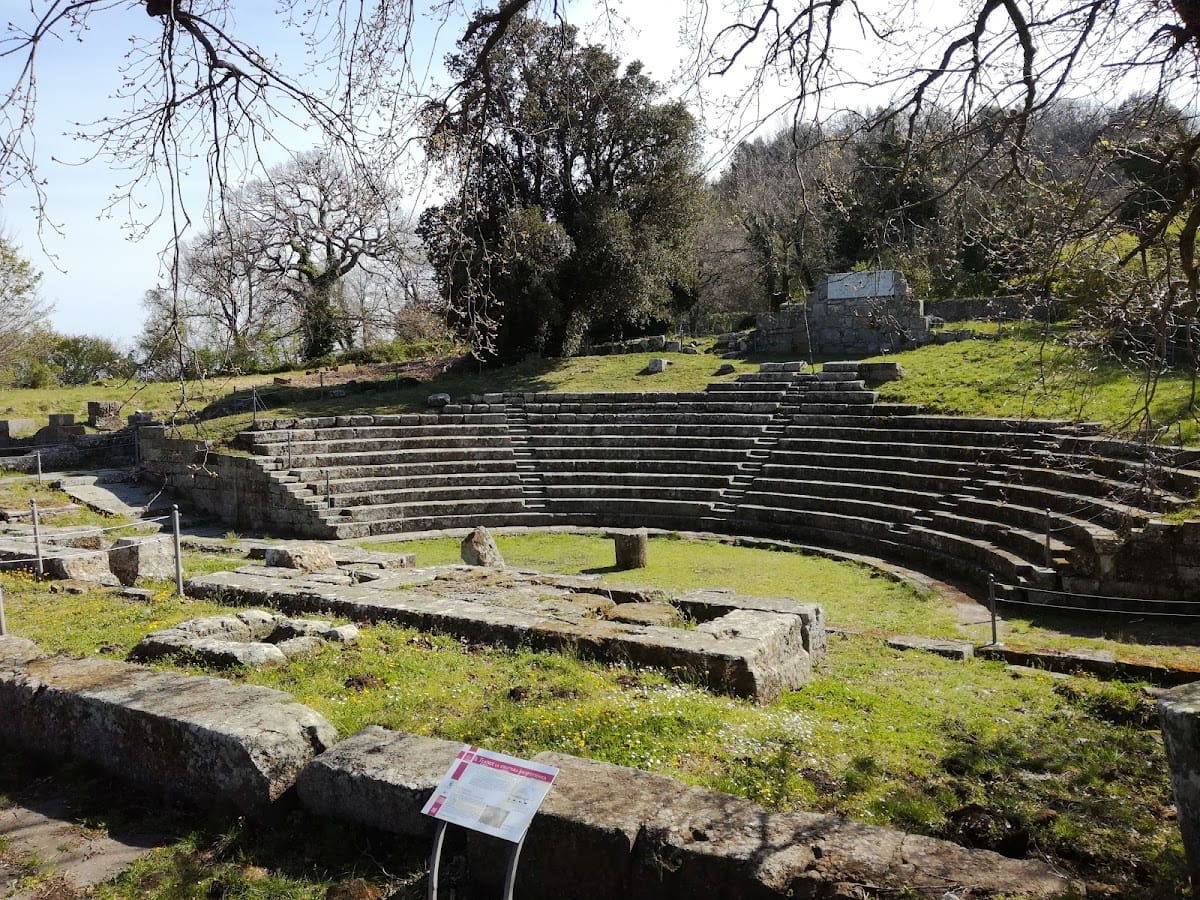
Constructed in the 1st century BCE on the southern slope of the plateau, the theater’s cavea (seating area) is partially preserved, carved into the tuff bedrock and supported by masonry vaults. Foundations of the orchestra and stage building remain visible, built with Roman concrete faced with tuff blocks. The theater’s design includes radial staircases and vomitoria (passageways) for audience access. While upper seating tiers are mostly lost, the lower tiers and stage area provide a clear indication of the original layout and an estimated capacity of approximately 1,500 spectators. Decorative statuary once adorned the stage area, including figures from Greek mythology and Roman comedy.
Residential Villas
Several villa complexes dating from the 1st century BCE to the 2nd century CE have been excavated within Tusculum’s urban area. These residences feature courtyards surrounded by rooms, constructed with opus reticulatum walls and tuff ashlar masonry. Some villas include hypocaust systems for underfloor heating, evidenced by pilae stacks and flue tiles. Mosaic floors and fresco fragments have been documented, though often fragmentary. Service areas such as kitchens and storage rooms are partially preserved, indicating complex domestic arrangements consistent with elite Roman dwellings.
Public Baths
The remains of a public bath complex date to the late 1st century CE. The structure comprises a caldarium (hot bath), tepidarium (warm room), and frigidarium (cold bath) arranged linearly. The caldarium contains a hypocaust system with surviving pilae stacks and channels for hot air circulation. Walls are constructed in opus mixtum, combining brick and tuff. Floor mosaics and wall plaster fragments have been found in situ. The bath complex remained in use until the 4th century CE, with evidence of repairs during late antiquity.
Religious Structures
Excavations have uncovered the foundations of at least one temple dating to the 2nd century BCE near the forum. The temple’s podium and cella (inner chamber) are partially preserved, built in tuff ashlar masonry. A small altar with dedicatory inscriptions was found nearby. Additional votive altars and small shrines, dating from the Republican through Imperial periods, have been documented within the settlement. These religious structures are modest in scale and primarily constructed of local stone. Inscriptions attest to dedications to deities such as Hercules and possibly the Dioscuri and Isis, referenced in 1st-century BCE inscriptions on the acropolis.
Infrastructure
The site contains a network of paved roads and drainage channels dating to the 2nd and 1st centuries BCE. Stone-paved streets with curbstones connect residential and public areas. Cisterns carved into the tuff bedrock and lined with waterproof mortar have been identified, dating from the 1st century BCE through the Imperial period. These cisterns collected rainwater for domestic and public use. Fragmentary remains of aqueduct channels supplying water to the settlement have also been documented.
Other Remains
Funerary monuments and tombs dating from the 4th century BCE to the early Imperial period are located outside the main settlement area. Several workshops and storage rooms, primarily from the 1st century BCE, have been identified by their layout and associated artifacts. Agricultural terraces and retaining walls constructed with dry stone techniques are visible on the slopes surrounding the plateau, indicating land management practices supporting local subsistence and villa economies.
Archaeological Discoveries
Pottery assemblages at Tusculum span from the Iron Age through the late Imperial period, including locally produced coarse wares, fine tableware, and imported amphorae from Campania and the Eastern Mediterranean. These ceramics, recovered from domestic contexts and refuse deposits, encompass storage jars, cooking vessels, and drinking cups. Inscriptions found on altars and public building plaques, mainly from the 2nd and 1st centuries BCE, confirm municipium status and record local magistrates and benefactors. Funerary inscriptions provide personal names and family relations.
Coin finds range from Republican denarii to Imperial sestertii and late Roman bronze issues, concentrated in habitation layers and public spaces, indicating sustained economic activity. Iron and bronze tools, including agricultural implements and craft tools, have been excavated primarily from workshops and domestic contexts. Domestic objects such as oil lamps, glass vessels, and cooking utensils date mainly from the 1st century BCE to the 3rd century CE. Religious artifacts include small bronze statuettes, votive offerings, and ritual vessels recovered from temple precincts and shrines, predominantly from the Republican and early Imperial periods.
Preservation and Current Status
Substantial sections of the fortification walls and theater remain standing, though some areas are fragmentary or collapsed. Residential villas and public buildings survive mainly as foundations and partial walls. The bath complex is partially preserved, with hypocaust remains visible but upper structures lost. The forum’s porticoes and basilica foundations are stable but incomplete. Restoration efforts have focused on stabilizing key structures, particularly walls and theater vaults, employing modern materials to prevent further deterioration. Some masonry has been consolidated in situ, while other areas remain exposed for archaeological study. Vegetation and erosion pose ongoing challenges, especially on exposed tuff surfaces. Local heritage authorities conduct regular maintenance and monitor the site to mitigate damage from natural and human factors.
Unexcavated Areas
Several sectors within the ancient town’s perimeter remain unexcavated, including parts of the residential quarters to the north and east. Surface surveys and geophysical studies suggest buried remains of additional houses and small public buildings in these zones. Necropolis areas outside the main settlement have been only partially explored, with some tombs identified through surface finds and aerial photography. Future excavations are planned but constrained by conservation regulations and the need to balance archaeological research with site preservation. Modern land use and vegetation cover also limit access to some areas. No large-scale urban excavation campaigns are currently underway, with research focusing on targeted interventions and non-invasive methods.
Nearby sites