Teurnia: An Ancient Roman Municipium and Provincial Capital in Carinthia, Austria
Table of Contents

Visitor Information
Google Rating: 4.6
Popularity: Low
Google Maps: View on Google Maps
Official Website: landesmuseum.ktn.gv.at
Country: Austria
Civilization: Roman
Remains: City

Context
Teurnia is situated near the present-day village of St. Peter in Holz, within the Austrian state of Carinthia. The site occupies a gently elevated plateau known as the Holzer Berg, positioned in the Gail Valley close to the Drava (Drau) River. This location provided strategic access to fertile alluvial soils and reliable water sources, which supported sustained settlement and agricultural activities. The surrounding Alpine foothills constrained urban expansion, resulting in a compact settlement footprint adapted to the local topography.
Archaeological investigations have demonstrated continuous occupation at Teurnia from the late Iron Age through the Roman period and into the early medieval era. The site’s development as a Roman municipium in the 1st century CE and its later role as a provincial capital and episcopal seat underscore its regional significance. Excavations have revealed well-preserved architectural remains and material culture that illuminate the city’s evolution and eventual decline amid broader demographic and political changes in the Eastern Alpine region.
Systematic archaeological research, initiated in the 19th century and continuing to the present, has uncovered urban layouts, public buildings, and religious structures. Conservation efforts prioritize the protection of exposed ruins and the integration of the site within Carinthia’s cultural heritage framework, facilitating ongoing scholarly study and public engagement with Teurnia’s historical legacy.
History
Teurnia’s historical trajectory reflects the transformation of a late Iron Age settlement into a prominent Roman urban center within the province of Noricum. Its evolution illustrates the processes of Roman provincial integration, urbanization, and Christianization characteristic of the Alpine region. The city attained municipium status in the mid-1st century CE, later becoming the capital of Noricum mediterraneum in Late Antiquity. Its decline and abandonment in the early medieval period correspond with the destabilizing effects of Gothic incursions and Slavic migrations, marking the end of Roman urbanism in the area.
Pre-Roman and Early Roman Period (before 15 BCE – 1st century CE)
Prior to Roman annexation, the Holzer Berg area was inhabited during the late Iron Age, as evidenced by Hallstatt and La Tène cultural artifacts recovered from the site. Although direct settlement traces from this period are scarce due to subsequent Roman construction, these finds attest to a Celtic presence. The incorporation of the Noricum kingdom into the Roman Empire around 15 BCE initiated a process of Romanization, reflected in early wooden structures and funerary remains in the western necropolis dating to this transitional phase.
By approximately 50 CE, under Emperor Claudius, Teurnia was formally established as a municipium, integrating it into the Roman administrative and urban network. This status facilitated the construction of a marble-paved forum and the development of economic activities including metalworking and textile production, as indicated by workshop remains. The settlement thus evolved from a rural Celtic community into a structured Roman town with civic institutions and growing economic complexity.
Roman Imperial Period (1st–3rd century CE)
During the 1st through 3rd centuries CE, Teurnia emerged as one of Noricum’s principal cities, second in importance only to Virunum. The urban plan featured an orthogonal street grid with terraced residential quarters on the southeastern slopes of Holzer Berg. The forum, measuring approximately 65 by 26–29 meters, was paved with marble slabs and flanked by porticoes. An apsidal chamber within the forum is interpreted as the curia, serving as the municipal council chamber, underscoring the city’s administrative role.
A Roman bath complex of the row type was constructed south of the forum, comprising caldarium, tepidarium, and frigidarium rooms, with two apses oriented toward the Drau River. Excavations indicate two construction phases, with the bath likely dating to the 3rd century CE and supplied by large water containers. Residential areas such as the Areal HA transitioned from early wooden buildings to stone foundations, with a significant rebuilding phase in the mid-4th century following a fire. Water management infrastructure included wells, cisterns near the bath and forum, water channels in residential zones, and possibly an aqueduct drawing from the Lendorfer Bach stream. These features reflect sustained urban prosperity and integration into imperial economic and administrative systems.
Late Antiquity and Christianization (4th–7th century CE)
In Late Antiquity, Teurnia attained the status of capital of the Roman province Noricum mediterraneum and became the seat of a Christian bishopric, referred to as Tiburnia in contemporary sources. Around 400 CE, the first bishop’s church was erected—a single-nave structure with an apse, freestanding clergy benches, and a reliquary sealed by a marble slab. Following a destructive fire, the church was rebuilt in the 6th century with a triconch (three-apse) design and open halls along its long sides. Wall paintings from this period depict women in Byzantine court attire, indicating cultural connections with the Eastern Roman Empire.
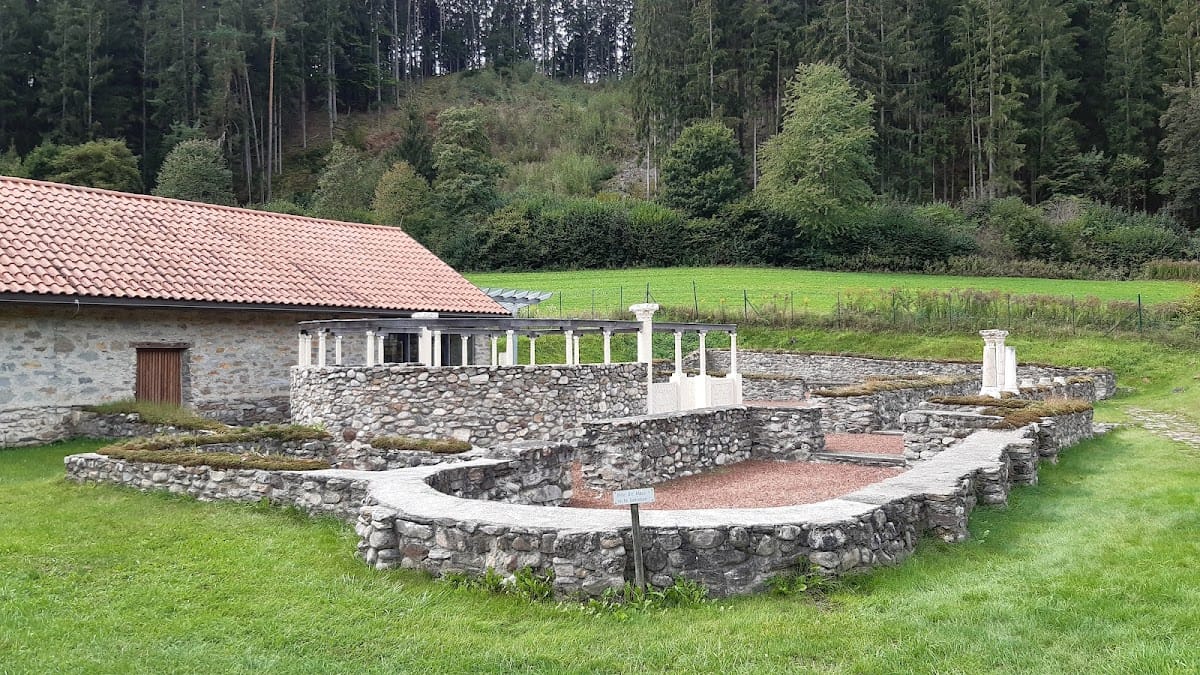
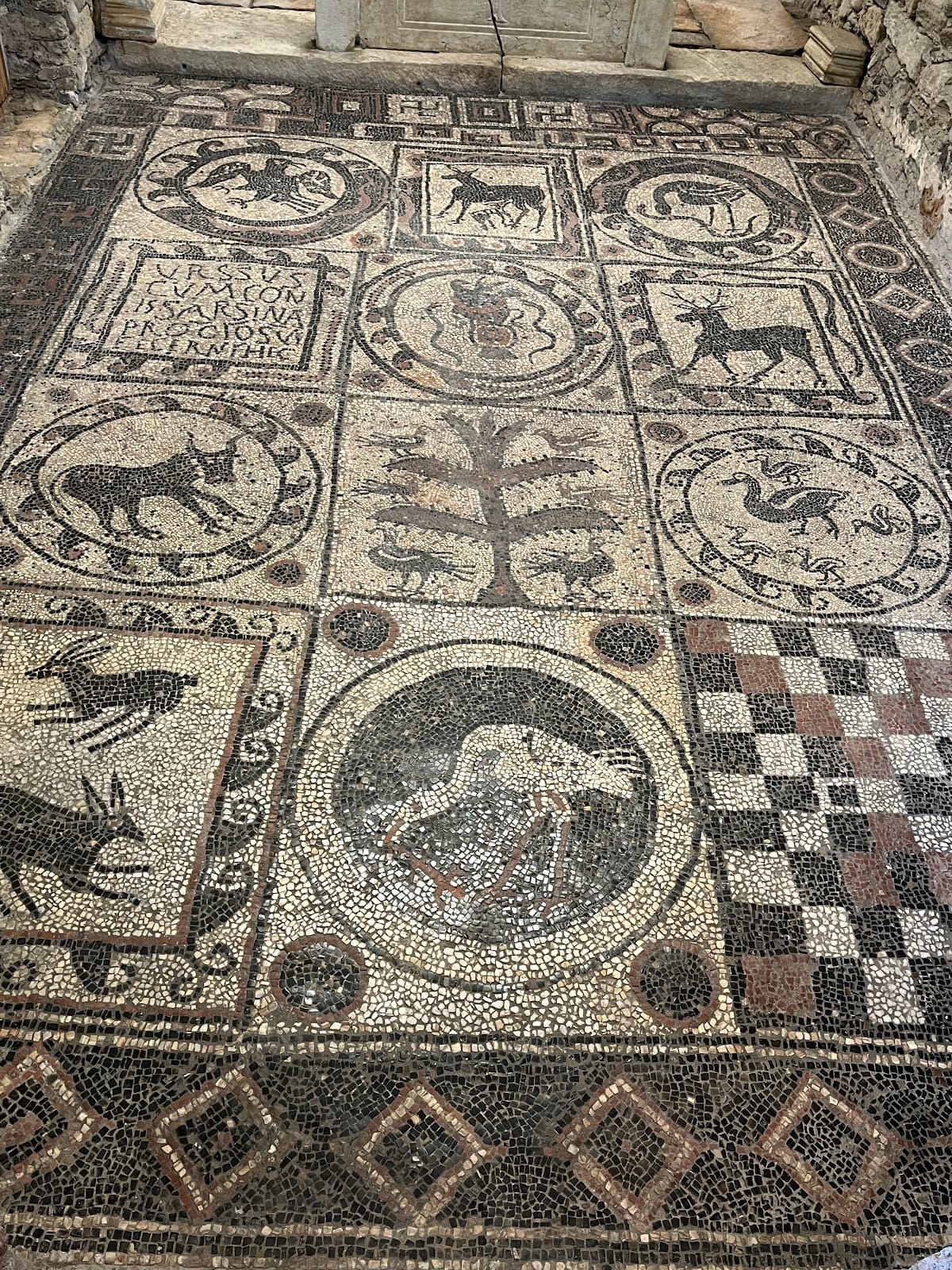
The Memorial Church, discovered in 1908 and excavated from 1910 onwards, is a rectangular hall church with a Latin cross floor plan formed by transept annexes. It features a freestanding clergy bench and a donor mosaic honoring the provincial governor Ursus in the southern side chapel. Approximately 65 graves were excavated in the surrounding western necropolis. Around 400 CE, a masonry city wall was constructed enclosing the hilltop of Holzer Berg, built of Roman concrete (opus caementicium) with a river cobble facing. This fortification responded to Gothic threats and the general insecurity of the Migration Period, leading to the contraction of the urban area as inhabitants retreated to the fortified summit and abandoned lower terraces. Graves from the 5th and 6th centuries were placed within the ruins of former houses, reflecting altered funerary customs.
Historical texts, notably the Vita Sancti Severini, document interactions between Bishop Paulinus and the Gothic leader Severin, including tribute payments to avoid siege damage. The city’s decline in the 6th or early 7th century is associated with economic downturn and Slavic settlement in the region. Some early medieval finds suggest continuity or association with the royal estate of Lurn(a)/Liburn(i)a mentioned in medieval sources. The bishopric of Tiburnia persists today as a titular archbishopric.
Medieval Period and Abandonment
Following its decline in Late Antiquity, Teurnia ceased to function as a significant urban center during the early medieval period. Archaeological evidence indicates limited continuity, with sporadic early medieval finds possibly linked to the royal estate documented in medieval records. The region underwent demographic and political transformations due to Slavic migrations and the dissolution of Roman administrative structures. No substantial medieval occupation layers have been identified at the site, suggesting that Teurnia was largely abandoned as a settlement. This pattern reflects the broader collapse of Roman urbanism in Carinthia and the reorganization of settlement and power structures in the early Middle Ages.
Modern Rediscovery and Archaeological Research
Teurnia was known from classical authors such as Pliny the Elder and Ptolemy, and from the Vita Sancti Severini by Eugippius, which recounts Bishop Paulinus’s role during Gothic sieges. The site’s identification with the Holzer Berg plateau was established in the 18th century by Jesuit scholar Markus Hansitz. Systematic archaeological excavations commenced in 1845 under Prince Alphons Seraphin von Porcia and continued through the 19th and 20th centuries with contributions from Michael Franz von Jabornegg-Altenfels, Fritz Pichler, Rudolf Egger, and others.
Major excavation campaigns between 1971 and 1984, led by Gernot Piccottini and Franz Glaser, uncovered key structures including the bishop’s church, the Memorial Church, and residential terraces. The Römermuseum Teurnia, inaugurated in 1924 and now part of the Kärnten Museum, houses numerous artifacts from the site. Conservation measures have stabilized exposed ruins, with the Memorial Church presented as an open-air museum. Ongoing research, including prospection surveys and rescue excavations, continues to refine understanding of Teurnia’s historical development within the context of Noricum and Late Antiquity.
Daily Life and Importance by Period
Pre-Roman and Early Roman Period (before 15 BCE – 1st century CE)
During this transitional era, the inhabitants of the Holzer Berg region were predominantly Noric Celts who gradually assimilated Roman customs following Noricum’s incorporation into the empire. Family and kinship structures likely persisted alongside emerging Roman civic institutions after municipium status was granted under Claudius around 50 CE. Economic activities centered on small-scale agriculture supported by fertile valley lands, supplemented by artisanal metalworking and textile production, as evidenced by workshop remains. Diets probably included cereals, local fruits, and game, consistent with regional Iron Age and early Roman subsistence patterns. Residential architecture initially comprised wooden structures with functional layouts, while religious practices combined indigenous Celtic cults—possibly including veneration of Grannus-Apollo near local springs—with emerging Roman religious influences. The elevation to municipium facilitated local governance and urban development, integrating the community into imperial networks.
Roman Imperial Period (1st–3rd century CE)
By the 1st century CE, Teurnia had developed into a diverse urban center inhabited by Roman settlers, local Noric populations, and specialized artisans. Social stratification included municipal elites, craftsmen, and laborers, with inscriptions attesting to civic officials such as duumviri. Households were organized around terraced stone houses featuring courtyards and multiple rooms, reflecting Roman domestic norms. Economic life intensified with specialized workshops producing metal goods and textiles. The marble-paved forum, porticoes, and curia indicate active civic administration. Public amenities such as the 3rd-century bath complex provided social and hygienic functions. Diet expanded to include imported commodities like olive oil and wine alongside local produce and fish from the Drava River. Domestic interiors were adorned with wall paintings and marble columns, particularly after mid-4th-century rebuilding following a fire. Water management infrastructure ensured reliable supply for public and private use. Markets within the forum likely offered a range of goods, evidencing integration into regional trade networks. Religious life remained pluralistic, with pagan cults persisting alongside nascent Christian influences emerging by the late 3rd century.
Late Antiquity and Christianization (4th–7th century CE)
In Late Antiquity, Teurnia’s population contracted and concentrated within fortified walls constructed circa 400 CE, reflecting heightened insecurity during the Migration Period. The city became the capital of Noricum mediterraneum and the seat of a Christian bishopric. Social hierarchy included ecclesiastical leaders such as bishops Paulinus and Leonidas, local elites like governor Ursus, clergy, and remaining artisans and farmers. Economic activity declined but persisted, with evidence of continued metalworking and textile production at reduced scale. The bishop’s church and Memorial Church, featuring Byzantine-influenced wall paintings and a donor mosaic, underscore the centrality of Christian worship and patronage. Domestic life adapted to the contracted urban footprint, with graves placed within former residential ruins indicating evolving funerary customs. Civic functions diminished as ecclesiastical authority grew. Trade and transport became more localized, relying on nearby agricultural estates. Religious practices centered on Christian liturgy and episcopal administration, with catechetical instruction likely under the bishopric’s auspices. The Vita Sancti Severini documents interactions between local leaders and Gothic groups, highlighting the city’s strategic and spiritual significance during this turbulent period.
Medieval Period and Abandonment
Following its contraction in Late Antiquity, Teurnia ceased to function as a significant urban settlement during the early medieval period. The population dispersed, with limited archaeological evidence for continuous habitation beyond small-scale activity possibly linked to the royal estate of Lurn(a)/Liburn(i)a. Social structures shifted from urban municipal organization toward rural lordship and estate management. Economic life focused on subsistence agriculture and localized production, with no indications of extensive craft or trade. Domestic architecture and material culture from this period are scarce, reflecting the site’s abandonment as a civic center. Transport and commerce diminished accordingly, with regional networks reoriented around emerging Slavic and Bavarian polities. Religious life persisted institutionally through the titular bishopric, despite the absence of substantial ecclesiastical structures at the site. Teurnia’s decline exemplifies the broader collapse of Roman urbanism in the Alpine region and the reconfiguration of settlement patterns in early medieval Carinthia.
Remains
Architectural Features
Teurnia occupies a gently elevated plateau on the Holzer Berg, with an orthogonally oriented urban layout adapted to the local topography. The settlement’s footprint was primarily civic and residential, with terraced housing on the southeastern slopes and a compact core. In Late Antiquity, the city contracted and was enclosed by a masonry city wall constructed around 400 CE, which enclosed the hilltop and parts of the southern slope facing the Drau River. The fortification was built using opus caementicium (Roman concrete) with an inner side abutting the slope and an outer facing wall of river cobbles. Surviving sections reach heights of 2 to 2.5 meters, though the southern wall has been lost to landslides. The wall incorporated reused materials, including fragments of marble grave monuments and late antique ceramics.
Construction techniques evolved from early wooden buildings in the 1st century CE to stone foundations and masonry structures by the 3rd and 4th centuries. Public spaces featured marble paving and porticoes, while water management infrastructure included wells, cisterns, and channels, with possible aqueduct supply from the Lendorfer Bach stream. The urban fabric reflects phases of growth, destruction, and rebuilding, particularly following a fire in the late 2nd or early 3rd century CE.
Key Buildings and Structures
Forum
The forum was established in the 1st century CE on a terraced platform above the residential terraces. Measuring approximately 65 meters in length and 26 to 29 meters in width, it was paved with marble slabs and framed by porticoes along its long sides. An apsidal chamber on the northwest side functioned as the curia, or municipal council chamber. The main entrance was likely situated on the south side, while a principal street crossed the northern edge of the forum, now overlain by modern constructions. The forum served as the administrative and social heart of the city.
Roman Bath
Located south of the forum, the Roman bath complex dates to the 3rd century CE and follows the row-type design. It comprised a caldarium (hot bath), tepidarium (warm bath), and frigidarium (cold bath). The southern façade, oriented toward the Drau River, featured two apses. Access was from the east. Excavations revealed substantial substructures and evidence of two construction phases. Water supply was facilitated by large containers positioned near the caldarium and frigidarium walls, indicating sophisticated hydraulic engineering for the period.
Residential Terraces (Wohnterrassen)
Situated on the eastern foot of Holzer Berg, the residential terraces were excavated between 1971 and 1978. These houses, aligned along a 6-meter-wide street with a terracing wall on the eastern side, were occupied from the 1st to the 3rd century CE, possibly extending into the 4th century. Two construction phases are evident, with interior wall paintings decorating some rooms. By the 5th and 6th centuries, graves were interred within the ruins of these deteriorated houses, reflecting changing settlement and funerary practices.
Residential Area HA
Located northeast of the museum, the Areal HA comprises remains of a late antique city house partially excavated in 1914 and further studied from 1979 to 1984. Early wooden buildings from the 1st century CE were replaced by stone foundations around the time of the city’s foundation. Following a fire at the turn of the 2nd to 3rd century CE, the area was abandoned and later reoccupied in the mid-4th century. The nearly square building HA 2 consisted of a single room with an upper floor. Late 5th-century additions included an apse, a hypocaust heating system, and small marble columns, indicating the elevated status of its inhabitants. Ceramic finds suggest the building remained in use until the 7th century CE.
City Wall (Stadtmauer)
The city wall, constructed circa 400 CE, enclosed the hilltop of Holzer Berg. Built of opus caementicium with an inner side against the slope and an outer veneer of river cobblestones, surviving sections stand 2 to 2.5 meters high. The southern wall along the steep slope to the Drau River has been lost due to landslides. The wall incorporated reused marble grave monument fragments and late antique ceramics, reflecting material recycling during construction. The fortification marked a significant shift in urban organization during the Migration Period.
Bishop’s Church (Bischofskirche)
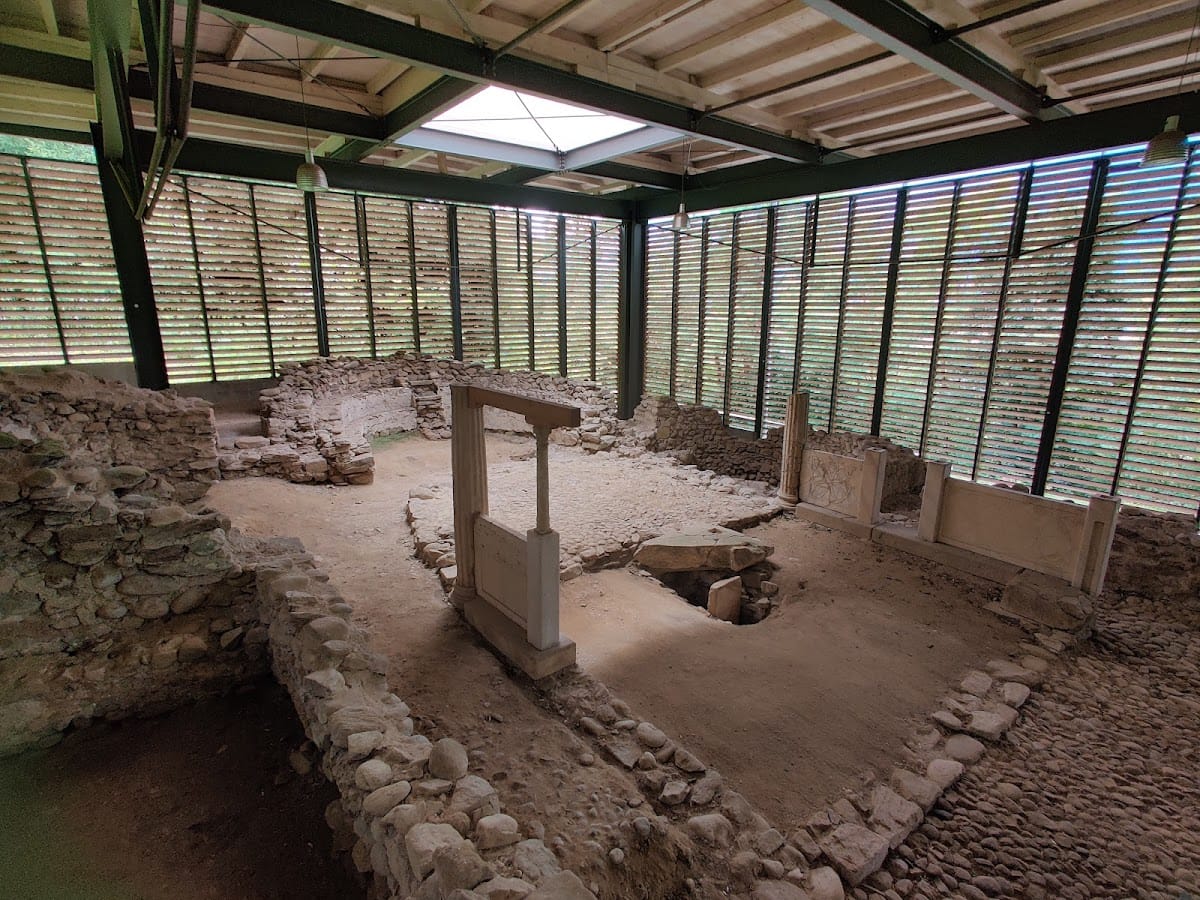
Constructed around 400 CE, the bishop’s church was a single-nave building with an apse. It featured a freestanding clergy bench with an adjoining barrier composed of slabs and posts topped by small columns. A sealed marble reliquary was discovered within the church. After a fire, the building was rebuilt in the 6th century with a triconch (three-apse) design and open halls added along the long sides. Wall painting fragments depict women in Byzantine court dress, indicating cultural influences from the Eastern Roman Empire. A guesthouse (hospitium) lies northeast of the church. The ruins are protected by a modern shelter designed by Reinhold Wetschko.
Memorial Church and Western Necropolis (Memorialkirche und Westnekropole)
Discovered in 1908 during water pipeline construction, the Memorial Church was excavated in 1910–11 and re-examined in the 1990s. Dating to Late Antiquity, it is a rectangular hall church with a Latin cross floor plan formed by two transept annexes. Chapels adjoin both sides of the transept’s east side, and a narthex with side entrances lies to the west. The church contains a freestanding clergy bench similar to that in the bishop’s church. A donor mosaic honoring Governor Ursus is located in the southern side chapel. Approximately 65 graves were excavated around the church, constituting the western necropolis.
Sanctuary of Grannus-Apollo
A building inscription discovered in 1977 indicates the presence of a sanctuary dedicated to the healing deity Grannus-Apollo on a terrace above the forum. Excavations in 2014 uncovered only minor wall remains insufficient to confirm the building’s function definitively. The sanctuary may have been associated with a spring located east of the modern parish church of St. Peter, reflecting continuity of Celtic healing cults into the Roman period.
Other Remains
The upper town extends over the summit of Holzer Berg, with terraced slopes facing the Drau River. A Roman imperial residential quarter occupied the eastern hillside. Prospecting and geophysical surveys have revealed a street settlement on the western hillside, where the Memorial Church was later constructed. Water supply features include a spring in the southeastern hill area, shaft wells in the Areal HA and beneath the Memorial Church, and suspected cisterns near the bath and forum. Water channels have been documented in the forum and eastern residential areas. Remains of a wall across the Lendorfer Moos suggest an additional water supply system drawing from the Lendorfer Bach stream.
Archaeological Discoveries
Excavations at Teurnia have yielded a wide range of artifacts spanning from the late Iron Age through the early medieval period. Pottery assemblages include locally produced tableware and imported amphorae, indicating trade connections. Inscriptions on stone and metal attest to civic and religious dedications, including those related to the sanctuary of Grannus-Apollo and the donor mosaic in the Memorial Church. Coins from various Roman emperors provide chronological markers. Tools associated with metalworking and textile production have been recovered from residential and workshop contexts. Domestic objects such as lamps and cooking vessels are common throughout the site. Religious artifacts include reliquaries sealed with marble slabs and fragments of wall paintings depicting ecclesiastical figures and Byzantine court dress. These finds derive from urban quarters, religious buildings, necropolises, and street layers, illustrating a spectrum of economic, domestic, and ritual activities.
Preservation and Current Status
Many structures at Teurnia survive as foundations and partial walls, with some sections of the city wall standing up to 2.5 meters high. The forum’s marble paving and porticoes are fragmentary, with modern construction overlying parts of the site. The Roman bath’s substructures remain visible, though above-ground elements are limited. Residential terraces and the Areal HA house preserve stone foundations and wall painting fragments. The bishop’s church and Memorial Church ruins have been stabilized and protected by modern shelters. The donor mosaic in the Memorial Church is conserved under a dedicated building. Conservation efforts focus on protecting exposed ruins and preventing further deterioration. Vegetation growth and erosion present ongoing challenges, while archaeological research continues under the auspices of regional heritage authorities.
Unexcavated Areas
Significant portions of the residential terraces remain unexcavated, with aerial photography and geophysical surveys indicating their extension to the east and south. The full extent of the upper town on Holzer Berg’s summit has not been completely explored. Some street settlements on the western hillside await further investigation. Modern development and conservation policies limit extensive excavation, but rescue digs occur in connection with construction projects. Future research aims to clarify the city’s late antique contraction and early medieval abandonment phases. Surface surveys and non-invasive methods continue to map subsurface remains, though large-scale excavation is constrained by preservation priorities and land use considerations.
Nearby sites