Taplacken Castle: A Historic Teutonic Fortress in Kaliningrad Oblast, Russia


Visitor Information
Google Rating: 4
Popularity: Low
Official Website: kaliningrad-guide.com
Country: Russia
Civilization: Medieval European
Site type: Military
Remains: Castle

History
Taplacken Castle is located in Talpaki, Kaliningrad Oblast, Russia. It was originally established by the Teutonic Order, a crusading military order active in the Baltic region during the medieval period. The castle’s history begins in 1336 when Heinrich Dusemer von Arfberg, who served as Marshal of the Teutonic Order, ordered the construction of a fortress near the village known at the time as Taplacken. This early fortification was made of wood and earth, typical of initial defensive designs before stone replaced such materials. The setting near the Prussian village reflected the Order’s efforts to consolidate control over the area during their territorial expansion.
In 1376, the original fortress was seized and destroyed by Lithuanian forces under the leadership of Prince Kėstutis amid ongoing conflicts between the Teutonic Order and neighboring Baltic powers. Following a period of German reassertion over the region, the castle was rebuilt three years later, in 1379, this time using stone to provide a more durable defensive structure. By the late 14th century, Taplacken had become an administrative center known as a kammeramt, overseeing local governance and resource management on behalf of the Teutonic Order.
The castle underwent another significant change in the early 16th century. In 1525, when the Teutonic State was secularized and transformed into the Duchy of Prussia, Taplacken transitioned into a ducal estate. Between 1525 and 1530, it was remodeled to serve as a representative residence rather than a purely military stronghold. This transformation included the addition of a three-story residential wing and a chapel, signaling its role as a noble domicile and religious site.
During the 18th century, the castle was designated as an administrative district center, reflecting its continued importance in regional affairs. However, by the early 19th century, Taplacken had lost much of its military relevance and functioned primarily as a large rural estate.
In the closing months of World War II, the main building suffered damage and partial destruction from combat in 1945. The following year, Soviet settlers took possession of the northern wing, repurposing parts of the castle. More recently, in 2007, the site was officially recognized as a regional cultural heritage monument. In 2012, ownership passed to the Russian Orthodox Church, marking a new chapter in the castle’s long history.
Remains
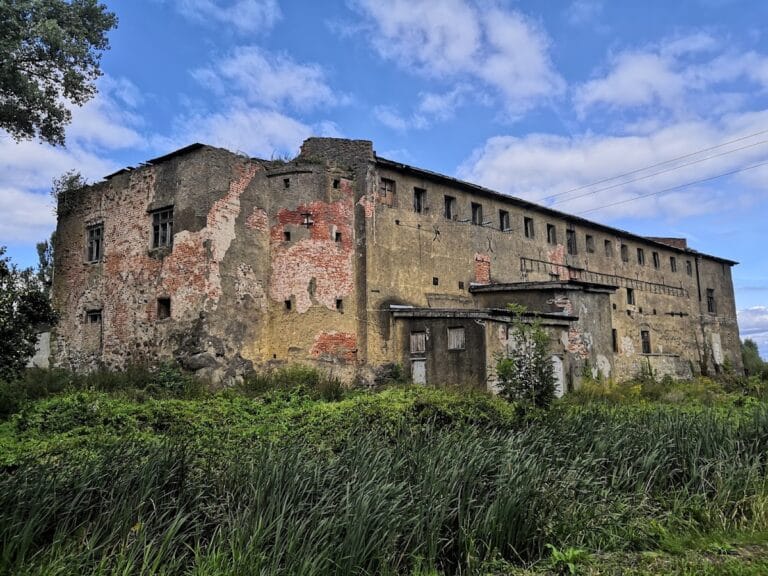
The surviving structures of Taplacken Castle reflect its origins as a small fortress belonging to the later period of the Teutonic Order’s construction activities. The castle’s layout centers on a roughly square courtyard enclosed by a ring wall constructed from fieldstone. Although parts of this defensive wall have survived only in fragments, they encircle the courtyard space, defining the castle’s core.
The main residential area consists of a single wing attached to the northern side of the courtyard, highlighting the castle’s relatively compact design. This wing includes a three-story segment with a basement on the west side, which dates from the early 16th-century conversion of the fortress into a ducal residence. Adjacent to it stands a chapel on the northern side, signifying the addition of religious functions during this period.
In the southern corners of the fortress’s enclosure, small towers once bolstered the defensive perimeter. While most of these towers have disappeared, the base of the southeastern tower remains visible, offering tangible evidence of the castle’s fortified nature.
The castle was built on a narrow strip of land rising out of surrounding marshy terrain, a location that presented challenges for construction. This wet ground prevented the building of traditional cellars, influencing the design and use of underground spaces within the castle. Despite this, a western economic building, likely constructed after the medieval period, is still standing and habitable today, indicating continued use and adaptation of the estate’s outbuildings over time.
Overall, the surviving elements of Taplacken Castle provide a glimpse into its transformation from a wooden fortress to a stone administrative center, and later, a ducal domicile with both residential and religious functions. Though partially ruined, the physical remains preserve key aspects of its role in the region’s medieval and early modern history.
Nearby sites