Scipione Castle: A Historic Fortress and Noble Residence in Salsomaggiore Terme, Italy




Visitor Information
Google Rating: 4.3
Popularity: Medium
Google Maps: View on Google Maps
Official Website: www.castellodiscipione.it
Country: Italy
Civilization: Medieval European
Remains: Military

History
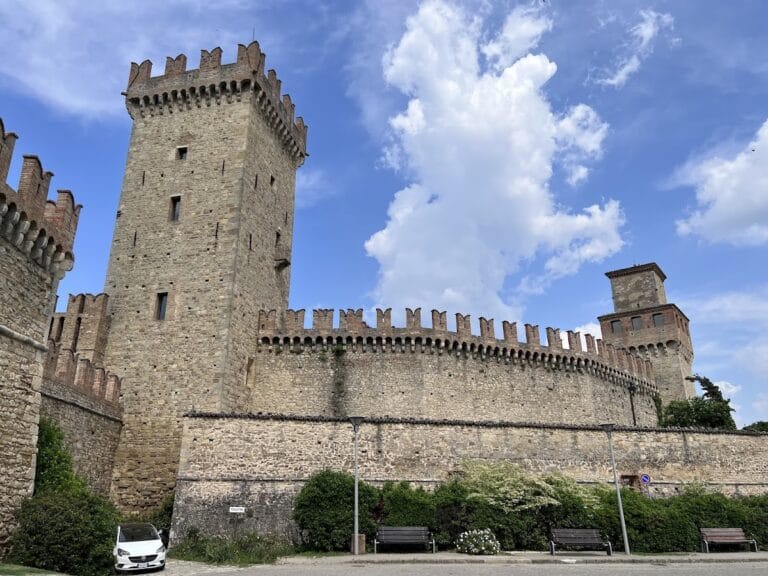
Scipione Castle stands in the municipality of Salsomaggiore Terme, Italy. It was originally constructed in 1025 by Adalberto Pallavicino on the site of an earlier Roman villa. This villa is traditionally linked to the consul Gnaeus Cornelius Scipio Calvus, the uncle of the famous general Publius Cornelius Scipio Africanus. The castle occupies a strategic hilltop position overlooking an ancient salt trade route, near salt extraction wells that have been active for thousands of years.
In 1145, the castle was granted by the Commune of Piacenza to Oberto Pallavicino, the influential local noble. From 1221, ownership passed to the branch headed by Marquis Manfredo. The Pallavicino family grew wealthy by controlling salt production in the area, especially through expanding salt wells in the nearby Salsomaggiore valley. Due to this economic activity, the castle acquired the nickname “Castello del Sale” or “Castle of Salt.”
Throughout its history, the fortress endured several military attacks. In 1267, the Piacenzan Guelphs launched an unsuccessful assault. Later, in 1403, the castle came under attack by the rival Rossi and Da Correggio families. Four years later, in 1407, Ottobuono de’ Terzi captured the castle; however, after territorial negotiations, it was returned to Pallavicino control. Following severe damages from these conflicts, the castle was rebuilt and strengthened in 1447 by Lodovico and Giovanni Pallavicino. Their renovations included lowering and reinforcing the walls, deepening the moat, and adding a circular tower at the southern corner.
By the mid-17th century, Scipione Castle had been transformed from a military fortress into an elegant noble residence. This period saw the addition of a panoramic loggia—a covered gallery offering broad views—a new entrance portal leading into the main courtyard, and richly decorated interior rooms that reflected contemporary tastes.
The Pallavicino family line at Scipione came to an end in 1776 with Dorotea, who married Duke Carlo Sforza Fogliani d’Aragona. Their descendants maintained ownership into the early 20th century. The last family owner, Clelia Sforza Fogliani d’Aragona, who had no children, donated the castle to the Opera Nazionale Orfani di Guerra, which repurposed it as an agricultural colony to care for orphans of World War I.
During World War II, between 1940 and 1943, the castle served as an internment camp. It housed enemy foreign nationals, mainly Slovenes and Dalmatians, as well as political prisoners and some Jewish refugees, accommodating up to 173 detainees by July 1943. After the Italian armistice in 1943, the facility was converted by the Italian Social Republic into a concentration camp where Jews from Parma province were detained prior to deportation to Nazi extermination camps.
Years of neglect followed the war until 1969 when Count Christian Frederik Pier von Holstein purchased the site and gifted it to his wife, Maria Luisa Pallavicino, a descendant of the castle’s original family. Restoration work began, allowing parts of the castle to open to the public by 2008. Further renovations from 2011 focused on consolidating the northwest wing, the square tower, sections near the old drawbridge, and the stables. These efforts uncovered and preserved many decorated and frescoed rooms. The ancient guard tower and adjoining hall were adapted into luxury suites, blending the site’s historical character with modern comforts.
Remains
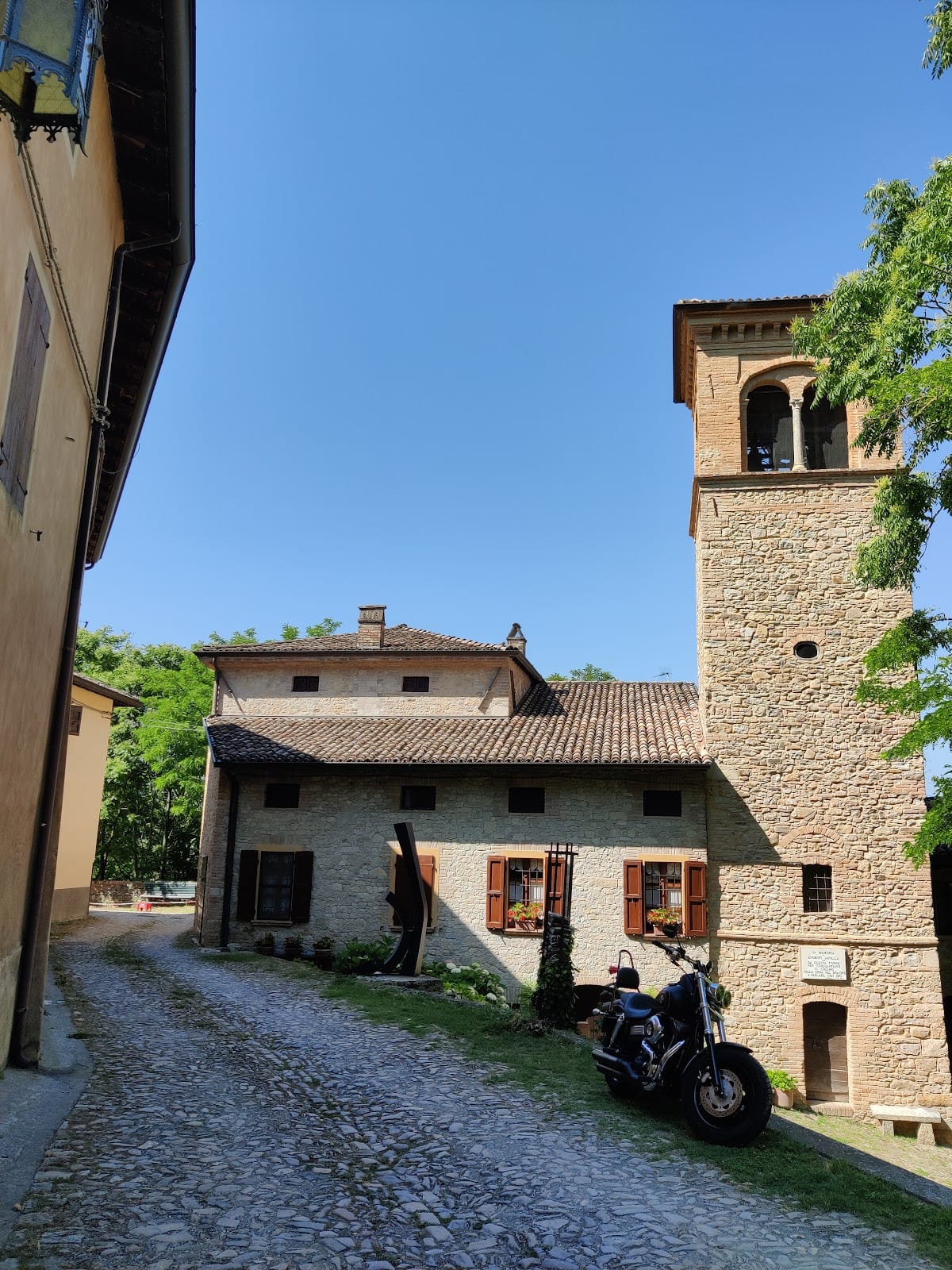
Scipione Castle presents a stone-built complex that merges closely with the medieval village on the hillside. Its layout includes two courtyards, with the main honor courtyard situated near a 17th-century entrance portal. Adjacent to the castle’s southern corner is a panoramic terrace featuring an angular portico, designed to offer extensive views of the surrounding valley.
The castle’s ancient entrance tower once functioned as its main gate. This tower is marked by a fresco depicting a crowned double-headed eagle, symbolizing the Pallavicino family. Below the fresco are tall, narrow openings called arrow slits, which originally held the bolts for the drawbridge. Inside, the vaulted chamber contains several paintings, including a depiction of the Madonna appearing to Saint Charles, a scene of the Assumption of Mary, and the Pallavicino coat of arms.
A square tower occupies the northern corner of the castle, connected to the north wing. This tower underwent recent restoration and remains a prominent architectural feature. The honor courtyard, accessed through a 17th-century arched portal topped with the Pallavicino stone coat of arms, includes a smaller southern arched gateway that provides direct passage to the parish church of San Silvestro. A large, cylindrical brick well stands at one corner of this courtyard, indicating the medieval water supply.
On the courtyard-facing southwest facade, the masonry slopes outward noticeably—a technique called a “batter” that was added during 15th-century defensive upgrades. Within it, traces of the original keep’s walls and Ghibelline battlements with their characteristic swallowtail-shaped crenellations remain visible.
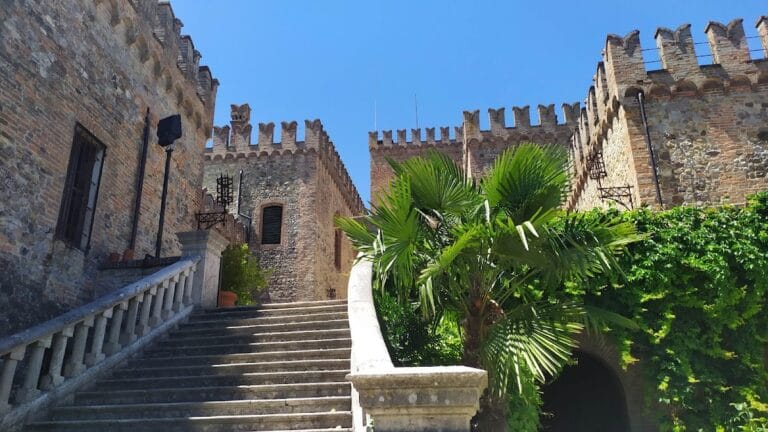
At the southern corner, a cylindrical tower known today as the “Piacentina” dates from around the mid-15th century. Nearby, a broad medieval portal opens into the castle’s entrance hall. From here, the stone “Scalinata dei Cavalli” (Horse Staircase) descends discreetly to a secluded garden hidden behind the castle walls. This secret garden is planted with tall trees, rose bushes, and irises, offering a tranquil retreat.
The circular tower also contains the castle’s ancient prison cells, accessible by a spiral staircase. Opposite this is another stone stairway leading into the castle’s interior rooms. One major corridor, originally a medieval walkway overlooking the valley through several windows, was remodeled in the 17th century into an elegant vaulted gallery ending with a small chapel. The chapel houses an altar from the 18th century. Along the north wall of this gallery hang numerous portraits of distinguished members from different branches of the Pallavicino family.
Among the richly decorated rooms is a vaulted chamber painted predominantly in shades of blue. This space features a 17th-century fresco depicting Jupiter and Ganymede within elaborate Baroque blue stuccoes, alongside 18th-century ornamental details. The room is furnished with antique pieces and displays porcelain collections from the 18th and 19th centuries.
The former armory presents a more austere setting, lacking elaborate decoration. It contains a small 19th-century cannon, bayonets, and a finely carved wooden bench dating to the 16th century, providing insight into the castle’s military past. A separate room now used as a dining area reflects 19th-century customs through its arrangement of a large table “alla russa” (in Russian style).
On the upper floor, the Red Dining Room has served since the 18th century and is distinguished by vivid red textiles covering the walls and carpet. Its stone fireplace and wooden ceiling date back to the 16th century, blending noble tradition with craftsmanship from different eras. Nearby, the Yellow Room features a 17th-century coffered ceiling decorated with scrollwork and floral motifs. Its red Verona marble fireplace bears the coats of arms of Marchesa Maria Luisa Pallavicino and Count Christian Frederik Pier von Holstein, linking the family heritage with the castle’s more recent restorations.
Within a small chamber of the medieval keep, an elegant boudoir was established in the late 16th century. Its walls are frescoed with lunettes—semi-circular paintings—depicting enigmatic scenes that include a female figure seated on a throne with a cityscape behind her, possibly representing Busseto. Other images suggest mythological stories, such as a man accompanied by dogs approaching three women (interpretations include the myth of Diana and Actaeon or the Judgment of Paris), views of Scipione Castle itself, and scenes from classical legends like the Rape of Europa and Helen. The remainder of the room’s walls and ceiling bear 18th-century frescoes featuring Baroque ornamental volutes and optical illusion landscapes interrupted by Corinthian red marble columns. One painted panel shows two fauns gathering pears, once mistakenly identified as devils.
Another vaulted room retains fragments of older frescoes including an oval portrait of Saint Barbara, 17th-century cherubs known as putti, and the tombstone of Giovanni Pallavicino, who died in 1478, along with a funerary inscription dated 1510.
Two rooms in the castle’s north wing still preserve parts of 14th-century ceiling frescoes. These decorations include the Pallavicino family coats of arms, as well as animals and plant motifs arranged within geometric patterns.
A notable hall from the 17th century boasts elaborate stucco work framing a fireplace painting that shows three cherubs at play. Around the room’s walls is a high fresco frieze depicting eight different sacred and secular scenes beneath a wooden coffered ceiling.
On the castle’s southern edge, a 17th-century loggia features plastered semicircular arches forming a corner portico. This large terrace, supported by high walls with defensive battering, commands panoramic views of the valley. From the eastern side of the loggia, the Scalinata dei Cavalli descends to the secret garden below. The loggia culminates at the uppermost level of the cylindrical tower, where a circular sitting room is covered by an umbrella-shaped vaulted ceiling.
Since 2008, portions of the castle including the ancient entrance tower, the honor courtyard, the Gallery of Ancestors, and several richly frescoed rooms like the Blue Sitting Room, Red and Yellow Dining Rooms, the Devil’s Boudoir, the Saint Barbara Corridor, the library, the panoramic loggia, and the restored north wing chambers have been accessible to the public, showcasing the site’s layered history and artistic heritage.
Nearby sites