Schloss Ort: A Historic Castle Complex on Lake Traunsee in Upper Austria


Visitor Information
Google Rating: 4.6
Popularity: Medium
Google Maps: View on Google Maps
Official Website: schlossort.gmunden.at
Country: Austria
Civilization: Medieval European
Remains: Military

History
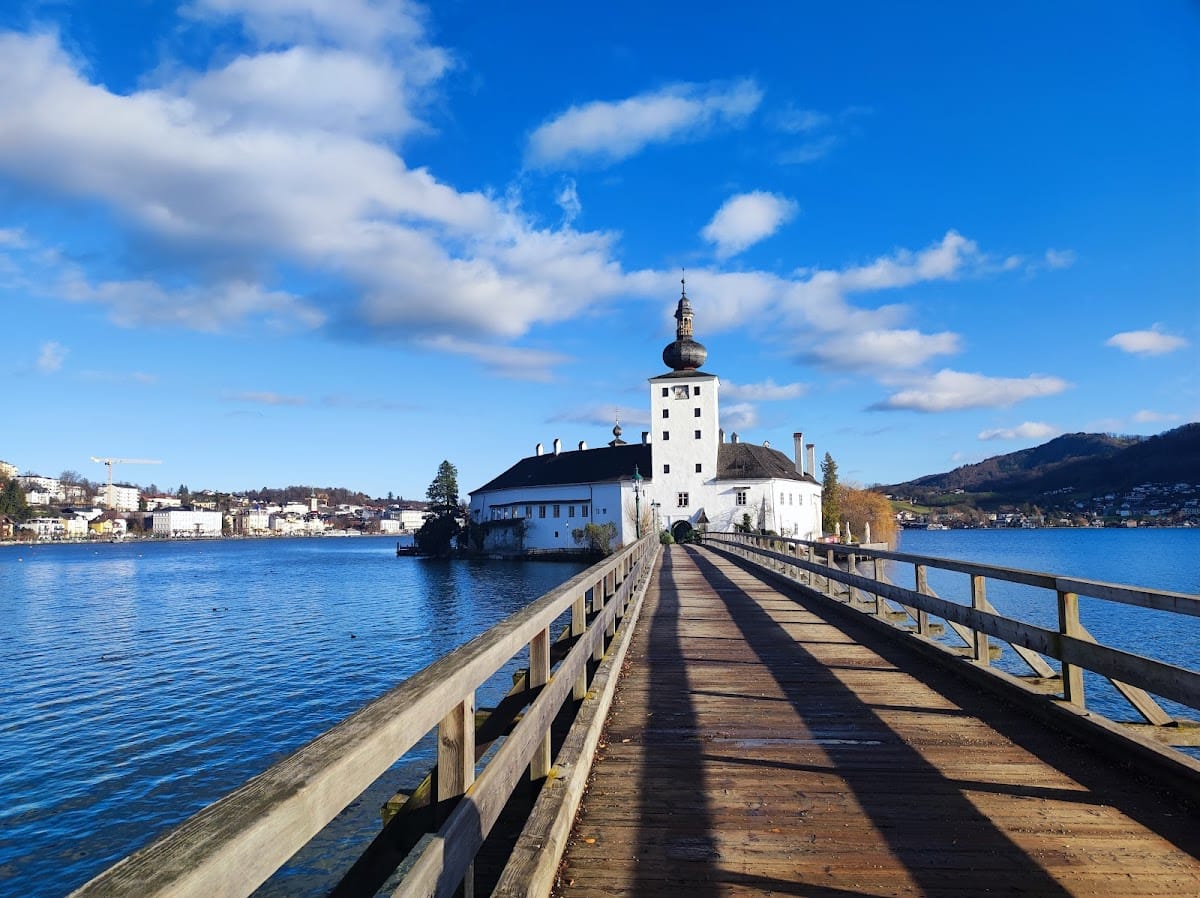
Schloss Ort is located on Lake Traunsee in Gmunden, Upper Austria. The site consists of two castles, with the island castle being the older and more renowned structure. The first written records mentioning Schloss Ort date back to 909 and 1053, indicating its early medieval origins. Around 1080, Hartnid von Ort, a descendant of the Bavarian Count Aribo II, founded the original castle. It was initially designed as a water castle, surrounded by a moat and outer walls, serving as a fortified residence.
The von Ort family governed the castle from the 10th century until 1244. Their rule ended when the last family member was imprisoned following a dispute with their overlord, resulting in the loss of the estate. Afterward, ownership of the castle changed hands multiple times. In 1483, Emperor Frederick III of the Holy Roman Empire acquired Schloss Ort and transformed the island fortress into a luxurious residence, marking a shift from purely defensive use to a more comfortable dwelling.
In the late 1500s, the wealthy town of Gmunden purchased the castle but sold it back to Emperor Rudolf II in 1603 due to the high costs of upkeep. During the Thirty Years’ War, Upper Austria was pawned to Bavaria in 1620. Adam Graf von Herberstorff became governor and made Schloss Ort his residence. He is remembered for his harsh rule, including the 1625 “Frankenburg Dice Games,” where 36 peasants were arrested and half were executed by a dice game, a grim episode linked to his governance.
The following year, in 1626, the Upper Austrian Peasants’ War led to an attack on Schloss Ort. Rebellious farmers plundered and largely burned the castle. Johann Warmund acquired the property from Herberstorff’s widow and rebuilt it in 1634. After 1690, the castle returned to Habsburg control and was repurposed as a prison for important state criminals until 1848. Three of the original prison cells from this period remain preserved.
In 1867, Leopold II of Tuscany purchased the island castle and gifted it to his son, Archduke Johann Salvator. The archduke renounced his titles, adopted the name Johann Ort, and disappeared at sea in 1890. The castle reverted to Emperor Franz Joseph I in 1911. Local authorities acquired Schloss Ort in 1915, and after World War I, it became federal property. It served as a forestry training center for several decades before being sold to the town of Gmunden in 1995.
The adjacent city castle, known as Landschloss Ort, was constructed between 1626 and 1629 on the site of farm buildings destroyed during the peasants’ war. It was used as a military hospital during World War I and later functioned as a forestry school and seminar center until 2018.
Remains
The island castle of Schloss Ort is an irregular triangular complex arranged around a central courtyard. Its buildings exhibit late Gothic architectural style, featuring two-sided double-storey arcades and an external staircase characteristic of the period. Originally, the castle was surrounded by a moat and outer wall, typical of water castles. The current structure mainly dates from the 1634 reconstruction following the fire caused during the 1626 peasants’ uprising.
Within the castle stands a chapel dedicated to St. James the Greater, built in 1634. Three of the original four prison cells remain intact, along with a “hunger tower,” a structure historically associated with imprisonment and deprivation. These features are preserved and accessible as part of a museum display. The castle also houses a unique clock mechanism from 1634 that continues to operate today, requiring daily manual winding.
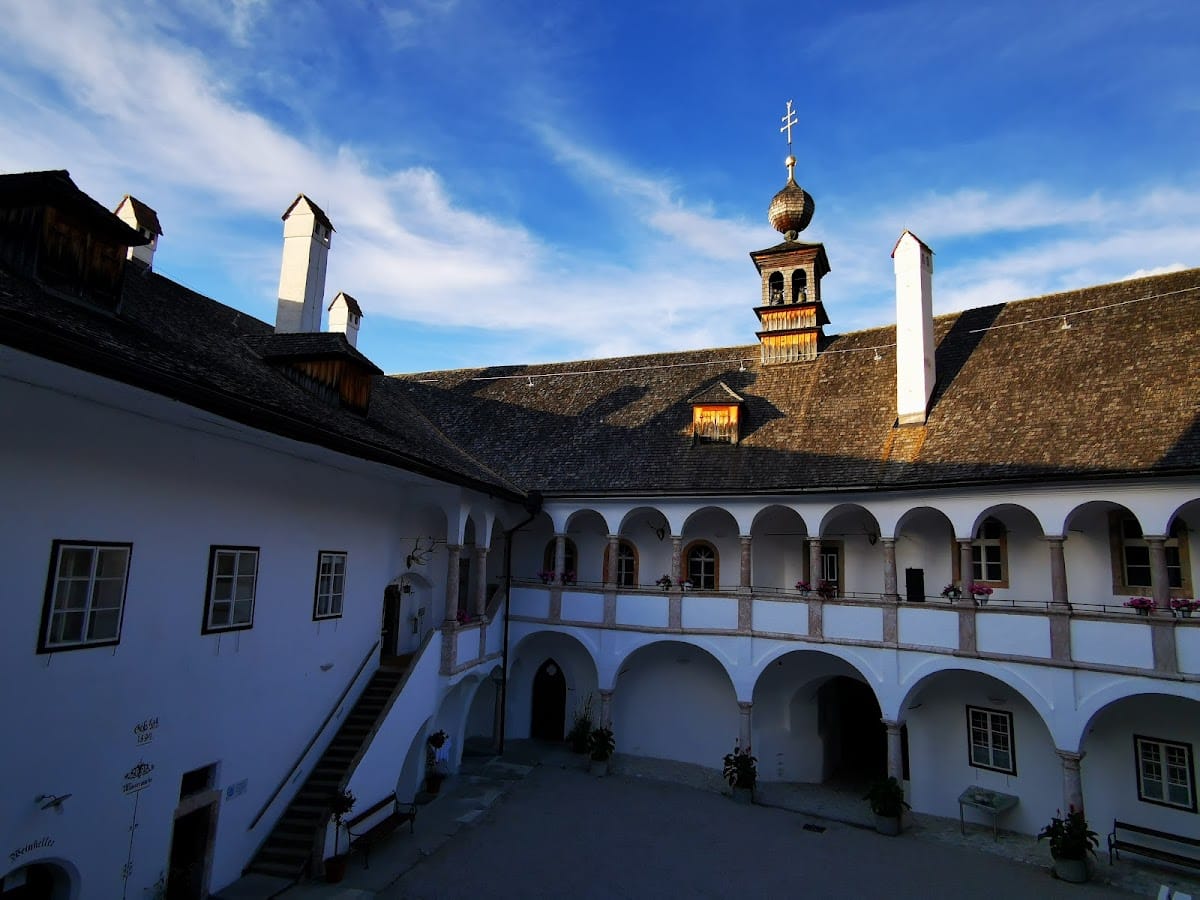
The city castle, or Landschloss Ort, is a square courtyard complex with four towers topped by onion-shaped domes. Built between 1626 and 1629, it features a Rococo-style fountain dated 1777 in the courtyard. The inner facades display coats of arms belonging to former owners. The ballroom contains a painted wooden coffered ceiling created between 1604 and 1612, along with large paintings from the 1910 International Hunting Exhibition held in Vienna.
Exterior windows of the city castle are protected by wrought-iron grilles dating from the first half of the 17th century. Door and fireplace stucco frames also originate from the original construction period. The castle grounds include a naturally protected siltation zone on the western side of the island, preserving the local environment around the historic site.
Nearby sites