Sanxay Archaeological Site: A Roman Healing Sanctuary and Theater in Western France
Table of Contents


Visitor Information
Google Rating: 4.4
Popularity: Low
Google Maps: View on Google Maps
Official Website: www.site-galloromain-de-sanxay.fr
Country: France
Civilization: Roman
Remains: Religious

Context
The Sanxay Archaeological Site is situated near the village of Sanxay in the Vienne department of western France, occupying a gently sloping plateau that overlooks the valley of the Clain River. This location lies within a landscape characterized by mixed woodland and agricultural fields, positioned along a minor ancient route that connected various regional settlements. The site’s placement afforded access to natural water sources and facilitated local communication and movement during antiquity.
Archaeological investigations have established that Sanxay was predominantly occupied during the Roman period, approximately from the 1st to the 4th centuries CE. The site comprises a complex of public structures, including thermal baths and a theater, which exemplify Roman architectural and social practices in a rural provincial context. There is no substantial evidence for significant habitation before the Roman era or after the late antiquity abandonment. The gradual decline and desertion of the site in the late Roman period remain insufficiently documented in the archaeological record.
Systematic excavations commenced in the 19th century and continued through the 20th century, revealing well-preserved remains, particularly of the theater and thermal installations. The robust stone construction and partial burial of these monuments have contributed to their survival. Conservation efforts have aimed at stabilizing the ruins and enabling scholarly study, situating Sanxay as a key example of a Roman rural sanctuary complex within the broader regional landscape of Gallia Aquitania.
History
Late Iron Age to Early Roman Period (Late 1st century BCE – Mid 1st century CE)
Following Julius Caesar’s conquest of Gaul in the 1st century BCE, the territory encompassing Sanxay was incorporated into the Roman provincial system as part of Gallia Aquitania. This period marked significant political and administrative reorganization, integrating local populations into Roman structures. Archaeological evidence at Sanxay, including Roman coinage dating to the late 1st century BCE, attests to initial occupation during this transitional phase.
By the mid-1st century CE, the site witnessed the erection of its earliest monumental architecture, notably an octagonal temple and associated sanctuary buildings. Concurrently, the first permanent stone residences (domus) were constructed, indicating a shift towards Roman-style settlement patterns. These developments established Sanxay as a rural sanctuary complex centered on healing waters, reflecting the introduction of Roman religious practices and architectural forms into the region. The sanctuary’s foundation corresponds with the broader Roman strategy of integrating provincial populations through cultic and civic infrastructure.
Imperial Roman Period (2nd century CE)
The 2nd century CE, under the Antonine emperors, was a period of relative stability and prosperity across the Roman Empire, facilitating the expansion and embellishment of provincial sites such as Sanxay. During this century, Sanxay reached its zenith as a healing sanctuary complex. The principal temple was completed, distinguished by an unusual architectural plan featuring two adjoining cellae within an octagonal structure. The cella, approximately 13 meters in diameter and likely covered by a dome, was encircled by a cruciform portico with colonnades supporting dual-pitched roofs. This temple was enclosed within a square peribolos measuring roughly 79 by 76 meters, delineating a sacred precinct of nearly 4,000 square meters.
Simultaneously, the sanctuary expanded into a thermal complex through at least eight documented construction phases. Initially, two separate bath complexes were established northeast and west of the temple; these lacked some standard Roman bath features such as a frigidarium, suggesting a specialized therapeutic function oriented towards visitors seeking healing rather than general bathing. In the 2nd century, the temple’s two cellae were converted into hot pools—one circular and one square—occupying most of the available space and complicating visitor circulation. Later phases involved eastward expansion, addition of new pools and small rooms, and elevation of basins, culminating in baths with a more classical Roman layout.
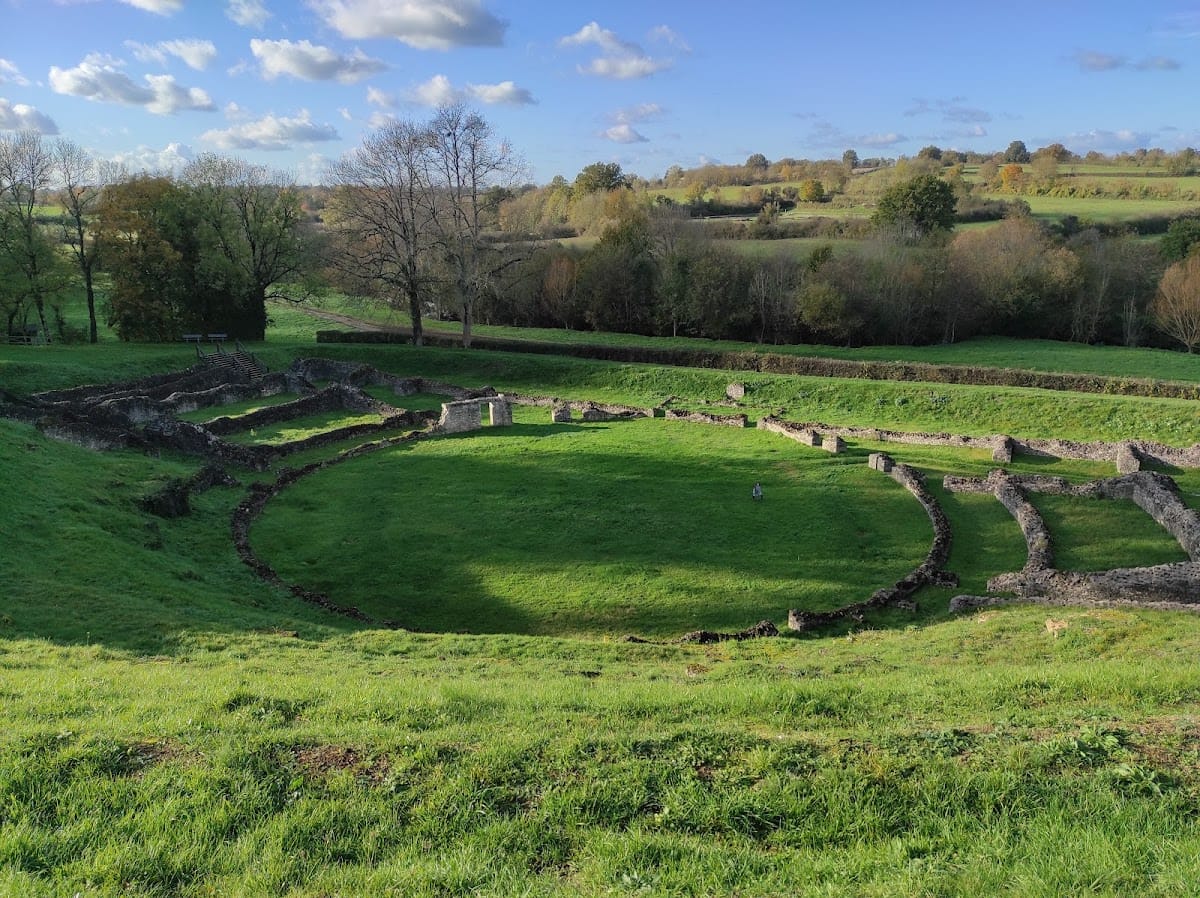
On the right bank of the Vonne River, a large rural theater was constructed, utilizing the natural slope to support the semicircular seating area (cavea) and minimizing masonry requirements. The cavea measured approximately 89 meters in width and could accommodate an estimated 6,600 spectators. Seating was arranged on wooden bleachers supported by masonry walls, and a small masonry honor box (loge d’honneur) once existed but has since disappeared. The circular orchestra, about 20 meters in diameter, and the theater’s mixed architectural features place it among rural venues blending characteristics of theaters and amphitheaters. The theater likely hosted a range of events including theatrical performances, gladiatorial games, religious ceremonies, and political assemblies.
The settlement extended over at least 20 hectares, encompassing numerous buried residential buildings, some interpreted as private homes and others as inns serving pilgrims and visitors to the healing sanctuary. A large basin southeast of the temple, connected by an underground conduit, likely fulfilled both practical drainage and sacred functions. A tholos-like structure on a sacred esplanade east of the octagonal temple may have served as a tomb. Additionally, a small square fanum (temple) on the right bank of the Vonne aligns with the octagonal temple and tholos along an east-west axis. Artifacts recovered during 19th-century excavations include Roman coins from the 1st to 3rd centuries, ceramic pottery, jewelry, household items, bronze statues of Mercury, and terracotta statues of Venus produced in Augustodunum (modern Autun), now housed in the Sainte-Croix Museum in Poitiers.
Late Roman Period and Decline (3rd–4th centuries CE)
The 3rd century CE was marked by widespread political and economic instability across the Roman Empire, known as the Crisis of the Third Century, which affected provincial sites including Sanxay. Archaeological data indicate that no significant new construction occurred at Sanxay after the 2nd century, suggesting a cessation of major building activity. The site underwent gradual decline and abandonment during the 3rd and 4th centuries.
This decline coincided with broader regional transformations, including the increasing ascendancy of Christianity, which supplanted pagan cults such as those centered on healing waters. The prominence of Christian figures like Hilary of Poitiers and Martin of Tours in the 4th century reflects this religious shift. No evidence has been found for Christian occupation or reuse of the sanctuary complex at Sanxay. The site’s abandonment likely resulted from a combination of economic contraction, religious change, and diminished pilgrimage activity.
Post-Roman Period and Modern Rediscovery (5th century CE to Present)
Following its abandonment in late antiquity, the Sanxay site was repurposed as a quarry for building materials, a common fate for many Roman ruins in Gaul. The ruins remained largely buried and unstudied until the 19th century, when systematic archaeological interest emerged. In 1865, the Société des Antiquaires de l’Ouest conducted the first formal survey of the site. Between 1881 and 1883, Jesuit priest Camille de La Croix led extensive excavations over approximately 15 hectares, uncovering the main public monuments including the theater, thermal sanctuary, and temple. Despite detailed documentation, excavation methods of the period resulted in some loss of contextual information. After excavation, the site was backfilled and returned to private ownership.
In 1882, several remains were designated as historic monuments, and the French state acquired parts of the site in 1884 and 1885, enabling further archaeological work. Subsequent investigations in the 20th century included focused studies of the octagonal temple (1938) and sanctuary (1940), with additional exploratory digs in the 1970s. From 1985 to 1994, renewed excavations under Pierre Aupert refined understanding of the sanctuary’s layout and function. Since 1998, precise surveys have concentrated on the visible complexes. Today, the site covers about 15 hectares as a protected archaeological and natural reserve. It is managed by the Centre des Monuments Nationaux and remains accessible to the public, with ongoing conservation efforts preserving its Roman heritage. The ancient theater continues to host cultural events, maintaining its historical role as a communal gathering place.
Remains
Architectural Features
The Sanxay Archaeological Site encompasses approximately 15 hectares of visible remains within an original area estimated at around 20 hectares. Located on a gently sloping plateau overlooking the Clain River valley, the site’s structures are arranged along an ancient minor route. The principal architectural components include a religious sanctuary complex, thermal baths, and a theater, primarily dating to the 1st and 2nd centuries CE. Construction predominantly employed stone masonry, with wooden elements such as seating supports in the theater. The layout reflects a combination of religious, therapeutic, and entertainment functions rather than a dense urban settlement. Residential and commercial buildings, including inns for visitors, are mostly buried and were uncovered during 19th-century excavations but have since been reburied.
Construction techniques include ashlar masonry for monumental structures and large foundation blocks designed to manage water flow. The site’s architecture evolved through multiple phases, especially in the sanctuary and bath complexes, with expansions and modifications mainly in the 2nd century CE. After the 2nd century, no significant new construction occurred, and the site gradually fell into disuse by the 4th century. The remains visible today primarily comprise the temple, theater, and thermal sanctuary, with other structures preserved underground or partially backfilled.
Key Buildings and Structures
Octagonal Temple
The octagonal temple, dating to the 2nd century CE, constitutes the focal point of the sanctuary complex. It features an uncommon octagonal cella fitting within a circle approximately 13 meters in diameter, likely surmounted by a dome. A natural spring emerges at the southeast corner of the cella, where foundations consist of large, unjoined stone blocks designed to capture and channel water. Surrounding the cella is a portico shaped like a Greek cross, with each arm exceeding 10 meters in width. This portico is supported by an approximately 8-meter-high colonnade that carries dual-pitched roofs, giving the temple an estimated total height of up to 23 meters.
The temple is enclosed within a roughly square courtyard (peribolos) measuring about 79 by 76 meters, covering nearly 4,000 square meters. The floors of the porticoes and temple gallery are elevated roughly one meter above the courtyard level. The eastern side of the enclosure includes three staircases providing access to side galleries and a porch leading to the cella’s esplanade. The western gallery is enclosed by walls on both sides and accessible via the northern portico and an external door. The northern and southern porticoes likely featured open colonnades facing the courtyard. A subterranean passage runs diagonally from the temple to the southeastern corner of the peribolos and extends outside to a basin, probably serving as a drainage system for the temple’s water features. Epigraphic and architectural evidence suggests the temple was dedicated to Apollo and possibly Mercury.
Theater
The theater, constructed in the 2nd century CE, is situated on the steep right bank of the Vonne River. It exploits the natural slope to support the semicircular seating area (cavea), reducing the need for extensive masonry. The cavea spans approximately 89 meters in width and could accommodate an estimated 6,600 spectators, comparable to modern large venues. Seating was arranged on wooden bleachers supported by masonry walls. A small masonry honor box (loge d’honneur) once existed but has since disappeared.
The orchestra is circular, about 20 meters in diameter, with a small stage opposite it. The theater’s architectural design combines features typical of both theaters and amphitheaters, classifying it as a rural performance venue. It likely hosted a variety of events, including theatrical performances, gladiatorial games, religious ceremonies, and assemblies. Excavations in the 19th century uncovered 143 inscription fragments near the theater, though over 100 are now lost and none can be definitively linked to the theater. Early excavation disturbed the stratigraphy, complicating modern interpretation.
Water Sanctuary and Thermal Baths
The sanctuary complex underwent at least eight construction phases, primarily during the 1st and 2nd centuries CE. The earliest phase included a temple with a peribolos containing three niches, possibly for statues. Later expansions added a room interpreted as the temple’s cella and two adjacent cellae measuring approximately 26.6 by 14.8 meters, an unusual arrangement associated with the cult of healing waters.
From the 2nd century onward, two separate bath complexes were constructed northeast and west of the temple. These baths were not initially connected and lacked some standard Roman bath features, such as a frigidarium (cold room), indicating a specialized therapeutic function. In the 2nd century, the two former temple cellae were converted into hot pools—one circular and one square—that occupied most of the available space, complicating visitor circulation. Subsequent phases expanded the baths eastward, adding new pools and rooms, and elevated some pools. The final known phase, documented only in 19th-century records, involved constructing a series of small rooms northeast of the site, corresponding to baths with a more classical Roman layout.
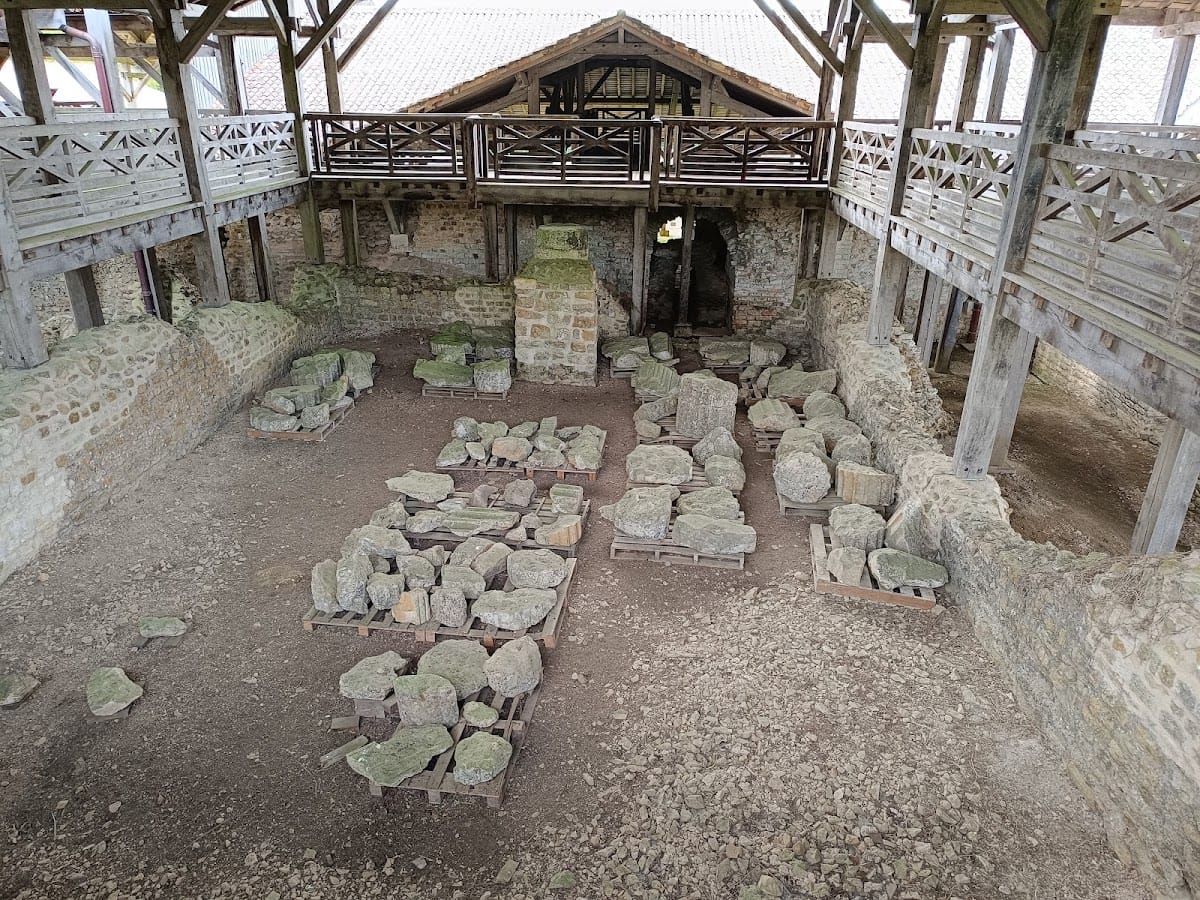
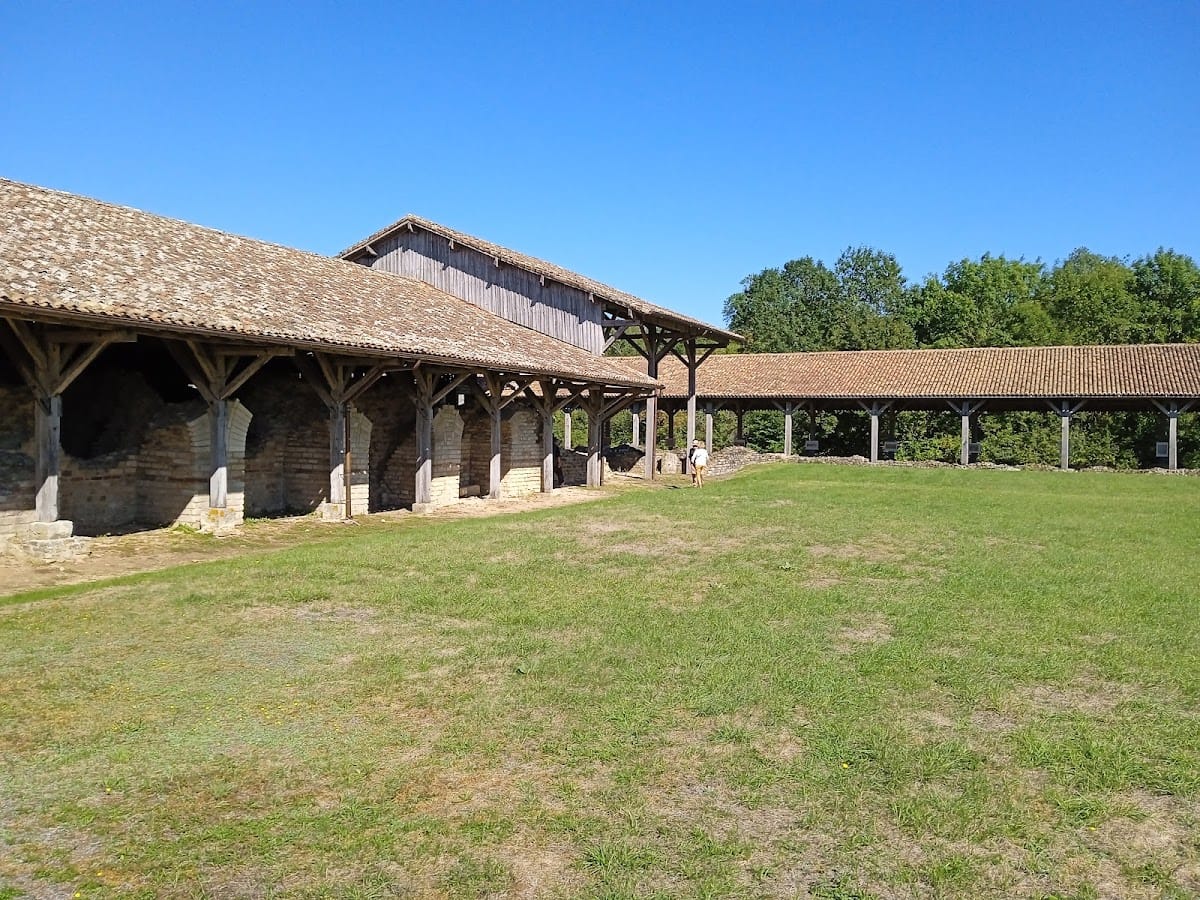
The thermal complex includes hot and cold water basins, heating hearths, a wastewater evacuation system, and a non-heated open-air swimming pool. The baths are well preserved, with the current ground floor corresponding to the ancient level -2, housing technical spaces for furnace maintenance and wastewater management. The level above contains the bathing pools. The ancient baths likely rose an additional 5 to 10 meters above the current visible walls.
Other Remains
Excavations from the 19th century revealed numerous buried buildings over approximately 20 hectares, mostly residential in nature. Some larger structures are interpreted as inns catering to pilgrims or visitors seeking cures at the sanctuary. A large basin southeast of the temple, connected by an underground conduit, likely served both drainage and sacred functions. East of the octagonal temple’s enclosure lies a large esplanade, probably sacred, featuring a central tholos-like structure that may have functioned as a tomb.
On the right bank of the Vonne River stands a small square fanum (temple). A building without pools leading to a riverbank feature was identified and interpreted as a bathing area where visitors could bathe directly in the river. The site also included streets, houses (domus), and an aqueduct, though the latter is now backfilled and inaccessible. After abandonment in the 4th century, the site was used as a quarry for building materials. Many of the buried structures were reburied after excavation and remain unexposed.
Archaeological Discoveries
Excavations at Sanxay have yielded a variety of artifacts dating primarily from the 1st to 3rd centuries CE. These include numerous Roman coins spanning this period, recovered from various parts of the site. Ceramic pottery of different types was found, reflecting domestic and ritual use. Jewelry and household items were also uncovered, indicating aspects of daily life and personal adornment.
Religious artifacts include bronze statues of Mercury and terracotta statues of Venus produced in Augustodunum (modern Autun). These statuettes were found mainly within the sanctuary area. Inscriptions were discovered during 19th-century excavations, including 143 fragments near the theater, though many have been lost and none can be definitively associated with specific buildings. The artifacts are preserved primarily at the Sainte-Croix Museum in Poitiers.
Preservation and Current Status
The remains of the octagonal temple, theater, and thermal sanctuary are relatively well preserved due to their robust stone construction and partial burial. The theater’s wooden seating supports have not survived, but the masonry walls remain intact. The temple’s porticoes and galleries retain their elevated floors and colonnades, while the subterranean drainage passage is still identifiable. The thermal baths preserve structural elements such as basins, heating hearths, and wastewater systems, though the original height of the walls is reduced.
Conservation efforts have focused on stabilizing the ruins and preventing further deterioration. Some areas have undergone partial restoration, but most structures remain in their original archaeological state without modern reconstruction. Vegetation and erosion pose ongoing challenges, managed through regular maintenance. The site is protected as a historic monument and managed by the Centre des Monuments Nationaux, with continued archaeological study and preservation activities.
Unexcavated Areas
Significant portions of the original settlement remain unexcavated or only partially explored. The western part of the sanctuary complex, including some bath structures, remains backfilled and unstudied in detail. Buried residential buildings and street networks extend beyond the visible ruins, with some identified through surface surveys and geophysical methods but not yet excavated.
The aqueduct supplying the site is known from excavation records but is currently backfilled and inaccessible. Future excavations are limited by conservation policies and the site’s status as a protected archaeological reserve. No modern developments obstruct the site, allowing potential for further research under controlled conditions.
Nearby sites