Sanctuary of Hercules Victor in Tivoli: An Ancient Roman Religious and Commercial Center


Visitor Information
Google Rating: 3.9
Popularity: Low
Google Maps: View on Google Maps
Official Website: villae.cultura.gov.it
Country: Italy
Civilization: Roman
Remains: Religious

History
The Sanctuary of Hercules Victor is located in Tivoli, within the province of Rome, Italy. It was built by the ancient Romans between the late 2nd century BCE and 82 BCE. The sanctuary honors Hercules Victor, a warrior god also known as Invictus, who was especially revered as a protector of commerce and livestock, vital to Tivoli’s economy. The cult likely originated in Tivoli and was connected to a local victory over the Equi tribe, reflecting the god’s role in safeguarding the community.
The sanctuary underwent two main construction phases. The first phase created a trapezoidal terrace complex in the 2nd century BCE but was interrupted by structural failure. The second phase produced a rectangular complex with a covered road before 89 BCE, coinciding with Tivoli’s transition from a federated city to a Roman municipality. During this time, the sanctuary became a multifunctional center, hosting priests and musicians who performed ritual dances and music, especially during festivals on the Ides of August.
Throughout the Republican and early Imperial periods, the sanctuary grew wealthy through offerings, commercial activities, and a tithe system managed by a college of officials called the Magistrati Herculanei. It also provided lodging, banking, and commercial services to pilgrims and traders. Emperor Augustus is recorded by Suetonius as administering justice under the sanctuary’s porticos, highlighting its administrative importance. The sanctuary’s prestige reached its peak under Emperor Hadrian, who lived nearby during his reign from 117 to 138 CE.
After the 4th century CE, the sanctuary declined due to the rise of Christianity, damage during the Gothic Wars in the 6th century, and eventual abandonment. In the Middle Ages, the site was repurposed by religious orders, including Benedictine and Franciscan communities. Between 1549 and 1552, Ignatius of Loyola founded a school there. Later, the sanctuary’s water resources powered industrial activities such as foundries and paper mills.
In the late 19th century, the sanctuary became part of a hydroelectric complex. The Canevari canal was constructed to channel water to turbines that, in 1892, transmitted alternating current to Rome, marking a significant technological achievement. Archaeological restoration in the early 21st century stabilized the remains and opened the site for cultural events under the management of the Villae institute.
Remains
The sanctuary covers a large rectangular area approximately 188 by 144 meters, situated on a hillside overlooking the Aniene River. The northern section descends about 40 meters in five levels. The complex was built using local travertine stone and Roman concrete, known as opus caementicium.
A dominant feature is the octastyle temple with eight columns on its front, standing about 18.5 meters tall. The temple lacks a rear colonnade and includes a pronaos, or front porch, with three rows of columns, and a cella, or inner chamber, with two orders of columns. The total height, including the podium, reached about 25 meters. The temple roof was double-pitched and painted yellow, making it visible from Rome. The hollow podium contains two underground chambers, likely used as an oracular room and a votive deposit called a favissa. Some travertine cladding with elegant moldings remains on the southern side of the podium.
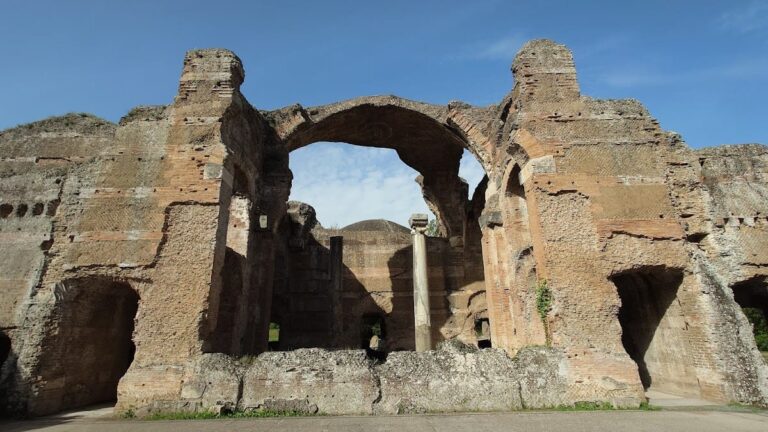
The sacred precinct, or temenos, is a rectangular plaza surrounded on three sides by two tiers of porticos. The lower portico, located on the fourth level, features barrel vaults and arches separated by semi-columns faced with opus incertum, a technique using irregular stone blocks. The upper portico on the fifth level has larger arches opening onto a terrace with balustrades, creating a continuous promenade about 550 meters long around the temple.
Behind the porticos are well-preserved multi-level rooms with large north-facing windows. Constructed in opus caementicium, these rooms have sophisticated vaults and travertine arches supporting cantilevered walls. They served various functions, including warehouses, stables, shops, inns, meeting halls, and workshops.
A covered road called the via tecta runs diagonally through the sanctuary at the third level. It encloses a former section of the Clivus Tiburtinus road. The via tecta is flanked by large rooms that increase in size toward the north. About half of this structure remains, with the southern side dating to the first construction phase, featuring simpler barrel vaults and lowered arches.
The sanctuary’s theater is integrated into its front and has an unusual slope compared to typical Greek theaters. It includes three vomitoria, or spectator exits, a stage, a pit for the curtain called an auleum, and two audience entrances. These features confirm its use as a theater rather than a stairway. The theater’s cavea, or seating area, uses limestone opus reticulatum, a net-like stone pattern, likely reused from earlier structures.
Decorative elements include monumental fountains flanking the temple’s western stairway and bases for statues of notable citizens and emperors along the upper portico. Painted stucco adorned columns and capitals. Later interventions include the Canevari Tower, built in the late 19th century atop the northern slope to house a water conduit for the hydroelectric plant, replacing a 15th-century tower.
The sanctuary’s remains have suffered damage from earthquakes, especially in 1349, medieval spoliation, and industrial use. Recent restorations have stabilized key architectural features and partially recovered the site for public access.