Saint Maire Castle, Lausanne: Historical Seat of Bishops and Cantonal Government

Visitor Information
Google Rating: 4.3
Popularity: Low
Google Maps: View on Google Maps
Official Website: www.lausanne-tourisme.ch
Country: Switzerland
Civilization: Medieval European
Remains: Military

History
Saint Maire Castle stands in Lausanne, located in the canton of Vaud, Switzerland. It was built by the medieval bishops of Lausanne between 1397 and 1431 to replace their former residence, which no longer met their needs. The castle served as a fortified home for the bishops, reflecting their religious and political authority in the region.
The castle’s name honors Saint Marius, also known as Saint Maire, a bishop from the 6th century who moved the episcopal seat from Avenches to Lausanne around the year 581. This relocation was prompted by Germanic invasions, marking an important shift in the ecclesiastical center of the area.
Saint Maire Castle remained the bishop’s residence until 1536. That year, Bernese forces conquered the Vaud region, forcing the last bishop, Sébastien de Montfalcon, to escape through a secret stairwell within the castle. Following this conquest, the castle ceased to serve as a religious residence.
Under Bernese rule from 1536 to 1798, the castle became the administrative center for the Bernese bailiff. During this period, defensive features such as crenellations were filled in, and the roof was extended to improve insulation, reflecting its new administrative rather than military role.
After the liberation of Vaud in 1798 and the establishment of the canton in 1803, the castle was repurposed as the seat of the cantonal government. It housed the Council of State and other executive offices, a function it continues to serve today.
Between 1476 and 1517, under bishops Benoît de Montferrand and Aymon de Montfalcon, the castle underwent significant interior renovations. These included the addition of murals and the installation of prison cells in the lower parts of the building.
Throughout the 19th and 20th centuries, the castle was adapted for administrative use. Changes included reconfiguring the courtyard, repairing facades, and uncovering 16th-century paintings. Since 1920, it has been recognized as a Swiss heritage site of national importance.
A major restoration took place from 2015 to 2018, modernizing the castle’s facilities while preserving its historical character. The castle remains the seat of the cantonal executive and is generally closed to the public.
Remains
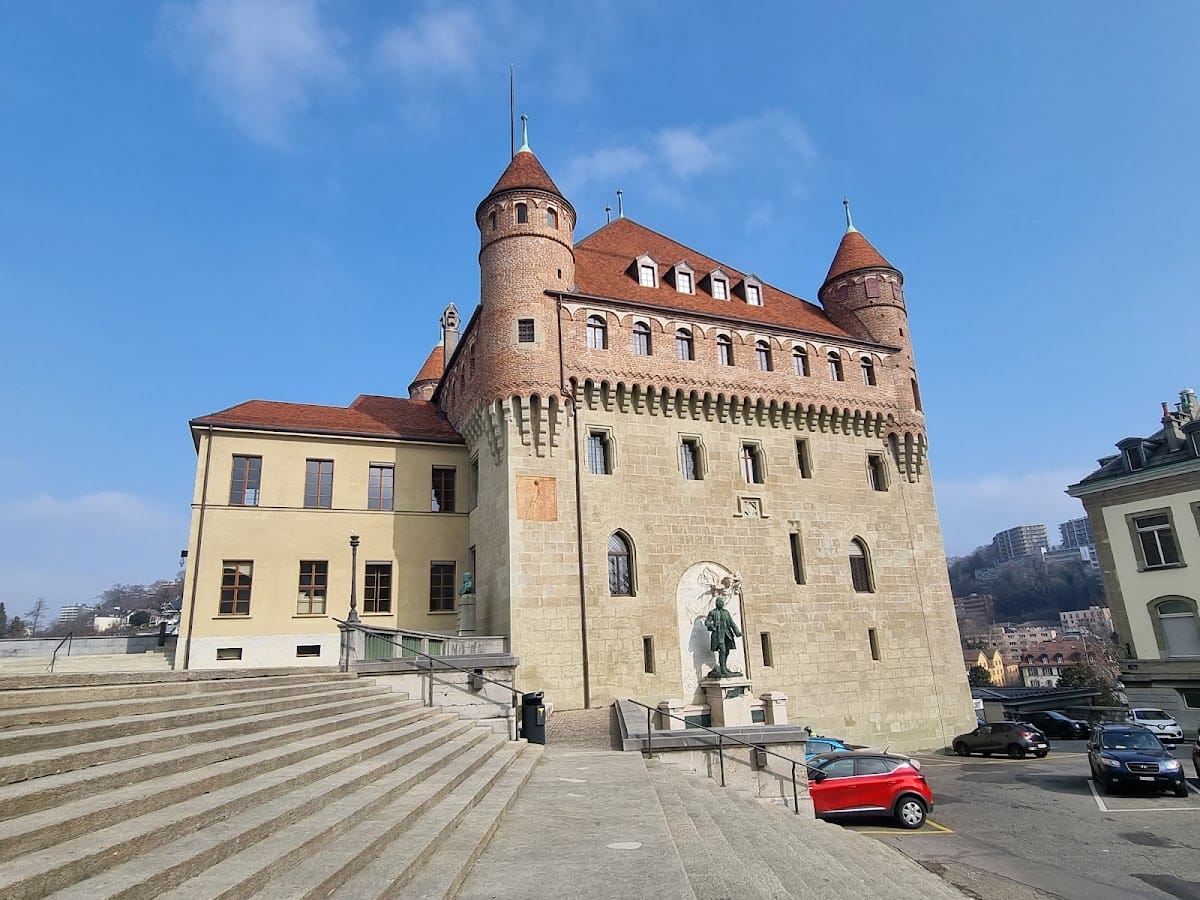
Saint Maire Castle is a large cubic building measuring about 25 by 23 meters, with walls 2.8 meters thick. Its south side rises to 25 meters in height. The lower walls are built from gray molasse sandstone, while the upper story is made of red brick. The upper section features machicolations—openings in the parapet used for defense—and small corner turrets shaped like pepper pots.
The roof is a four-sided pitched design standing 13.5 meters tall, with a ridge that has two peaks. Originally, the roof was topped with Ghibelline merlons, a style of battlement with swallowtail-shaped notches common in Italy. These merlons were later filled in during the 16th century, and windows were added just below the eaves, filling the spaces between the original battlements. The window arches echo the shape of the former merlons.
Originally, the castle was separated from the city by defensive walls and a dry moat on the west side. Access was provided by a drawbridge, which has since been filled in. In 1789, a two-story annex was added on the west side; this annex now serves as the main entrance. A nearby tower was demolished around 1890.
Inside, the bishop’s chamber was renovated in the early 1500s and decorated with the Montfalcon family coat of arms and motto. The chamber also contains 16th-century murals, which some attribute to the artist Pierre Spicre, though this attribution is debated. Prison cells were installed in the castle’s lower areas during the late 15th and early 16th centuries.
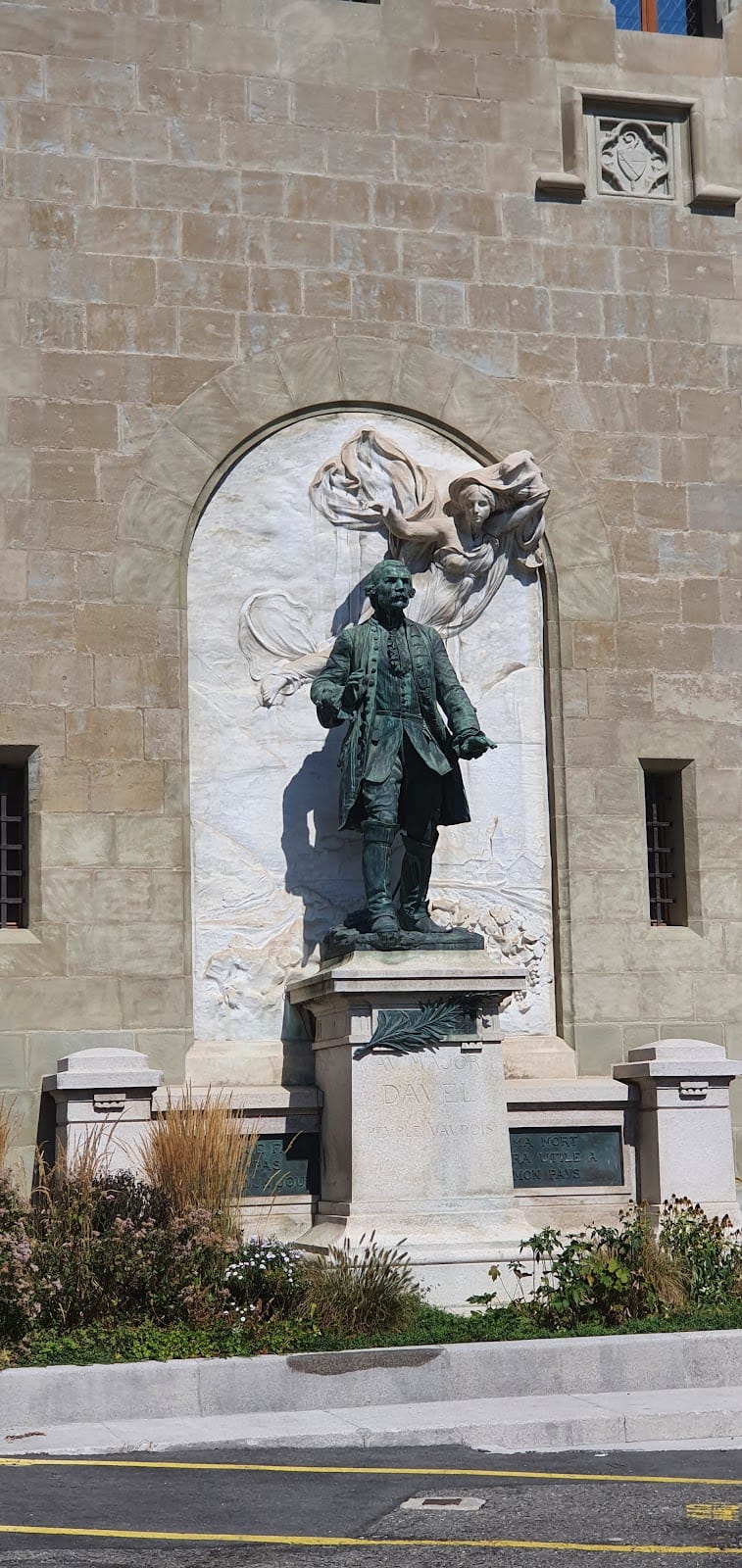
The courtyard was redesigned in the mid-19th century to include a raised esplanade with a balustrade and stairs, revealing the base of the main tower, or donjon. A monument to Major Abraham Davel, who was executed nearby in 1723, stands against the castle’s southern facade.
The castle’s structure has undergone repeated restoration, including facade repairs, stone replacement, and the installation of modern features such as an elevator during the 2015–2018 renovation. These efforts have preserved the castle’s historical fabric while adapting it for contemporary use.
Nearby sites