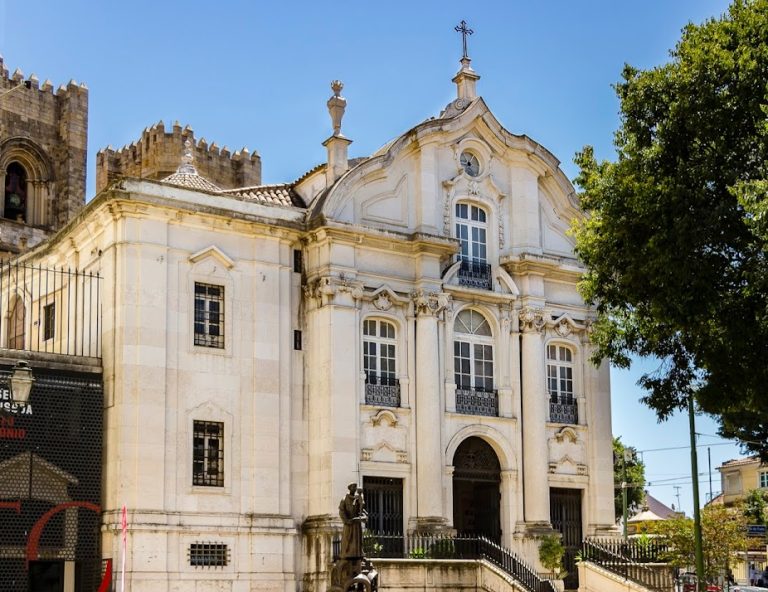
Sao Jorge Castle: A Historic Citadel and Royal Residence in Lisbon


Site at a Glance
- Rating
- 4.4
- Popularity
- Very High
- Country
- Portugal
- Primary era
- Medieval
- External website
- Open
- Eras represented
- Classical, Medieval, Early Modern, Modern
- Civilizations
- Portuguese, Roman, Umayyad
- Site type
- Military
- Remains
- Castle
On this page15 sections
History
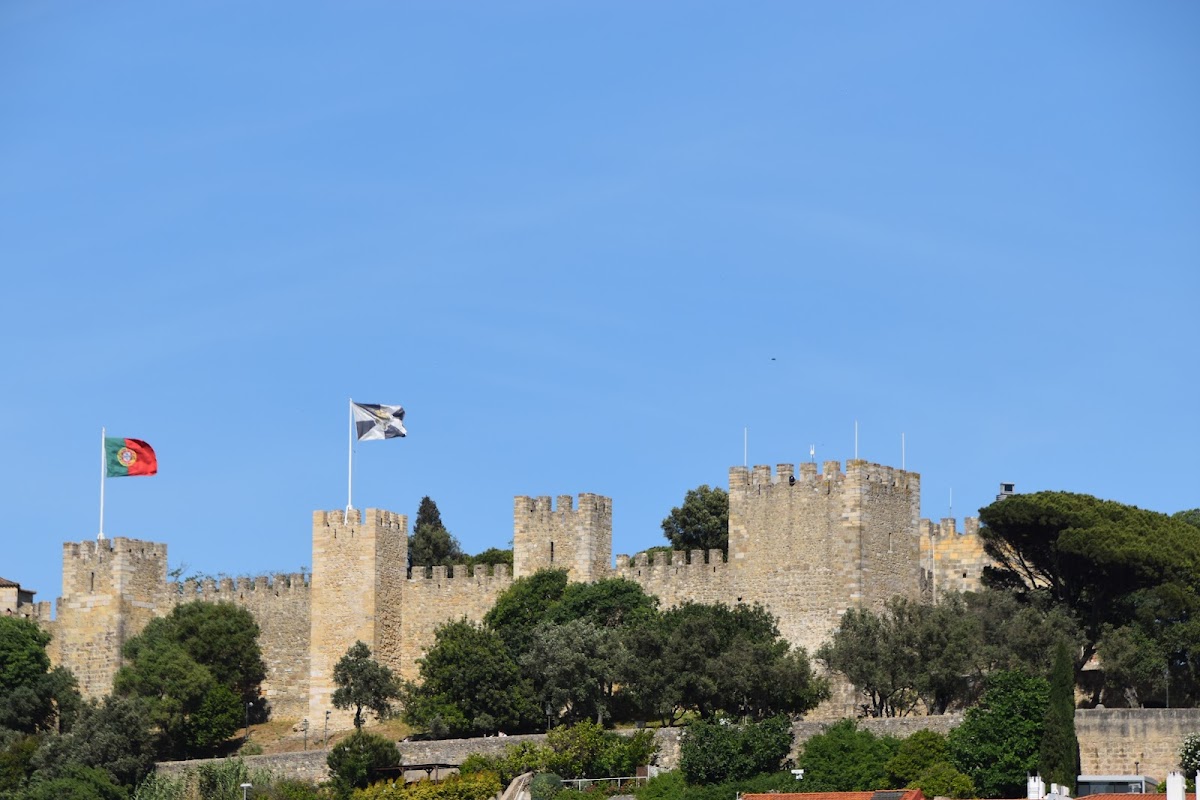
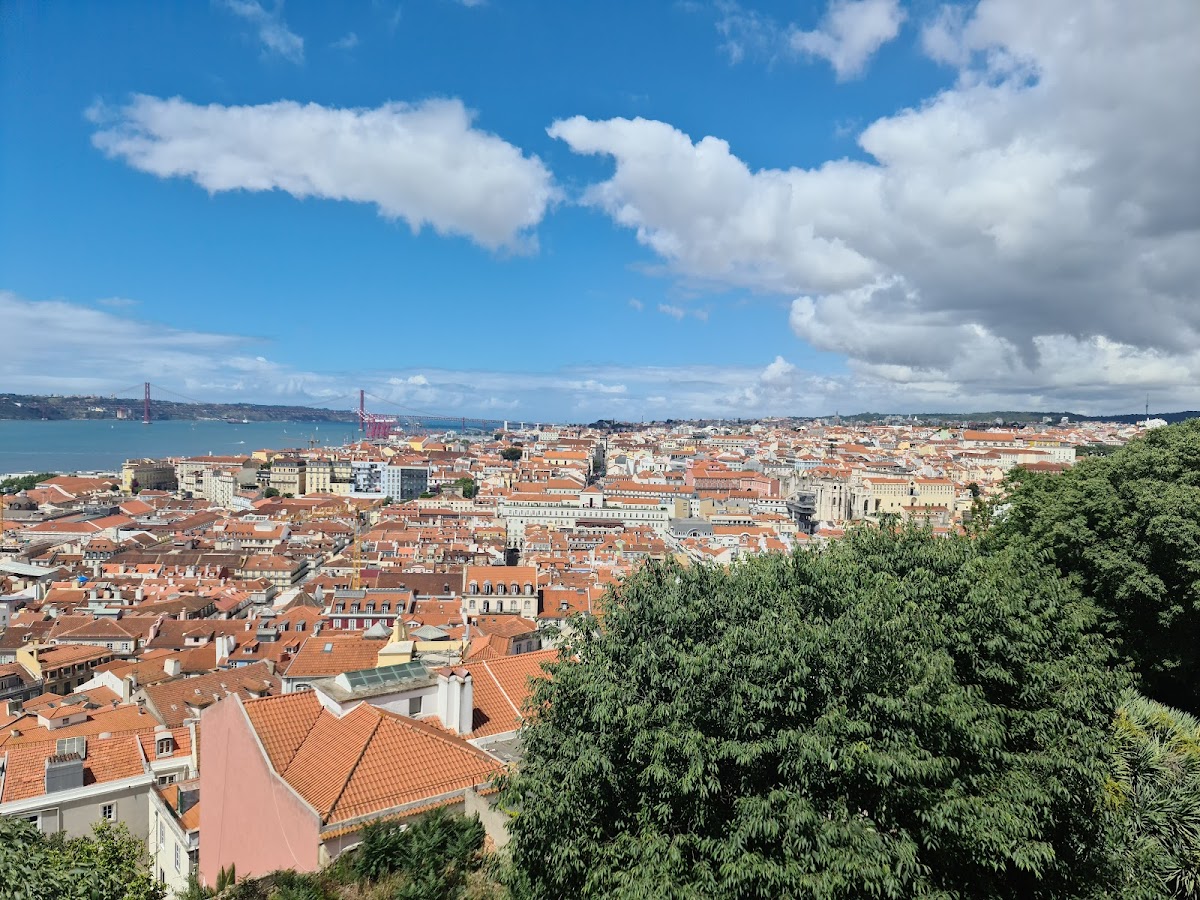
Sao Jorge Castle is a historic fortification in Lisbon, Portugal, whose hilltop defenses developed from foundations dating to the 2nd century BC into a Muslim citadel and later a Portuguese royal residence. The site occupies the summit above the city and the Tagus estuary, and its long history reflects successive Celtic, Phoenician, Greek, Carthaginian, Roman, Suebi, Visigothic, Muslim, and Portuguese phases.
Ancient and early medieval foundations
Human occupation of the castle hill dates to at least the 8th century BC. The earliest known fortifications belong to the 2nd century BC, while a first fortification is traditionally associated with 48 BC, when Lisbon became a Roman municipality. In the Roman period, the settlement was known as Olisipo. From 139 BC, the hill reportedly served as a base for the Roman consul Decimus Junius Brutus Galaico during operations against Lusitanian groups. In 60 BC, the Roman propraetor Julius Caesar granted the settlement the name Felicitas Julia and Roman citizenship to its inhabitants.
The city passed through several early medieval regimes. Suebi forces conquered it in the mid-5th century under King Maldras, and Visigothic rule followed under Euric before becoming definitive under King Leovigild. Muslim forces took Lisbon in the 8th century, when it was known as Al-Ushbuna or Lissabona. In the 10th century, Berber rulers strengthened the hill with fortifications that formed part of the Cerca Moura, or Moorish Encirclement, a defensive circuit around the settlement.
The conquest of Lisbon and the royal citadel
During the Christian expansion known as the Reconquista, Christian rulers made several temporary attempts to seize Lisbon. Alfonso II of Asturias captured the city in 796, and Ordoño III of León later did so again, but both forces withdrew after plundering the settlement and causing severe damage. In 1093, the ruler of the taifa of Badajoz, a Muslim-ruled principality, transferred Lisbon, Santarém, and Sintra to Alfonso VI of León and Castile as part of a defensive alliance. Muslim control returned under the Almoravids the following year.
Lisbon and its fortification were conquered in 1147 after a three-month siege led by Afonso Henriques, the first king of Portugal, with the assistance of Norman, Flemish, German, English, and other northern European crusaders travelling toward the Holy Land. The campaign is described in De expugnatione Lyxbonensi. Control of the fortress enabled Christian forces to defend Lisbon through the end of the 12th century. A later tradition tells that the knight Martim Moniz sacrificed himself by blocking a partly open gate with his body, preventing its closure and allowing the attacking troops to enter. This episode is a legend rather than an established historical fact.
After the conquest, the castle was placed under the invocation of Saint George, a Christian warrior saint associated with military and crusading traditions. The dedication expressed gratitude for the victory and reflected the devotion of many crusaders. By the late 14th century, the association had also become linked with King John I. Lisbon became the capital of the Kingdom of Portugal in 1255, and the hilltop complex became the fortified Alcáçova residence of Afonso III in his role as governor. An Alcáçova was a fortified residence or citadel associated with Muslim and later royal rule.
Around 1300, King Denis extensively renovated the complex and transformed the former Muslim Alcáçova into the Royal Palace of the Alcáçova. Between 1373 and 1375, King Ferdinand I ordered the construction of the Cerca Nova, also called the Cerca Fernandina. This expanded city wall enclosed parts of Lisbon that had previously remained outside the older Moorish circuit. Built by João Fernandes and Vasco Brás, it partly replaced the earlier walls and was completed in two years with 77 towers, between 34 and 38 gates, and a perimeter of approximately 5,400 metres.
Royal residence and military stronghold
The castle and Lisbon resisted Castilian forces during the conflicts of the 14th century, notably in 1373 and during the crisis of 1383 to 1385, a struggle over the Portuguese succession and the country’s independence from Castilian control. On 26 January 1383, however, the castle was surrendered to João Afonso Telo, Count of Barcelos, by its governor, Martim Afonso Valente. Lisbon was later heavily besieged by the forces of John I of Castile during the same crisis.
From 1378, much of the kingdom’s documentary record was housed in the Torre do Tombo, also called the Torre Albarrã. The archive remained there until the earthquake of 1755, and the Portuguese royal archive continued to bear the name Torre do Tombo because of this original location. Public works between 1449 and 1452 converted parts of the fortified complex into a royal residence. Gil Pires became master builder on 9 December 1448, replacing Afonso Esteves. The mason João de Alverca carried out stonework, while laborers worked on the palace and its associated materials.
The castle remained connected with the Portuguese monarchy during the great maritime expansion. A royal menagerie had been established in the nearby Royal Palace of Lisbon in the early 15th century, and after the conquest of Ceuta in 1415, King John I brought two Barbary lions to Lisbon. They were housed in a large palace room called the Casa dos Leões, or Lions’ House. In 1498, King Manuel I received Vasco da Gama at the castle after his return from the voyage that opened the maritime route to India. In 1502, Gil Vicente staged Monólogo do Vaqueiro there to celebrate the birth of Manuel’s son and heir, the future King John III.
The Royal Palace of the Alcáçova lost importance after the Ribeira Palace was built beside the Tagus in the early 16th century. Earthquakes in 1290, 1344, 1356, 1531, 1551, 1597, and 1699 damaged the castle or associated structures. In 1569, King Sebastian ordered the rebuilding of the royal apartments so that they could serve as his official residence. Filippo Terzi demolished a tower near the main facade of the Church of Loreto in 1577, but much of the project remained unfinished after Sebastian’s apparent death at the Battle of Alcácer Quibir.
During the resulting dynastic crisis and the 60 years of Spanish rule, the castle was converted into military barracks and a prison. Teodósio de Frias the Younger became master builder in 1642, continuing work begun by his father, Luís de Frias, and his grandfather, Teodósio de Frias, within a Spanish plan to recommission the fortification. After Portugal regained independence in the Portuguese Restoration War, the Portuguese government assumed responsibility for the works. Nicolau de Langres was appointed in 1648 to design and construct a new fortification around the castle and Lisbon’s walls. Mateus do Couto became master builder in 1650, João Gillot built new walls in 1652, and construction continued according to Couto’s plans between 1657 and 1733. New projects began under Custódio Vieira in 1733.
Decline, reconstruction, and present status
A Soldiers’ Hospital dedicated to Saint John of God was installed beside Rua do Recolhimento in 1673. The Recolhimento do Castelo, or Castle Shelter, was built along the southeastern angle of the courtyard at the end of the 17th century. The Lisbon earthquake of 1755 severely damaged the castle and accelerated its decline. The old castle walls remained, while the hospital and shelter were left in ruins. The site continued to function as a garrison and military presidio.
Casa Pia, a charitable institution established to educate poor children, operated in the citadel from 1780 to 1807. Soldiers continued to be stationed there, and Jean-Andoche Junot used the site as a headquarters in 1807. Portugal’s first geodetic observatory was built on a castle tower in 1788, partly in response to the earthquake and the tsunami that followed it. The tower later became known as the Torre do Observatório, or Observatory Tower.
By the 1930s, later additions and annexes had almost completely concealed the castle from Lisbon’s skyline, and the complex was in an advanced state of ruin. During the 1940s, the government of António de Oliveira Salazar initiated extensive reconstruction through the DGEMN. Incongruous later structures were demolished, and the Recolhimento was partly restored. Much of the castle’s present medieval appearance therefore results from this reconstruction campaign rather than uninterrupted survival from the Middle Ages.
Lisbon’s municipal government assumed responsibility for the castle’s operations on 31 May 1942, a role reaffirmed on 8 June 1979. The Portuguese government remains the owner, and the complex functions as a national monument and museum. It was classified as a National Monument by decree on 16 June 1910. In 2006, a special protection zone was defined for the castle, the remaining Lisbon walls, Baixa Pombalina, and other protected properties. The National Council of Culture proposed abandoning that definition in 2011, with support from IGESPAR. In 1998, the museum Olissipónia was created by adapting semi-rectangular spaces, columns, and a cistern within the former palace remains. These late-1990s interventions, together with the 1940s reconstruction, rehabilitated the monument and reinforced its medieval appearance.
Remains
The complex occupies a hill in central Lisbon, with parts of its enclosing walls extending around the citadel into the civil parishes to the east and south. It includes the medieval castelejo, the remains of the royal palace, gardens, a large terraced square, exhibition spaces, and the Casa do Governador, a meeting and reception room. Stone, granite, and reinforced concrete are among the materials used across the surviving and restored structures. The former Muslim Alcáçova occupied the summit in a roughly quadrangular enclosure about 60 metres on each side, while its broader defensive circuit extended for approximately 200 metres, with walls descending east and west toward the river and enclosing the settlement.
The medieval castelejo and defensive walls
Castelejo
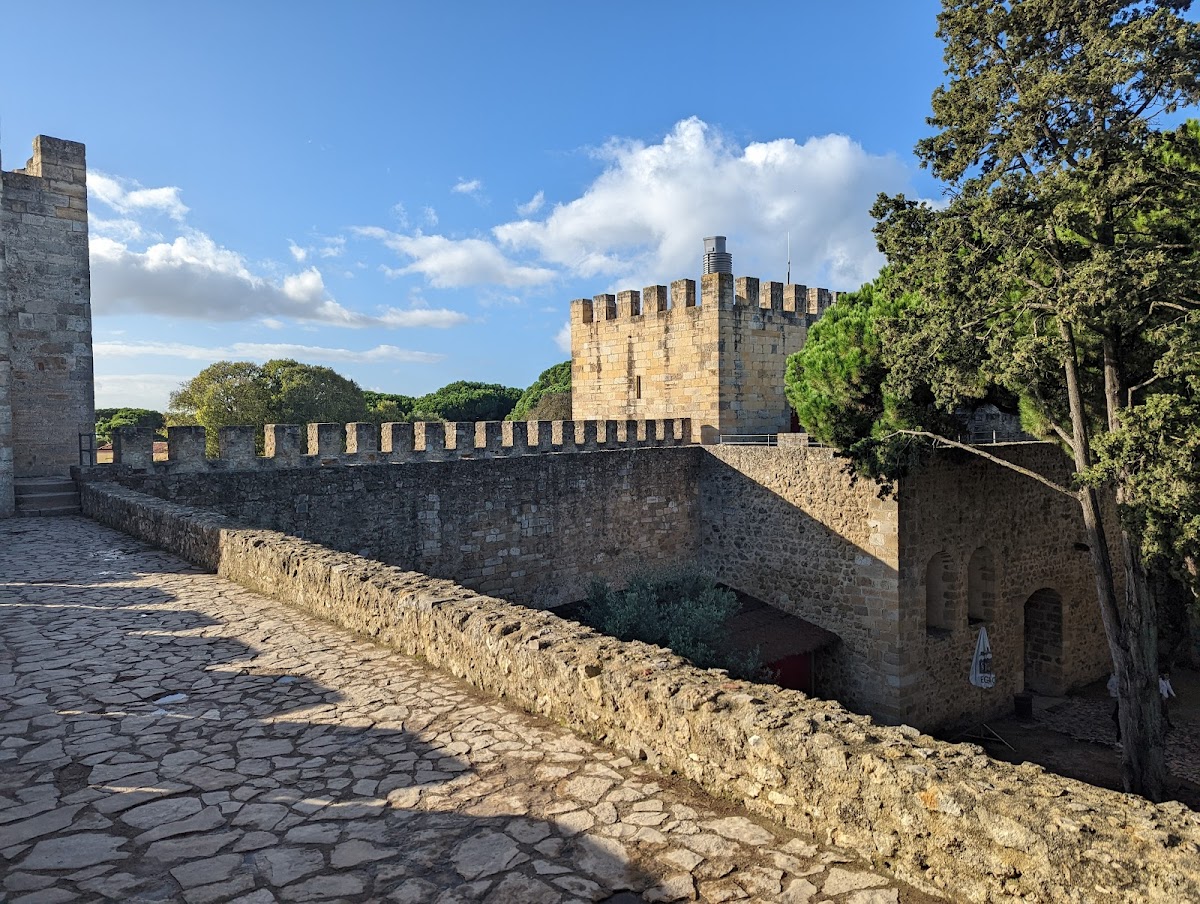
The castle itself has a roughly square plan and was enclosed by a wall that formed a citadel. The medieval castelejo occupies the northwestern corner of the citadel at its highest point. It is rectangular and has ten towers. A wall containing a tower and a connecting doorway divides its courtyard into two halves, while stairways lead to the wall walkways and towers.
Barbican and moat
The southern and eastern sides are protected by a barbican, a low outer wall designed to keep siege engines away from the principal defenses. Steep slopes descending from the foundations protect the northern and western sides. A partly encircling moat, now dry, surrounds the castle, and the principal entrance is reached across it by a stone bridge.
Curtain walls and gates
A long western curtain wall descends toward the Torre de São Lourenço, which guarded a gate in the Cerca Fernandina. The castle walls contain twelve gates, seven of them opening toward the parish of Santa Cruz do Castelo. A separate outer curtain leads to a barbican tower, while eighteen towers support and reinforce the walls. The southern gate is approached through Rua de Santa Cruz do Castelo and gives access to the Praça d’Armas, or main square.
Citadel buildings and later installations
Praça d’Armas
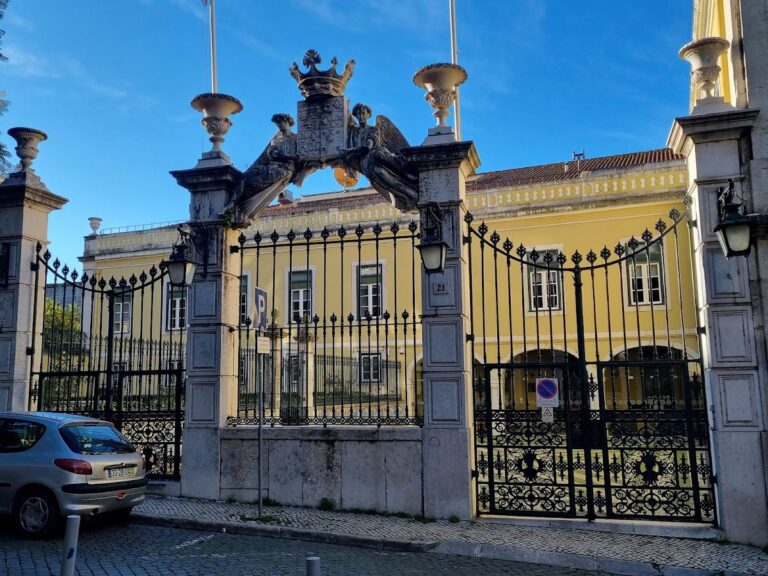
The citadel’s main entrance is a 19th-century gate bearing the Portuguese coat of arms, the name of Queen Maria II, and the date 1846. It opens onto the Praça d’Armas, which contains old cannons and a bronze statue of Afonso Henriques. The statue is a copy of the 19th-century original by the Romantic sculptor António Soares dos Reis, located near Guimarães Castle.
Royal Palace of the Alcáçova
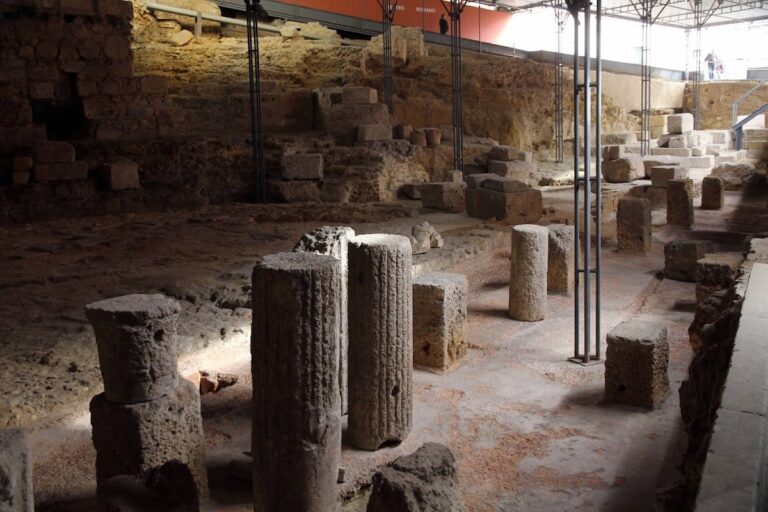
The remains of the Royal Palace of the Alcáçova stand near the main square. They consist chiefly of walls and several rebuilt rooms, including the Casa Ogival. These spaces now accommodate Olissipónia, a multimedia presentation about Lisbon’s history. The rooms, columns, and a cistern were adapted for the museum in 1998, giving the surviving palace structures a continuing cultural use.
Tower of Ulysses
The Torre do Tombo, formerly also called the Torre Albarrã and now known as the Tower of Ulysses, survives as a castle tower associated with the former royal archive. A camera obscura, an optical device that projects an outside image onto an interior surface, was installed there in 1998 and provides a 360-degree view of Lisbon and the Tagus.
Observatory Tower and Recolhimento
The tower that housed Portugal’s first geodetic observatory in 1788 is known as the Torre do Observatório, or Observatory Tower. The Recolhimento do Castelo occupies the southeastern angle of the courtyard. Built at the end of the 17th century, it was partly restored during the reconstruction of the 1940s. The complex also retains gardens, viewpoints, a terraced esplanade, exhibition areas, and the Casa do Governador.