Allaman Castle: A Medieval Fortress and Castle of Peace in Switzerland
Site at a Glance
- Rating
- 3.9
- Popularity
- Very Low
- Country
- Switzerland
- Primary era
- Early Modern
- External website
- Open
- Eras represented
- Medieval, Early Modern, Modern
- Civilizations
- Duchy of Savoy, Swiss
- Site type
- Domestic
- Remains
- Castle
On this page10 sections
History
Allaman Castle is a medieval castle in Allaman, Switzerland, developed by the local lords of Allaman, a family of medieval service nobles, during the medieval period. Timber from its southeastern wall was felled in 1291 or 1292, providing a date for an important building phase. The castle stood above the road linking Geneva and Lausanne, with routes toward Aubonne and the Marchairuz, and its strategic role was recognized when it was explicitly described as a castle in 1375.
Medieval lordship and destruction
The lords of Allaman are documented from 1219. As ministeriales, members of a service nobility who served higher lords in administrative, military, and court functions, they probably already held a fortified residence at Allaman. During the fourteenth and fifteenth centuries, the castle passed through several hands. In 1530, Swiss Confederates burned the medieval building during the conflict known as the Affair of the Spoon Knights.
Transformation into an aristocratic residence
In 1546, ownership passed to the notary Jean Challet, who also possessed the Rochefort residence in Allaman. The Cerjat family acquired the property in 1547 and carried out major works, including the addition of arcades in the courtyard. The Margravine Jeanne-Marguerite de Langallerie, a noblewoman holding the female equivalent of the title margrave, took possession in 1723 and modernized the castle as a residence during the following decade.
Around 1757, Gaspard Sellon created a monumental façade on the courtyard and established a representative entrance. During Jean-François de Sellon’s period, several rooms received elaborate wood paneling and French wallpaper. Particularly refined wallpaper panels were installed around 1790, while Jean-Jacques de Sellon carried out further interventions in 1819.
Jean-Jacques de Sellon and the peace movement
Jean-Jacques de Sellon (1782–1839), a Genevan philanthropist, politician, patron, landowner, pacifist, and amateur of architecture and gardens, gave Allaman Castle a wider political and intellectual role. In 1820, the castle became the provisional seat of the Society of Peace, an early organized peace movement later regarded as a forerunner of the League of Nations and the United Nations. Around 1830, de Sellon founded the Société des Amis de la Paix de Genève, described as the first peace society in continental Europe. An international peace summit was held at the castle in 1830, contributing to its reputation as the “Castle of Peace.”
De Sellon received guests including Joseph Bonaparte, Empress Joséphine de Beauharnais, Hugues-Bernard Maret, Franz Liszt, George Sand, Louis Niedermeyer, Voltaire, and Camillo Cavour. He was also associated with efforts to abolish the death penalty in Switzerland. Around 1845, his daughters remodeled the outer end of the eastern wing in the Neo-Gothic style, a nineteenth-century revival of medieval Gothic forms. The grounds were redesigned during de Sellon’s period with an English garden and pond.
Modern ownership and renovation
In 1802, the Bourla-Papey, a Vaud-based insurgent movement active during the political upheavals of the early nineteenth century, burned much of the castle archive. From 1975 to 2006, the property belonged to the Société vinicole de Perroy before being sold to a German investor. Later ownership changes followed financial difficulties involving the owning company, and the property was ultimately sold through the bankruptcy office of the canton of Vaud.
The interiors had already been remodeled in the 1940s under the banker Gérard de Loriol in a style intended to evoke medieval castles, reportedly influenced by restoration work at Chillon Castle. A complete renovation took place from 2009 to 2015, including further interior alterations and the conversion of the large attic into residential units. Works of art formerly associated with the castle entered the antiques trade in 2017. In 2022, the Groupe Franck Muller Genève acquired the property with the aim of giving it a new function as a venue for events and exhibitions. Allaman Castle remains privately owned. It was classified as a historic monument in 1975 and is listed in the Swiss Inventory of Cultural Property of National Significance.
Remains
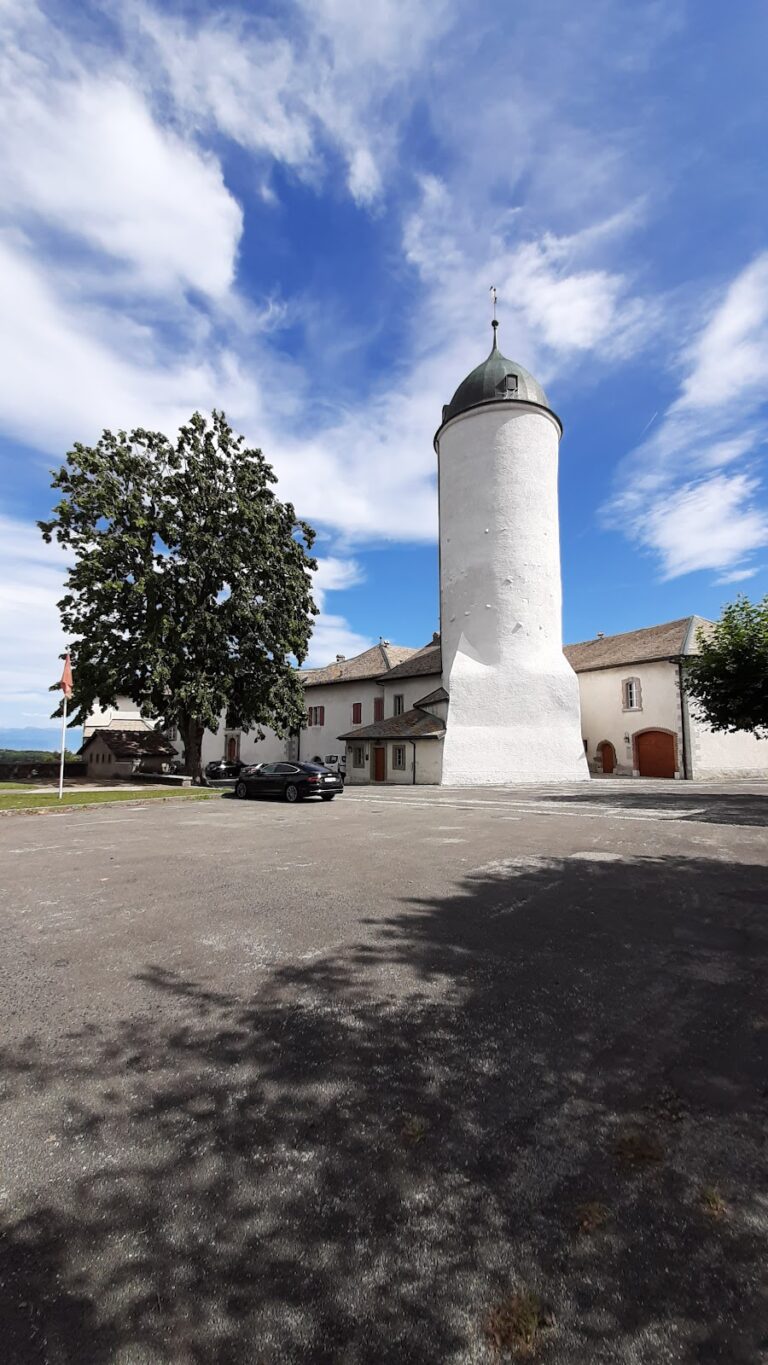
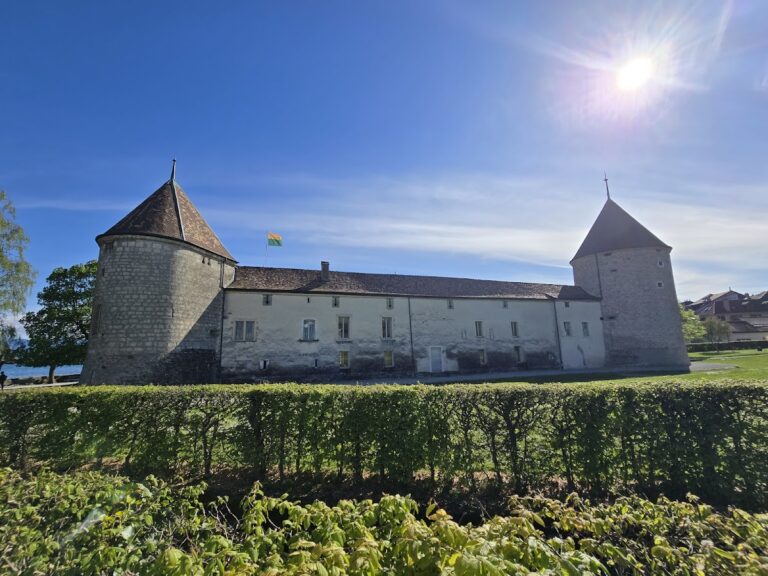
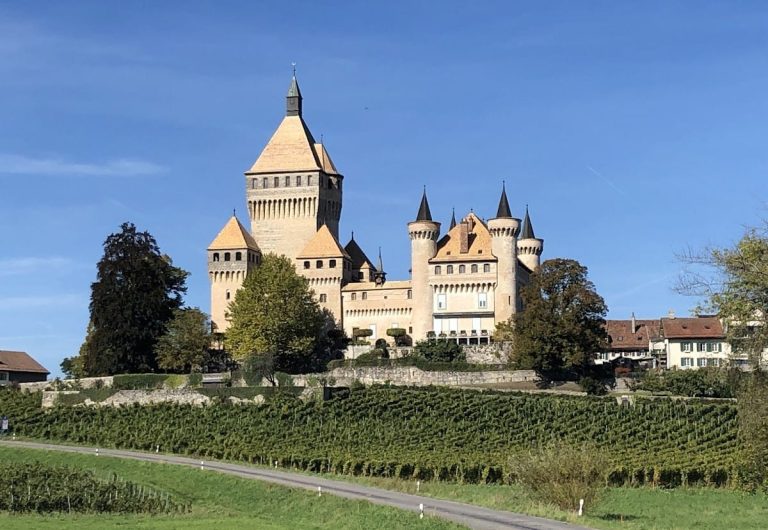
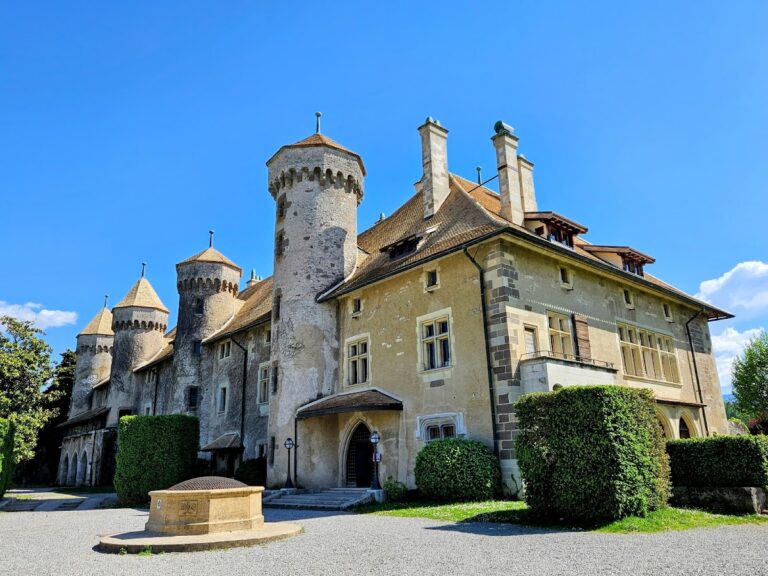
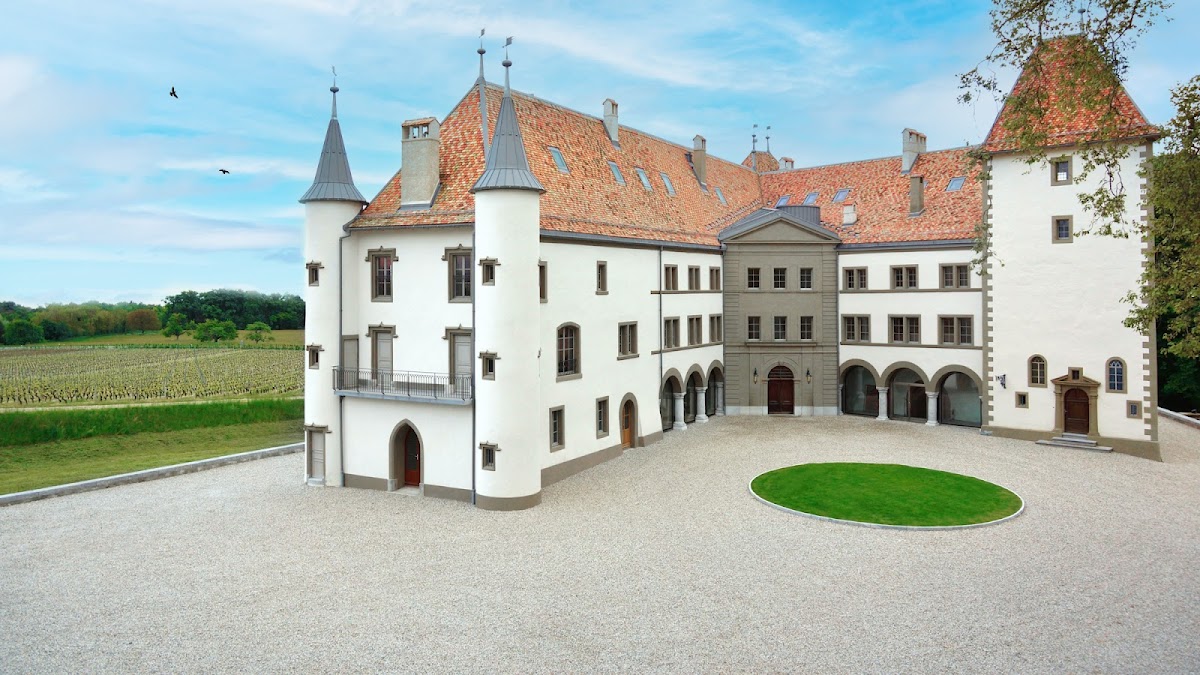
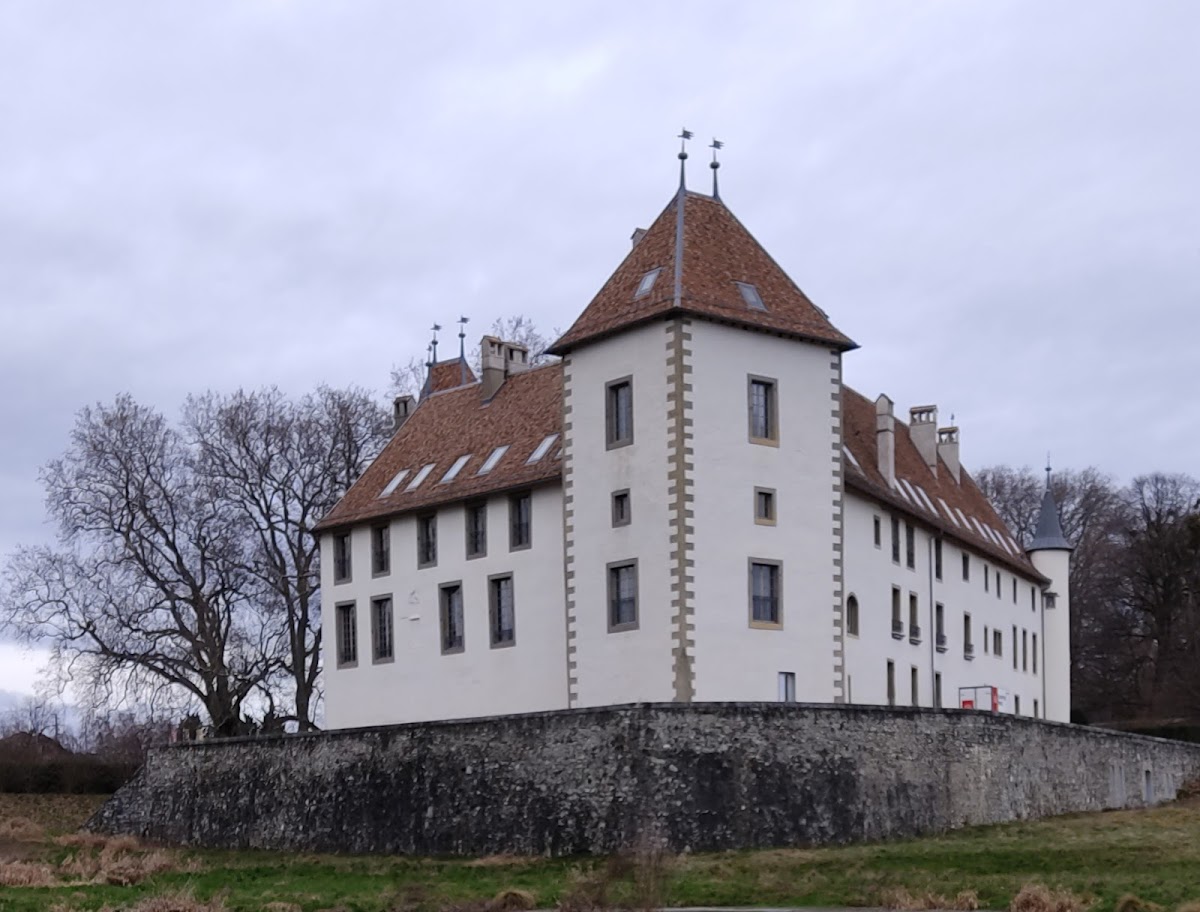
Allaman Castle stands on a terrace above the road between Geneva and Lausanne. A simple retaining wall marks its downhill side, while service buildings and a small park occupy the adjoining grounds. The present complex consists of two wings arranged around a courtyard. It developed from a fortified medieval residence whose moat, enclosing wall, and drawbridge disappeared during later rebuilding and enlargement. Repeated transformations make the medieval fabric difficult to distinguish within the surviving structure.
Castle buildings
Courtyard and façades
Baroque arcades supported by columns run along the courtyard side of the two-winged complex. Gaspard Sellon’s monumental courtyard façade, created around 1757, is crowned by a pediment, the framed upper element of a façade, and incorporates a representative entrance. The outer end of the eastern wing was remodeled around 1845 with Neo-Gothic details.
Interiors and attic
Several rooms retain substantial wood paneling and French wallpaper. The panels installed around 1790 are among the castle’s most valuable decorative elements. The interiors were substantially reshaped in the 1940s to evoke medieval castles, and the large attic was converted into residential units during the renovation completed between 2009 and 2015.
Park, canal, and estate landscape
The grounds include a small park, an English garden, and a pond. The historic Armary irrigation canal passes through the park and descends toward the vineyard. It formerly also powered the seigneurial mill of Allaman. Below the castle, the Chanivaz–Delta de l’Aubonne landscape extends toward Lake Geneva. The estate contains private forests, parks, gardens, and a 15-hectare vineyard producing wine under the Château d’Allaman label. Altogether, the estate covers more than 330,000 square meters, approximately 33 hectares, and includes about 6,200 square meters of living space.
Nearby sites