Fectio: A Roman Fort in the Rhine Delta of the Netherlands



Visitor Information
Google Rating: 4
Popularity: Very Low
Google Maps: View on Google Maps
Country: Netherlands
Civilization: Roman
Remains: Military

History
Roman Fort Fectio was established around 4 or 5 AD by the Roman Empire in the province of Germania Inferior. It was located near the meeting point of the Rhine and Vecht rivers, close to what is now Vechten in the municipality of Bunnik, Utrecht, Netherlands. The fort was founded under the orders of Tiberius during his military campaigns and likely served as a naval base and a launching point for raids beyond the Roman frontier.
Under Emperor Claudius, Fectio became part of the northern frontier defense system known as the Limes Germanicus. In 40 AD, Emperor Caligula visited the fort and owned vineyards nearby, indicating the area’s importance. Around 70 AD, the fort was destroyed during the Batavian Revolt, a major uprising against Roman rule. It was later rebuilt, this time serving as a cavalry base.
Throughout the first and second centuries, Fectio experienced several cycles of destruction and reconstruction. Initially built with wooden structures, the fort was eventually rebuilt in stone and brick during the reign of Antoninus Pius (138–161 AD). It housed auxiliary military units, including Cohors II Britannorum milliaria equitata, Cohors I Flavia Hispanorum equitata, and Ala I Thracum. The garrison size ranged from about 500 to possibly 1,000 soldiers.
By around 200 AD, sediment buildup in the Rhine river made the fort inaccessible by water, which was critical for its function. This environmental change led to the fort’s abandonment around 275 AD. After this, the site was never used again as a military installation.
Following its abandonment, materials from Fectio were repurposed in early medieval church construction in Utrecht. Archaeological excavations began in 1828, uncovering the fort and its surrounding civilian settlement, or vicus. Many artifacts were collected during the 19th century and later transferred to the Centraal Museum in Utrecht in 1995. In 2021, Fectio was recognized as part of the Lower Germanic Limes and inscribed on the UNESCO World Heritage List for its significance as one of the earliest and largest military sites in the Rhine delta.
Remains
The archaeological site of Fectio includes the remains of the fort, a port, a cemetery, and a civilian settlement covering about 10 hectares east of the fort. The fort evolved from wooden buildings to a stone and brick fortress by the early third century. Archaeologists have identified six wooden reconstructions and a seventh built from tuff stone, a volcanic rock commonly used by the Romans.
Excavations revealed a Roman road segment, a wooden bridge, and a palisade, which is a defensive fence made of wooden stakes. One of the earliest Roman ships found in the Netherlands was also uncovered at the site, highlighting its role as a river port. The soil’s low oxygen levels have preserved wooden and leather objects exceptionally well.
Numerous inscriptions and votive stones have been found, including dedications to the goddess Viradectis, a deity worshiped by the Tungri, a local tribe. An altar stone bearing the name “Fectio” confirms the fort’s identity. Tombstones of individuals such as Valens, son of Bititralis, and a woman named Salvia Fledimella provide personal insights into the people who lived there.
Artifacts include stamped pottery, amphoras from Rhodes and Baetica (regions known for wine and olive oil), and a wine barrel linked to Caligula’s vineyard. Military equipment such as helmets decorated with snakes and birds of prey, fibulae (brooches), perfume bottles, samian ware (fine Roman pottery) with graffiti, and writing tablets have also been recovered.
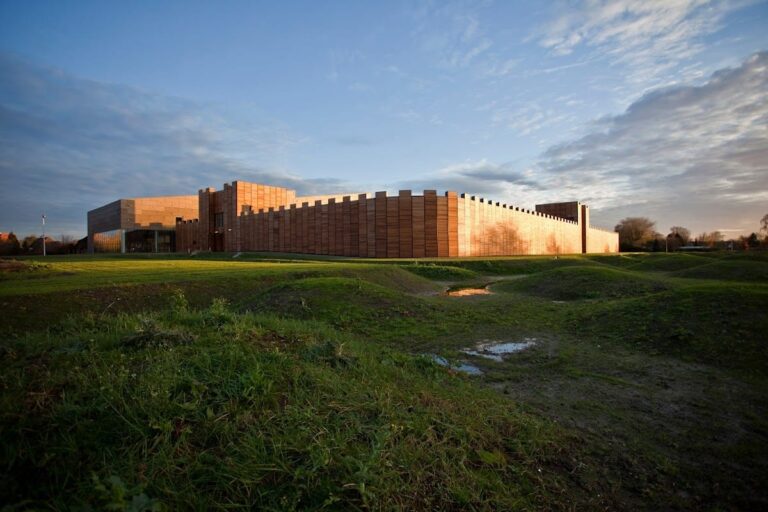
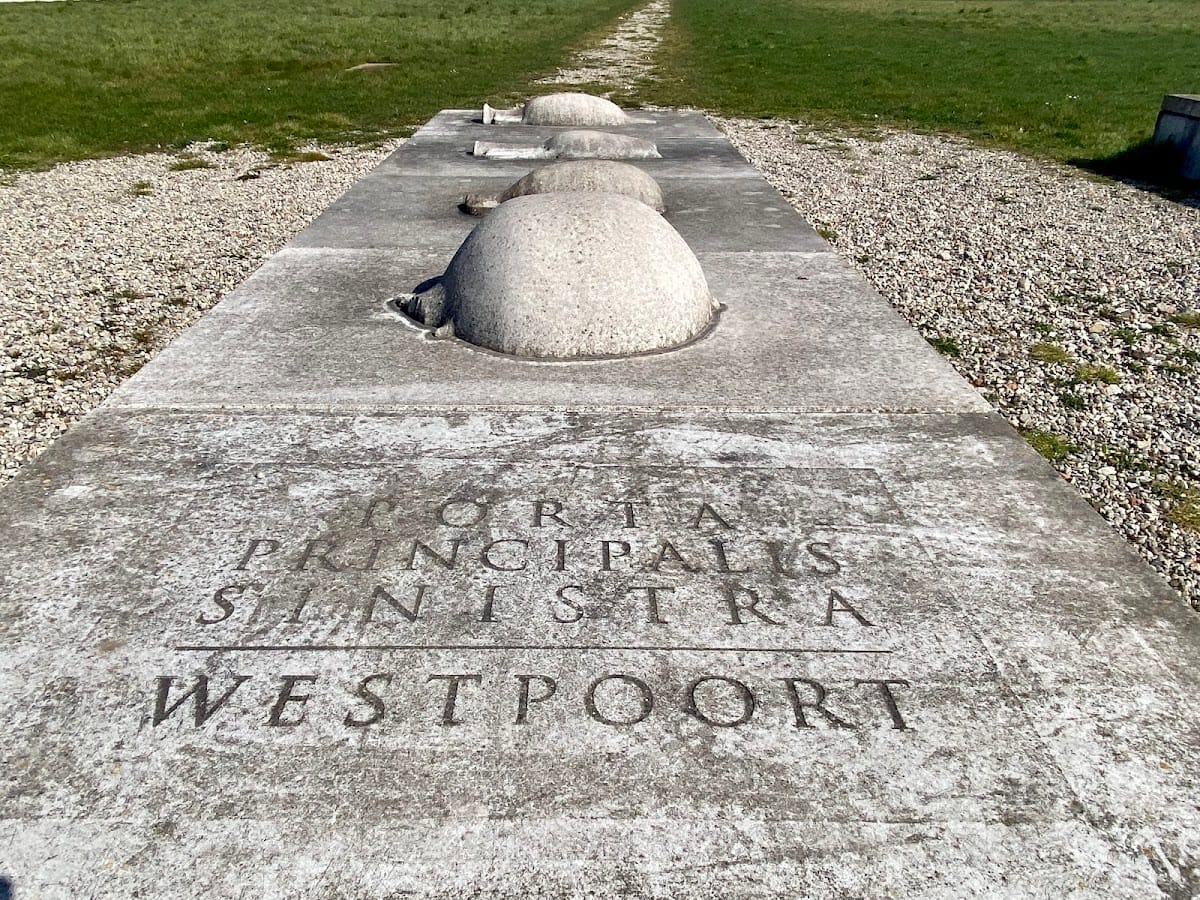
The fort’s strategic location controlled river access to the Frisian and Cananefatian territories, with the Rhine and Vecht rivers serving as transport and communication routes. Today, the site lies west of the 19th-century Fort bij Vechten, which covers the remains of the Roman vicus. A reconstructed Roman watchtower marks the area of the ancient military settlement. In 2016, a landscape artwork was created to outline the last fort’s contours, incorporating Roman texts, images, and artifacts.
Nearby sites