Rocca Malatestiana: A Medieval Fortress in Verucchio, Italy
Visitor Information
Google Rating: 4.5
Popularity: Medium
Google Maps: View on Google Maps
Official Website: www.atlantide.net
Country: Italy
Civilization: Medieval European
Remains: Military

History
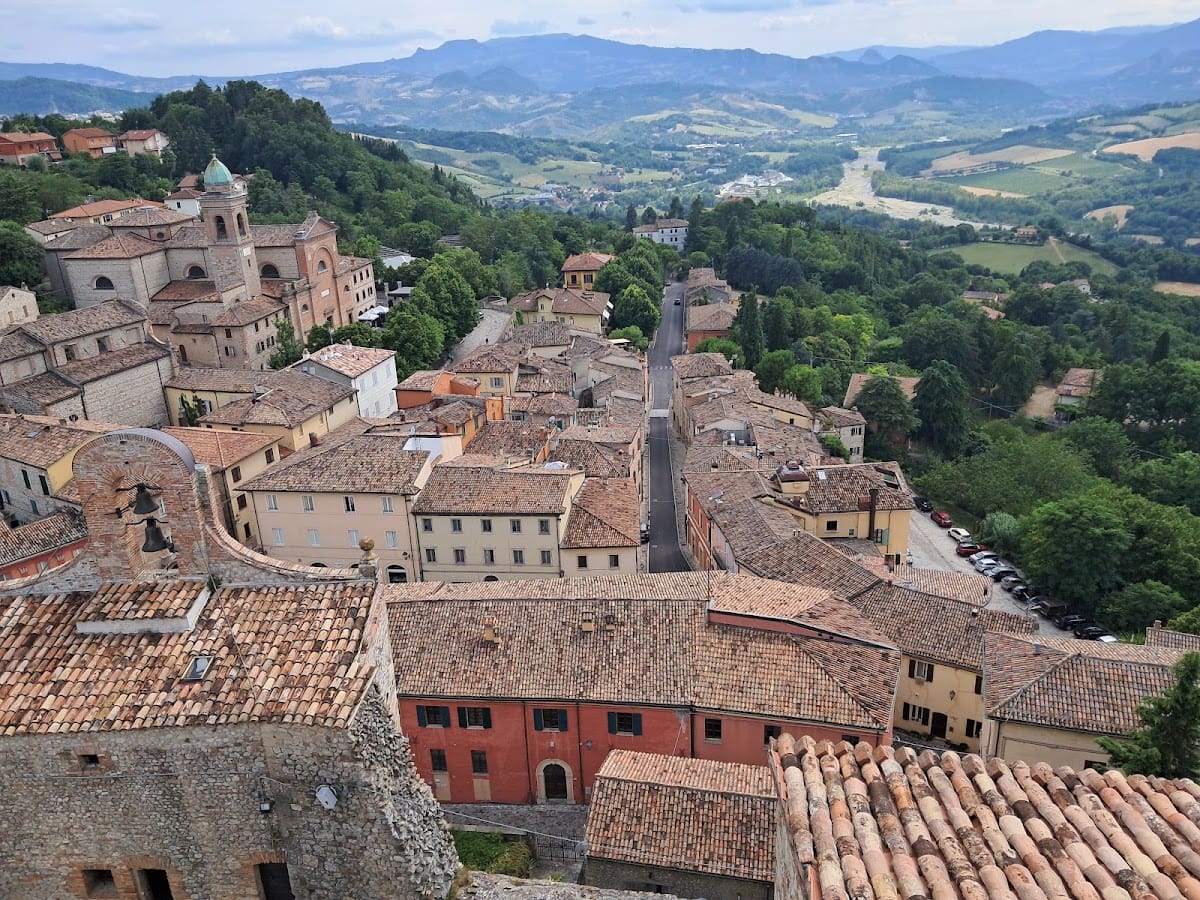
The Rocca Malatestiana is a medieval fortress perched on a rocky outcrop above the town of Verucchio in Italy. Its origins trace back to the early Middle Ages when the Holy Roman Empire exerted influence across the region. The fortress first appears in historical records in 962 AD, when Emperor Otto I granted the site to a noble named Ulderico, signifying its early military and strategic importance.
By the early 12th century, the hilltop site was identified as a fortified settlement, or castrum, with documentation from 1114 marking the presence of the Malatesta family, who would come to play a defining role in the area. Over the following three centuries, the Malatestas established the Rocca Malatestiana as their stronghold, governing the surrounding territory that included parts of the Romagna coast and the Marche region. Their rule provided a base for both political and military control.
The mid-14th century brought shifts in power when Pope Innocent IV appointed Cardinal Gil Álvarez Carrillo de Albornoz in 1353 to reclaim the Romagna region under papal control, which had weakened during the period of the Avignon Papacy. By 1355, Albornoz had defeated the Malatesta forces and restored papal authority. Despite this political change, the fortress remained under Malatesta administration, with Galeotto Malatesta taking on the role of papal vicar overseeing nearby cities such as Rimini, Fano, and Pesaro.
The early 15th century saw further conflicts and changes in control. After a defeat at the Battle of Zagonara in 1424, Carlo Malatesta temporarily lost the fortress to the Visconti family. Later, in 1462, Sigismondo Malatesta surrendered the fortress following an extended siege led by Federico da Montefeltro. This event marked the end of sustained Malatesta control over the Rocca Malatestiana.
In the early 16th century, the fortress underwent several ownership changes. Cesare Borgia took possession between 1501 and 1503, followed briefly by the Venetian Republic from 1503 to 1506. The site then reverted to the Papal States. In 1516, Pope Leo X granted the fortress as a fiefdom to Giovanni Maria Guideo di Domenico Alemanno, a German-born Jewish convert to Christianity. Along with the title, Alemanno was given the prestigious Medici family coat of arms and name. A few years later, on March 21, 1518, the settlement of Verucchio was officially granted city rights by the pope.
Malatesta da Verucchio, the founder of the Malatesta family, was traditionally born at this location, adding a personal historical significance to the fortress. Over time, especially during the 16th century under the Medici-affiliated lords, the fortress was adapted from a primarily military stronghold to include residential features.
Remains
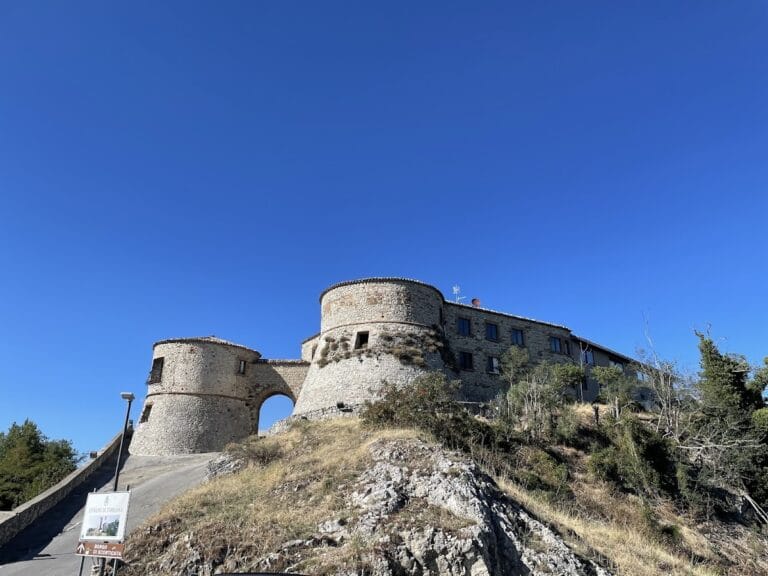
The Rocca Malatestiana complex stretches across the highest section of the “Sasso,” the rocky promontory overlooking Verucchio. Its construction spans from the 12th to the 16th centuries and reflects a combination of early medieval military architecture and later modifications for residential use. The fortress’s lower walls consist of carefully worked stone blocks carved to fit together precisely, creating strong foundational defenses that supported further building phases.
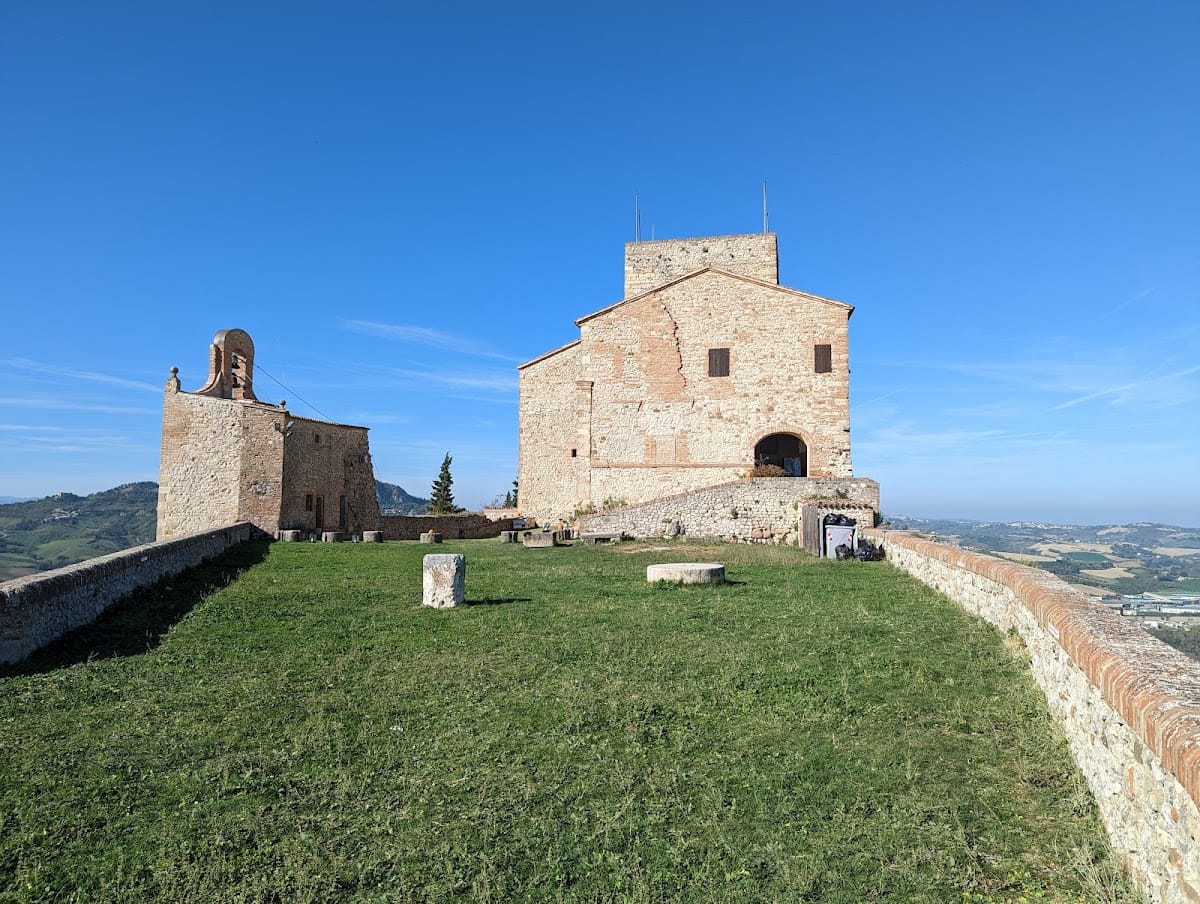
At the heart of the fortress lies its oldest element: a solitary tower situated within a modest courtyard. This space uniquely houses the genealogical tree of the Malatesta family, symbolizing the family’s longstanding attachment to the site. The fortress layout includes two main courtyards that open into rooms formerly part of the Baronial Palace, which itself underwent renovations and expansions over several centuries.
The main keep, known as the Torre Mastio, stands as a prominent feature within the complex. Alongside this, a large round tower called Santa Trinità has been documented, both serving as defensive watchpoints. Additional structures include a bell tower and fortified walls surrounding the site, underscoring the fortress’s role as a defensive bastion strategically placed atop an Apennine outcrop.
Throughout its long history, later buildings were appended to the initial stonework, reflecting the shift from purely military use to more comfortable and residential purposes during the Renaissance. The fortress today remains a mixture of original medieval masonry and layers of later architectural interventions, with much of the stonework preserved in situ. This layered construction offers a tangible narrative of the fortress’s evolution across centuries of warfare, political change, and administrative use.
Nearby sites