Rocca di Monfalcone: A Historic Fortress in Italy




Visitor Information
Google Rating: 4.4
Popularity: Low
Google Maps: View on Google Maps
Official Website: www.turismofvg.it
Country: Italy
Civilization: Unclassified
Remains: Military

History
The Rocca di Monfalcone is a fortress situated on a hill near the town of Monfalcone within modern-day Italy. It was originally established by the Ostrogoths under the rule of Theoderic the Great around the year 490 AD. This construction followed Theoderic’s victory over Odoacer, king of the Heruli, near the Isonzo River, marking the fortress as an important symbol of Ostrogothic power in the region.
Long before the fortress itself was built, the hill had already been the site of a prehistoric fortified settlement, known as a castelliere. The original name connected to the site was “Verruca Montis Falconis,” which in time was shortened simply to “Rocca.” By the late 10th century, in 967 AD, Monfalcone and its fortress were granted by Emperor Otto I to the Patriarchate of Aquileia, signaling the site’s integration into religious and political structures of the era.
The fortress enters the historical record in 1289, a period marked by conflict between the Republic of Venice and regional feudal powers such as the County of Gorizia and the Duchy of Carinthia. Control of the Rocca shifted in 1409 when it came under the County of Gorizia, specifically under Count Heinrich of Ortenburg. However, Venetian forces conquered it in 1420, and the fortress became part of Venice’s defensive network.
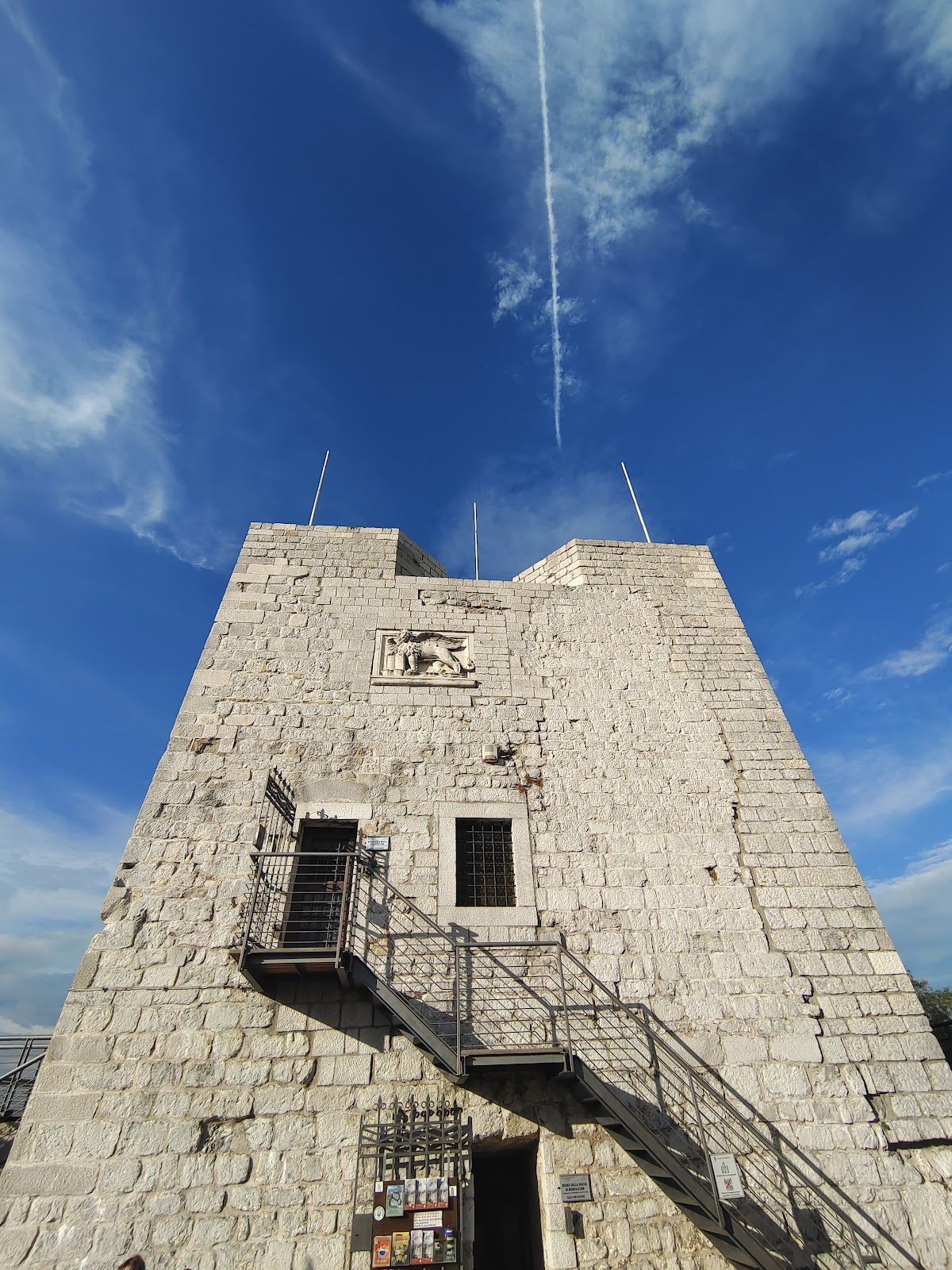
During the 15th century, the Venetians undertook several major renovations. They repaired existing walls and added battlements in four key campaigns between 1431 and 1462. Despite these reinforcements, the fortress was subjected to multiple Turkish assaults. It was briefly seized in 1514 by mercenaries from the League of Cambrai, who killed the garrison stationed there. Nevertheless, Venetian authority was restored in 1525, an event commemorated by a carved stone plaque above the tower’s entrance.
Under the Venetian governor Giovanni Diedo, extensive remodeling took place during the early 1500s to prepare the fortress for modern warfare involving firearms. This included building a central, square-based tower designed to store gunpowder safely. By the end of the 16th century, the Rocca’s importance as a frontline defense diminished with the rise of the Palmanova fortress. It was repurposed primarily as a lookout on Venice’s eastern boundaries, although it experienced further hostilities such as a looting by Uskoks in 1615.
Venetian military presence remained at the Rocca until the Republic of Venice fell to Napoleon’s forces in 1797. Following this political upheaval, the fortress was largely abandoned and suffered damage during World War I. In the mid-20th century, between 1950 and 1955, restoration efforts were carried out to conserve the remaining structure. Since 1968, the local speleological group known as the Gruppo Speleologico Monfalconese “Amici del Fante” has managed the site, establishing a museum focused on paleontology initially and later dedicated to speleology.
Remains
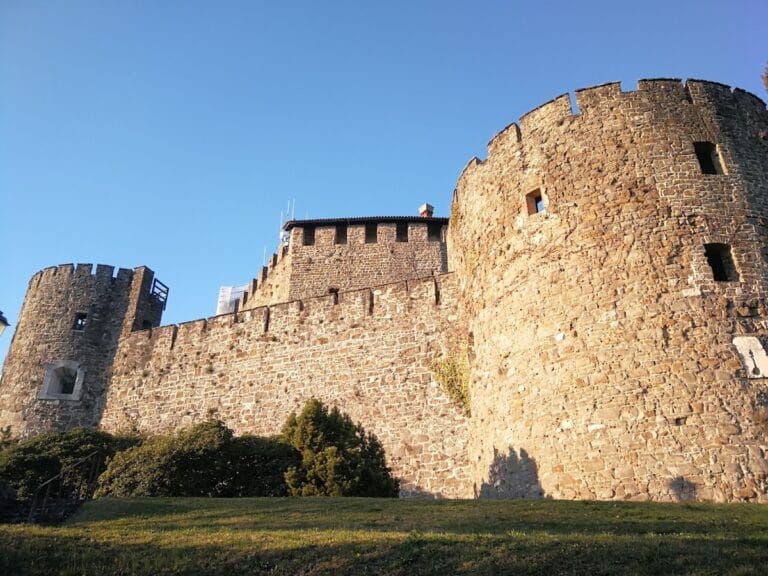
The Rocca di Monfalcone occupies a prominent hilltop location, blending its late antique fortress remains with earlier prehistoric fortifications. Excavations reveal visible sections of the earlier castelliere, a type of prehistoric hillfort, which forms part of the underlying defensive landscape supporting the later medieval and Renaissance structures.
At the heart of the fortress stands a central tower, rebuilt in the early 16th century with a square base designed specifically for storing gunpowder. This tower was constructed entirely of stone from its foundations upwards and forms a significant feature of the renewed fortress architecture adapted for the introduction of firearms. Above the entrance of this tower is a carved stone plaque dating from 1525, marking the restoration of Venetian control after the fortress’s recapture from hostile forces.
The enceinte, or outer defensive walls, were repaired and fortified during the 15th century under Venetian administration. These renovations included the addition of battlements—parapet walls with regular openings used for defense—which enhanced the fortress’s capacity to resist assaults. The existing masonry seen today owes much to the restorations made in the mid-20th century, which aimed to consolidate and conserve the aging walls.
Though the fortress’s military significance waned by the late 1500s, it continued to serve as a border watchpost. The visible remains reflect this transition from a frontline defensive bastion to an observation and signaling point on Venice’s eastern frontier. Today, the site houses a permanent speleological exhibition managed by the local speleology group who also operate related museum facilities within the nearby town. The exhibition and conservation efforts underscore the fortress’s layered historical importance—from its prehistoric origins to its role in the military and cultural heritage of the region.
Nearby sites