National Archaeological Museum of Aquileia: Roman History in Italy



Site at a Glance
- Rating
- 4.7
- Popularity
- Medium
- Country
- Italy
- Primary era
- Classical
- External website
- Open
- Eras represented
- Classical
- Civilizations
- Roman
- Site type
- Museum
On this page14 sections
History
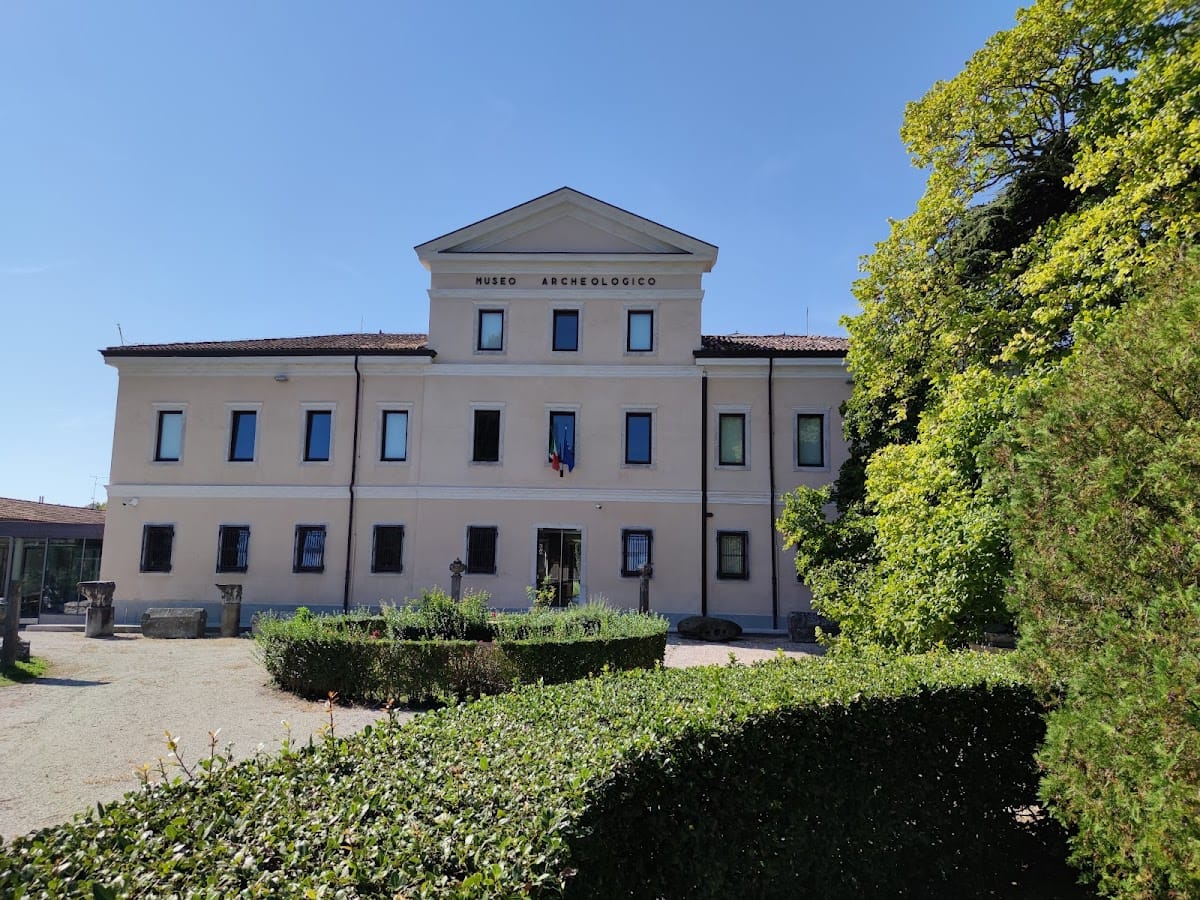
The National Archaeological Museum of Aquileia is an archaeological museum in Aquileia, Italy, housed in Villa Cassis Faraone and devoted to the Roman city’s history. It was inaugurated on 3 August 1882 as the Imperial-Royal State Museum of the Habsburg state, in the presence of Archduke Karl Ludwig of Austria. Its collections mainly span the second century BC to the fifth century AD, covering about seven centuries of Aquileia’s Roman history.
From private collection to public museum
The museum grew from the eighteenth-century collection of Gian Domenico Bertoli, a canon and antiquarian. A first public museum, the Eugenian Museum, opened in 1807 in the baptistery opposite the Basilica of Aquileia. Bertoli’s collection was acquired in 1879, while further archaeological material was recovered from the Moschettini house and transferred to the developing institution.
Enrico Maionica, the first director, shaped the museum as a central institution for finds recovered in excavations at Aquileia. His aim was to acquire and display archaeological material so that it would not be dispersed. Giovanni Battista Brusin became director in 1922 and remained in charge until the second postwar period. Luisa Bertacchi was among the museum’s other historical directors.
Aquileia as a Roman colony
Aquileia was founded as a Latin colony in 181 BC by decision of the Roman Senate, in a region already shaped by protohistoric settlement. Protohistoric communities are known partly through archaeology and partly through limited early written evidence. The foundation formed part of Rome’s expansion toward northern Italy, the Alps, and the Balkans, and was associated with the magistrates Publius Cornelius Scipio Nasica, Gaius Flaminius, and Lucius Manlius Acidinus Fulvianus.
From its foundation, the city possessed a regular urban plan and defensive walls. Its position beside the ancient Natissa River influenced the settlement’s development. The forum, Aquileia’s principal square and its oldest major urban complex, was already organized by the middle of the second century BC. Between the late first century BC and the early decades of the first century AD, it acquired the monumental form whose remains can still be traced.
Aquileia’s public monuments provided the setting for political, economic, religious, and institutional life. Their construction was planned from the colony’s foundation through impulses from Rome’s central government and through the participation of civic authorities and private citizens. The museum presents inscriptions, architectural fragments, reliefs, and sculptures from these public spaces, including the forum, port, circus, and theatre.
Port, society, and religion
Aquileia linked the Mediterranean with the Danubian and Rhine regions. Its port at the northern end of the Adriatic redistributed raw materials, foodstuffs, and manufactured goods, helping the city develop as an economic, cultural, and military center. Intensive olive and wine production characterized the surrounding agriculture, while local industries made bricks, roof tiles, ceramics, lamps, glass, metalwork, marble sculpture, and objects from Aurisina marble and limestone.
The city’s commercial connections contributed to a multiethnic population and a varied religious life. Roman deities were worshipped alongside cults and religions associated with Isis, Serapis, Mithras, Belenus, Cybele, and Attis, as well as Judaism and Christianity. Isis and Serapis were Egyptian deities adopted into the Greco-Roman religious world, Mithras was associated with a mystery cult widespread in the Roman Empire, and Belenus was a Celtic deity.
Aquileia’s necropolises stood outside the city walls along the principal approach roads. Funerary monuments, statues, reliefs, architectural structures, and inscriptions displayed the social standing of the deceased’s family. Cremation remained in use until the second century AD, represented in the museum by urns made from several materials. The museum’s wider evidence brings together inscriptions and objects connected with commercial, military, religious, domestic, funerary, and manufacturing activity.
War, administration, and modern development
The museum presents the siege of Aquileia by Maximinus Thrax in AD 238 through an altar bearing a relief of Rome and Aquileia. After the First World War, the institution passed from Austrian to Italian state administration. It was reorganized in 1954 and 1955, and redevelopment of its exhibition spaces, storage areas, and lapidary galleries began in 2016. A major modernization of the interior exhibition was undertaken from 2017, reshaping the way the archaeological material is presented.
Remains
The museum occupies Villa Cassis Faraone, a classical villa built between 1812 and 1825. Its displays extend across three floors and twelve rooms, while the garden contains interconnected arcades and external lapidary galleries. A lapidary gallery is a display area for stone monuments such as inscriptions, architectural fragments, funerary monuments, and sculpture. The ground floor introduces Aquileia and its territory, archaeological research, the museum’s history, public monuments, and funerary archaeology. Domestic life, trade, cultural connections, and production occupy the first floor, while luxury objects are displayed on the second.
Garden galleries and stone collections
The arcades around the villa garden were built in 1898 to house numerous stone remains and monuments. They were enlarged between 1940 and 1950 into a four-sided portico. The garden lapidary arranges mosaics, urns, tomb monuments, inscriptions, and architectural ornaments by type and chronology. The museum’s stone collections include statues, portrait busts, inscriptions, reliefs, funerary monuments, architectural elements, and mosaics. Fragments come particularly from the forum, funerary monuments, and public buildings, while some mosaics are set into the gallery floors.
Foundation and public monuments
The first exhibition room presents finds connected with Aquileia’s foundation and geographical setting. A marble relief of the sulcus primigenius, the ritual furrow drawn to mark the boundary of a newly founded Roman settlement, depicts the city’s foundation ceremony. A large map shows the Roman urban plan, defensive walls, and the ancient Natissa River along the eastern and southern sides of the settlement.
The public-monument displays bring together inscriptions, architectural fragments, reliefs, and sculptures associated with the forum, port, circus, and theatre. Marble medallions represent deities of the Roman pantheon, the group of gods worshipped in Roman religious tradition, including Vulcan, Mercury, Jupiter, Mars, Minerva, and Roma. Reliefs of Jupiter Ammon and Medusa, originally placed on the attic above the forum porticoes, are also displayed. Their imagery presented the eastern and western parts of the Roman Empire as united and pacified under Augustus.
Funerary monuments and portraits
The funerary section contains cremation urns made of stone, glass, ceramic, lead, and alabaster, together with stelae, sculptural groups, inscriptions, and other funerary material. The over-life-size marble statue known as the Navarch was discovered at Cavenzano, several kilometres from Aquileia. It portrays a deceased man in heroic nudity and belonged to a large funerary monument that also included a ship’s prow. His cuirass and sword support an interpretation of the figure as an important admiral.
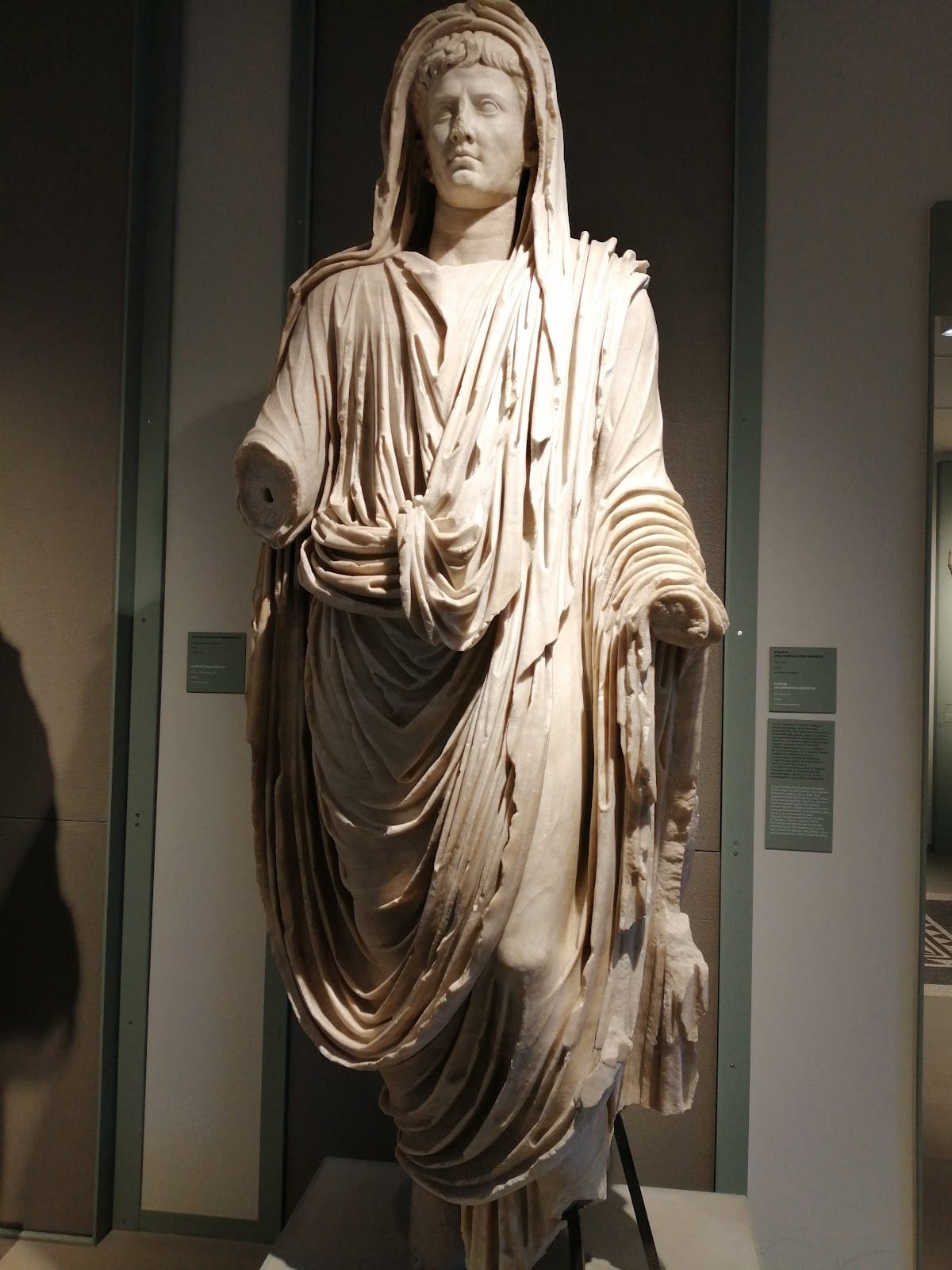
The staircase portrait gallery contains marble and local-stone heads that once formed parts of busts or full-length statues. Their original settings included urban spaces, funerary monuments, and houses belonging to middle- and upper-class families. One representative head depicts an elderly man carved in local limestone during the first century BC, in the realistic manner especially associated with Republican-period portraiture.
Domestic life
The domestic-life section includes three floor mosaics from the district between the forum and river port. One shows a Nereid riding a sea bull, another represents the Asaroton oikos, or “unswept floor,” and a third depicts a bow with vine tendrils. Their designs follow models from the Greek East and demonstrate the high level of local craftsmanship.
Other domestic exhibits include a marble statue of Venus and a glass-and-shell mosaic from a villa excavated south of Aquileia. Furnishings and wall decoration accompany objects used for banqueting, lighting, cooking, and food storage. Kitchen equipment includes pots, casseroles, dishes, containers, chopping boards, and knives made from ceramic, glass, stone, and metal. Ceramic and metal lamps represent the methods used to illuminate domestic interiors.
Trade, performance, and military life
The trade section presents maritime and overland routes that connected Aquileia with the Mediterranean and distant regions of the Roman Empire. A reconstructed ship’s hold contains amphorae from different Mediterranean areas, African and eastern tableware, glass objects, amber, partly worked gemstones, colored marbles, and antiquities from Greece and Egypt.
The funerary stele of Bassilla, a Greek mima or performer in the ancient mime tradition, combines her portrait with a Greek inscription in hexameters. The poem was composed by the head of the acting troupe with which she worked and records that she died while touring at Aquileia.
Objects associated with the city’s military function include footwear, helmets, military equipment, weapons, and ammunition. A funerary stele of a blacksmith shows a seated smith working at an anvil with a hammer and tongs. An assistant appears to operate bellows beside the forge, while pincers, a hammer, a file, and a lock represent the workshop’s tools.
Production and craft
The productive-activities section contains a wooden barrel lid, wine amphorae, funerary reliefs showing occupations, locally made ceramics and lamps, and brick products bearing manufacturers’ stamps. A warning scratched into a still-wet brick reads, in translation, “Watch out! If you have not smoothed 600 bricks, you will be in trouble!” Whether the inscription was a joke or a threat remains uncertain.
The glass collection follows changing production methods, from forming vessels over a mould to free blowing and mould blowing. Local glassworkers also used waste and fragments recycled from earlier manufacture. Unfinished marble pieces demonstrate the presence of sculpture workshops at Aquileia. One marble male torso retains projecting supports that were probably used to move the unfinished statue from Greece.
Luxury objects and long-distance materials
The second-floor luxury displays include personal-care accessories such as mirrors, strigils, containers for oils and perfumes, and other toilet articles. A strigil was a curved tool used to scrape oil, sweat, and dirt from the skin. The numismatic collection contains gold, silver, and bronze coins dating from the fourth century BC to the sixth century AD.
Jewelry from the archaeological area includes gold necklaces, chains, pendants, bracelets, earrings, and rings, along with silver and bronze bracelets, glass rings and necklaces, and ornaments decorated with gemstones, emeralds, colored glass, or engraved designs. These objects represent personal adornment among different levels of Aquileian society.
Amber objects from Aquileia are particularly numerous and finely made. Amber reached the city from northern Europe through long-distance exchange networks and was worked in Aquileian workshops into varied forms. The Roman gems were made from hard stones imported by sea from the East or obtained from European deposits, then carved locally and redistributed to markets across the empire.
A first-century AD gem depicts Eros and Psyche carved on an oval nicolo, a layered gemstone material with a thin upper surface over a darker base. The nude, winged Eros embraces Psyche, who wears a long tunic and has butterfly wings. Their myth describes the god of love and Psyche enduring separation and trials before their union is restored.
Funerary monuments and mosaics in the garden
The external galleries present funerary monuments in typological and chronological order, from stelae and urns to reconstructions of large tombs. One reconstruction is the Curri family monument, an aedicule-shaped structure with a pyramidal roof sheltering a statue. An aedicule is a small architectural frame or shrine-like structure.
The garden displays mosaics from Aquileian houses and the fourth-century Great Baths complex. They include a sea monster on a chariot, a panel showing a triton and a Nereid identified as Klumene, and three octagonally framed portrait medallions probably depicting athletes. The last medallion may represent a priest. Renovation and redevelopment have also affected the external storage areas, lapidary galleries, and garden as the museum reorganizes and modernizes its exhibition and storage environments.