Qirqbize: An Early Christian Settlement in Northwestern Syria


Visitor Information
Google Rating: 4.4
Popularity: Very Low
Google Maps: View on Google Maps
Country: Syria
Civilization: Byzantine, Roman
Remains: City

History
Qirqbize is situated in northwestern Syria near the Turkish border, within the Jebel il-Ala limestone massif at about 700 meters elevation. This settlement lies in the region known as the Dead Cities, an area notable for its early Byzantine ruins. The site was established during Roman times and remained inhabited until at least the 7th century CE.
The earliest phase of Qirqbize dates back to the 2nd century CE, when it consisted primarily of residential buildings. During the early 4th century, one of these houses was transformed into a Christian worship space, marking the site’s importance in early Christian history. This house church is among the oldest preserved examples, second only to the church at Dura Europos, reflecting the spread of Christianity in the region.
Throughout the Byzantine period, Qirqbize developed as a modest rural community. The house church underwent architectural changes, evolving from a simple domestic space into a hall church form. This transformation influenced later church designs in the area, particularly the multi-aisled basilicas. The settlement maintained its Christian character until the 7th century, after which it appears to have been abandoned or significantly reduced in occupation.
In modern times, the area around Qirqbize is inhabited mainly by Druze communities. These residents engage in agriculture and sheep herding, adapting to the less fertile terrain surrounding the ancient ruins.
Remains
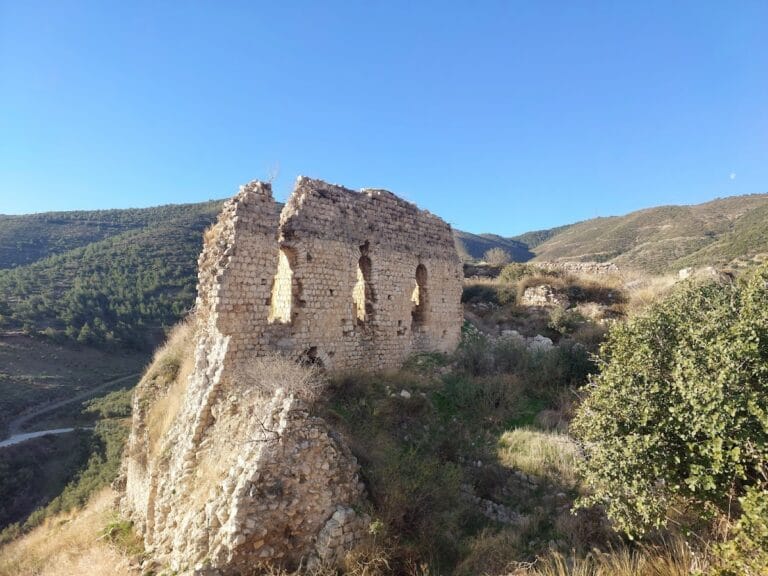
Qirqbize consists of a small cluster of simple houses built from large, carefully cut limestone blocks. Some structures survive up to two stories and retain their gable ends. The settlement is spread over gently sloping rocky ground, interspersed with olive groves separated by dry stone walls. The site covers roughly 120 by 100 meters and is divided into three neighborhoods.
The most significant building is the early Christian house church, originally a two-room rectangular house measuring about 15 by 7.5 meters. The rooms were connected by an internal door and accessed from the southern side. A wooden-beamed pitched roof, shaped like a Greek temple roof, covered the church. Windows were rectangular, and the building lacked a roof cornice.
Inside the church, an altar podium was installed in the eastern room, later enhanced by a triumphal arch resembling an apse. West of the center stood a bema platform with seating for fourteen clergy members, indicating a clear spatial division between clergy and congregation during services. The church had two entrances on the south wall, with all other sides enclosed.
In a later phase, a column-supported portico was added along the southern facade. Four capitals from this portico survive and date to the late 5th or 6th century. Near the altar, a stone sarcophagus containing a relic was placed. Pilgrims poured olive oil over this relic, collecting the oil in small clay containers called ampullae as holy souvenirs. This practice connected the church’s religious rituals to the local olive cultivation economy.
Beyond the church, the site includes 23 villas with courtyards, ten olive presses, and a rock-cut water reservoir. These features reflect a community with some wealth and social standing, sustained by agriculture and olive oil production.