Penteskoufi Castle: A Medieval Fortress in Corinth, Greece



Visitor Information
Google Rating: 4.7
Popularity: Very Low
Google Maps: View on Google Maps
Country: Greece
Civilization: Unclassified
Remains: Military

History
Penteskoufi Castle is a medieval fortress situated within the municipality of Corinth, Greece. It was constructed by Frankish rulers following their capture of Corinth in the early 13th century.
The castle’s origins are linked to the period shortly after the Frankish conquest led by Otto de la Roche. It was likely built under the direction of Jakob II of Avesnes to support military operations against the Byzantine forces still holding the nearby Acrocorinth fortress. Notably, the castle helped contain the activities of Leon Sgouros, a Byzantine ruler who had taken refuge in Acrocorinth and launched attacks outward. The castle is believed to correspond to the fortress called Montesquieue or Mont Escouvé in the medieval Chronicle of Morea. Its current name, Penteskoufi, appears to have evolved as a local corruption of the original Mont Escouvé.
The fortress played a strategic part during the siege of Acrocorinth, which lasted about two years and ended in 1208 with the death of Leon Sgouros. Following the fall of Acrocorinth to the Franks, Penteskoufi Castle gradually lost its importance and was eventually abandoned.
Centuries later, during the period of Venetian control over the region between 1687 and 1715, the castle was restored to act as a secondary fortification supporting Acrocorinth. This revitalization indicates the continuing military value of the site under Venetian administration.
In the early 19th century, during the Greek War of Independence, Penteskoufi Castle witnessed renewed military activity. Greek forces seized the fortress in March 1821, and Ottoman troops were compelled to retreat from the site by January 1822, marking the castle’s involvement in the struggle for Greek liberation.
Beyond its military history, the area near the castle became notable archaeologically in 1879 when a farmer uncovered numerous small votive tablets approximately 900 meters northwest of the fort. Subsequent archaeological investigations, first by Arthur Milchhoefer in 1880 and later by researchers from the American School of Classical Studies at Athens in 1905, revealed about 1,500 fragments of the renowned Pinakes of Penteskouphia, offering rich cultural insights into the region.
Remains
Penteskoufi Castle occupies the summit of Kastraki hill, rising 476 meters above sea level and located roughly 1.25 kilometers southwest from the main entrance of Acrocorinth. The fortress covers an area of about 500 square meters, measuring approximately 17 meters across from west to east and 35 meters along the north-south axis.
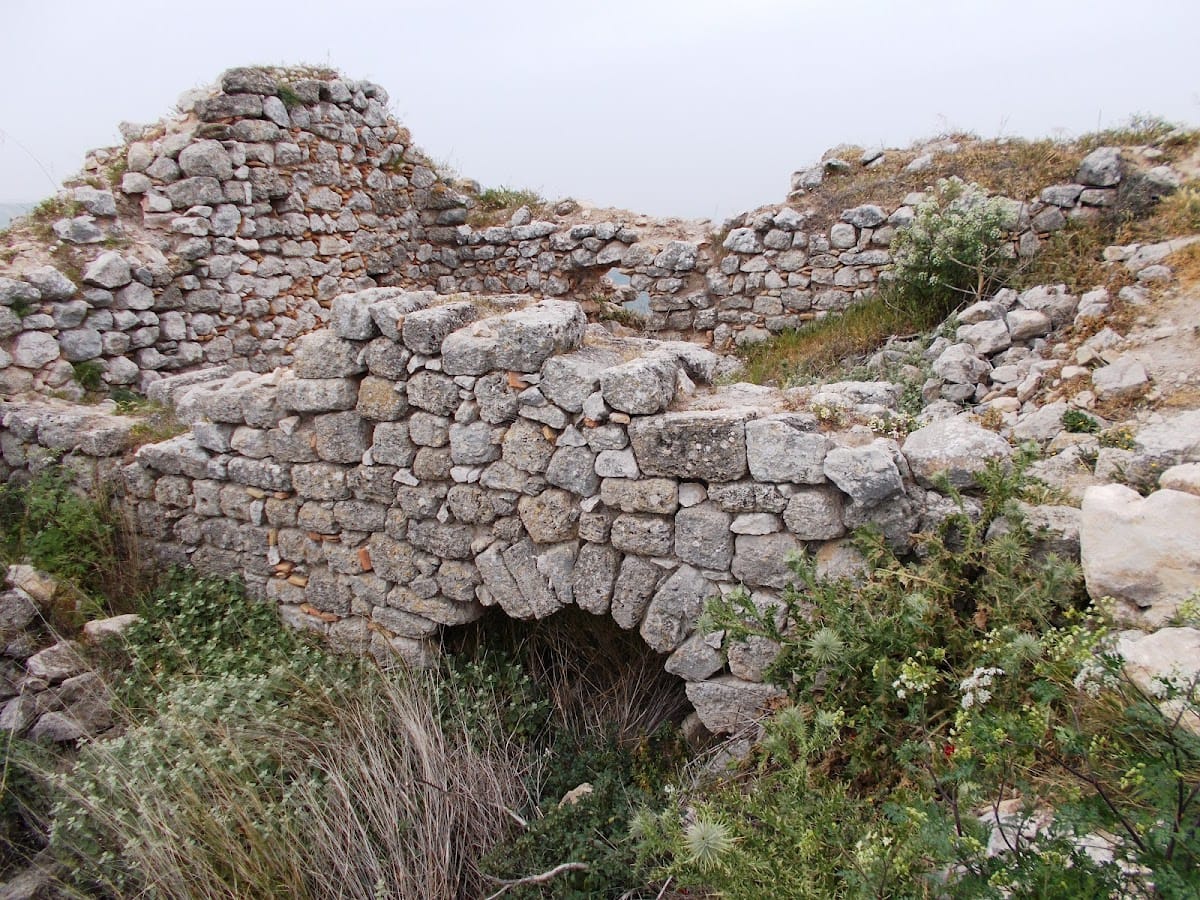
The castle’s perimeter is defined by an outer wall constructed with thickness varying between two and 2.5 meters. This robust wall includes six narrow vertical slits, known as arrow slits, which date from a later stage of the castle’s use. These openings would have allowed defenders to shoot arrows or firearms while remaining protected.
A prominent feature on the northern edge of the castle is a tower whose footprint measures nearly 10.5 by 9.5 meters. When originally built, this tower was composed of a single large ground-floor room. Later modifications divided this space into two chambers of roughly equal size by installing a wall made of porphyry, a type of hard, purple-hued volcanic stone.
Entry into the tower was through a door on its southern side, while the main gate into the entire castle lay just east of the tower. This entrance arrangement shows that the tower likely played a central role in defense and controlling access.
Construction techniques reveal two distinct building phases. The first phase employed roughly shaped blocks of limestone fitted together with gaps filled by clay bricks, a method typical of Frankish medieval architecture in the region. In a subsequent period, probably during Venetian or possibly Ottoman rule, renovations introduced more precisely cut porphyry stones, especially evident in the tower’s subdivision wall and other strengthened structures.
Today, the remains of the castle’s thick enclosing walls, the northern tower, and the arrow slits still stand noticeably on the hilltop. These surviving elements illustrate the fortress’s defensive purpose and its adaptations over centuries of use and re-use.