Montozzi Castle: A Historic Estate in Laterina Pergine Valdarno, Italy


Visitor Information
Google Rating: 4.7
Popularity: Low
Google Maps: View on Google Maps
Official Website: www.castellodimontozzi.it
Country: Italy
Civilization: Unclassified
Remains: Military

History
Montozzi Castle is situated in the municipality of Laterina Pergine Valdarno, Italy. The site has its origins linked to the Bulgari fortified settlement founded in the 6th century by the Bulgar people, who were allies of the Lombards. The earliest recorded ownership connects the castle area with the Sassi family, named after Teuzzo di Ildebrando dei Sassi, the lord of Bulgari, from whom the name “Mons Teuzi” is derived.
From 1186, control of the castle shifted to the Ubertini family of Arezzo, who were closely related to ecclesiastical authority in the region. They established a new fortification on the summit of the Bulgari hill to oversee the valleys below. This castle is referenced in a documented agreement from 1221 involving the Ubertini and the prominent Guidi family. However, military struggles marked its early history as Florentine forces besieged it in 1303, leading to its destruction. After the Ubertini rebelled against Bishop Guido Tarlati of Arezzo, Florentine armies again destroyed the fortress in 1326. Despite this, the Ubertini reconstructed the castle before Bishop Buso degli Ubertini submitted to Florence in 1335, transferring control of the Valdambra territory, including Montozzi, to the Florentines.
By 1385, Azzo di Franceschino degli Ubertini formally surrendered Montozzi to Florence, which incorporated it into the podesteria, or administrative district, of Valdambra. A rebellion in 1399 saw the Florentine Guelphs recapture the castle. Following this reconquest, Montozzi’s military importance waned, and its defensive walls and keep fell into disuse and eventual neglect.
During the 16th century, the Bartolini Baldelli family began acquiring land and properties in Montozzi, progressively expanding their holdings throughout the following century. By 1660, brothers Francesco and Ottavio Bartolini Baldelli constructed a palace that integrated the remaining ruins of the castle and reoriented the village as the central estate. Francesco Maria Bartolini Baldelli (1646–1711) further embellished the palace with artistic decorations and commissioned the construction of a new church dedicated to Saints Martino and Lucia. This new church replaced the earlier extra-urban church of San Martino di Tours, and the family kept ecclesiastical patronage rights granted by Cosimo III, a notable Medici ruler.
In the 19th century, Bartolomeo Bartolini Baldelli (1804–1868) undertook detailed surveys of the estate and enhanced its grounds by commissioning a romantic English-style park known as “la Bandita.” He also built a chapel for the local cemetery in 1866, replacing an older Romanesque structure. Later, Luigi Bartolini Baldelli (1854–1906) completed additional estate buildings, including stables. During World War II, the palace sustained damage under German occupation but was subsequently restored after 1945 by family members Carlo, Francesco, and Cesare Bartolini Baldelli, ensuring the preservation of the estate into modern times.
Remains
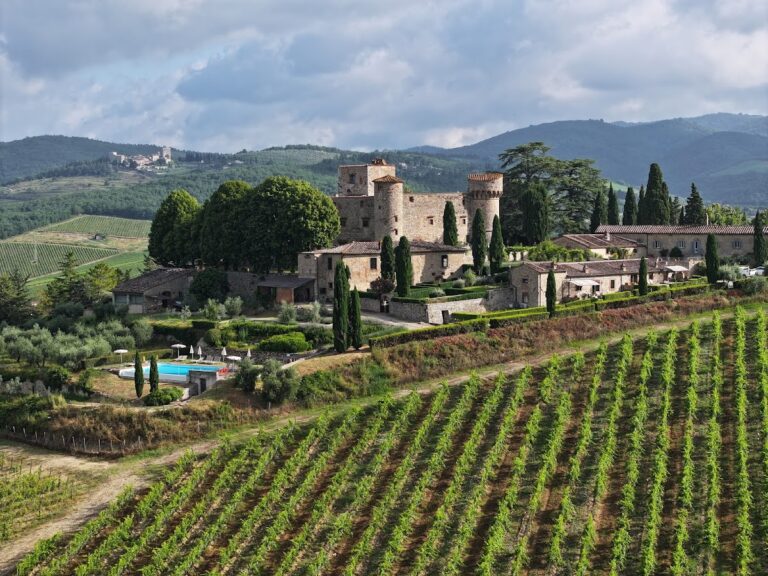
The core of Montozzi Castle’s remains is a 17th-century villa constructed with a rectangular layout that incorporates parts of the old castle’s keep. Built beginning in 1660 by the Bartolini Baldelli family, the structure faces northwest with a main façade that overlooks the castle’s former internal courtyard. A prominent double symmetrical staircase leads to the entrance portal, which is adorned with a relief keystone displaying the Bartolini Baldelli coat of arms. Along this façade are five windows supported by stone corbels beneath the sills, all suggesting a careful blend of Renaissance and Baroque architectural influences. The villa’s construction reuses the original masonry of the medieval fortress in its foundations and parts of the walls.
At the rear of the villa, early 18th-century additions include a double loggia—a covered gallery with open arches—along with new agricultural buildings such as a granary. Inside, the villa features stucco reliefs attributed to the artist Giovan Martino Portogalli and frescoes painted by Giovanni Camillo Sagrestani, reflecting the artistic taste of the period. In 1843, the central hall underwent modifications that replaced the original terracotta floor with Venetian-style terrazzo, a type of decorative marble flooring. That same period also saw the installation of a neo-medieval fireplace, adding a historicizing element to the interior. After sustaining damage during the German retreat in World War II, post-war restorations focused on repairing altered structures and preserving the villa, which today holds the Bartolini Baldelli family archive.
Attached to the west side of the palace is the Church of Saints Martino and Lucia, constructed from 1702. This church integrated an older oratory previously dedicated to Santa Lucia. The building presents a simple façade originally topped with a broken pediment and decorated with the Bernardine trigram, a symbol related to Saint Bernardino of Siena; this feature was damaged during wartime and is presently under restoration. A rounded arched window sits above the entrance, illuminating the church’s single nave interior, which includes three altars carved from pietra serena, a local gray sandstone.
Within the church, the left altar preserves a fresco by Giovanni Camillo Sagrestani that depicts Saint Bartholomew freeing the Armenian king’s wife from demonic possession. The right altar’s original Santa Lucia fresco was destroyed in 1806 and was replaced by a niche holding a Madonna of the Rosary statue. The central altar contains an early 18th-century painting from the Florentine school showing the Virgin Mary and Saints Martino and Lucia appealing to the Trinity. Additionally, a 15th-century sandstone tabernacle from the old San Martino di Tours church has been preserved inside. An 18th-century plaque inside the church records the patronage of the Bartolini Baldelli family. A choir loft connects this place of worship with the palace’s first floor, linking religious and residential functions.
Nearby stands the cemetery chapel of San Martino, erected in 1866 by Bartolomeo Bartolini Baldelli to replace a previous Romanesque chapel. Its design combines classical architectural elements into an eclectic style. The chapel’s interior features a plain nave intended for use by local residents, while an upper floor, accessible via two symmetrical staircases, is reserved for family commemorations. Behind the altar lies the Bartolini Baldelli family burial chapel, consolidating the family’s historical ties to the estate.
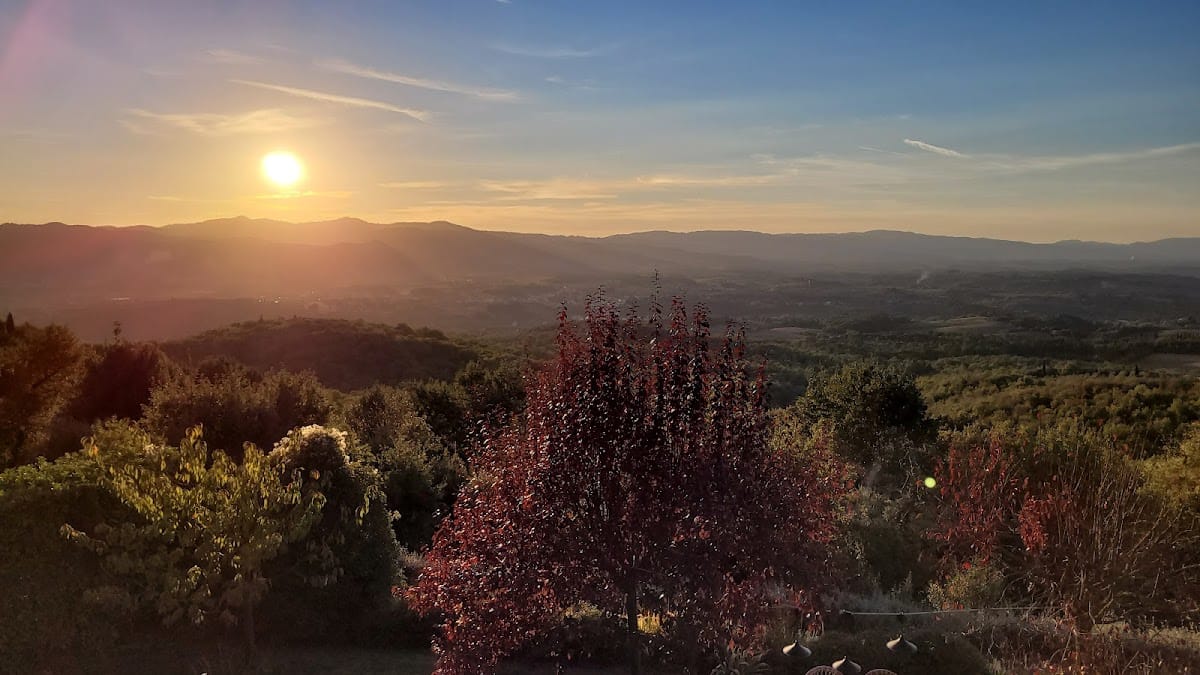
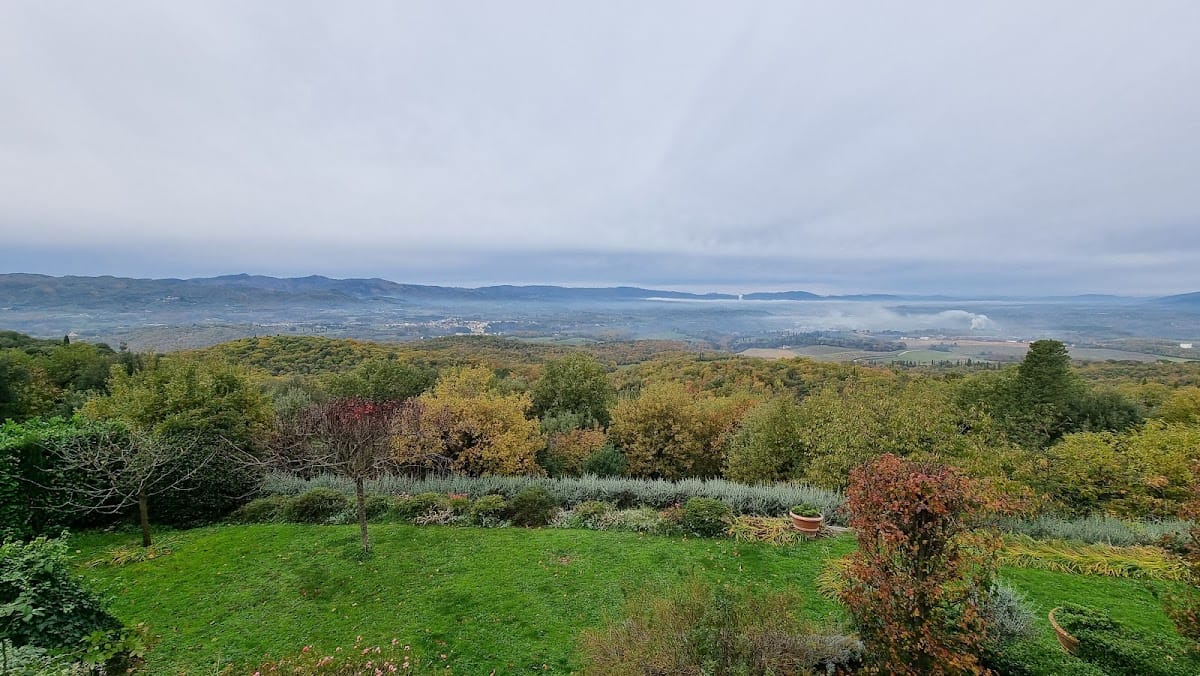
The landscape surrounding the villa and chapel includes the mid-19th-century park known as “la Bandita,” created by Bartolomeo Bartolini Baldelli with the gardener Angiolo Pucci. This English-style woodland park features holm oaks and winding paths accessed through a sandstone gate flanked by classical columns topped with decorative vases. Adjacent formal gardens were laid out in the late 19th century, divided into eight segments by boxwood hedges. These gardens contain a collection of rare trees such as Lebanon cedars arranged in stone circles, as well as giant and dwarf thuja trees, yews, and historically a giant Californian pine that no longer survives.
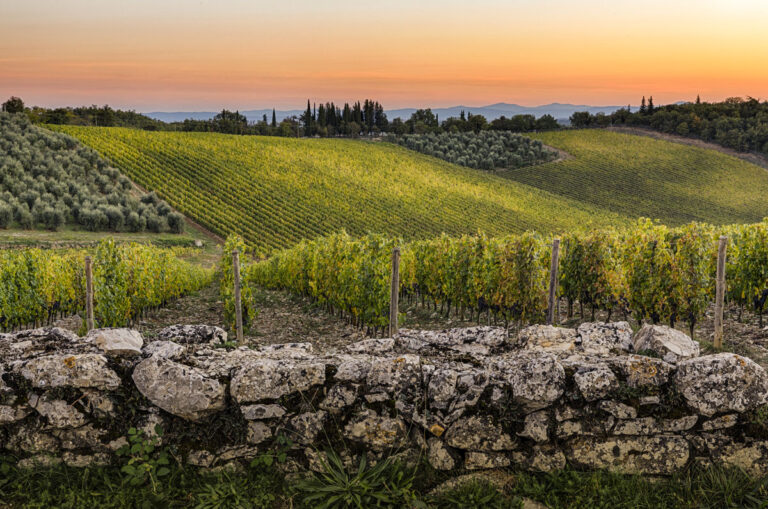
Beyond the ornamental grounds, the Montozzi estate encompasses extensive farmland and woodland cultivated for agricultural production. Vineyards across the property produce Chianti and IGT wines, complemented by olive groves, cereal crops, and plants for animal fodder. Since 2010, all farming practices on the estate have followed organic methods. The estate also includes a managed area for wildlife hunting and conservation, reflecting a sustained relationship between historic heritage and natural resource stewardship.
Nearby sites