Montjuïc Castle: A Historic Fortress in Barcelona



Visitor Information
Google Rating: 4.4
Popularity: Very High
Country: Spain
Civilization: Unclassified
Site type: Military
Remains: Castle

History
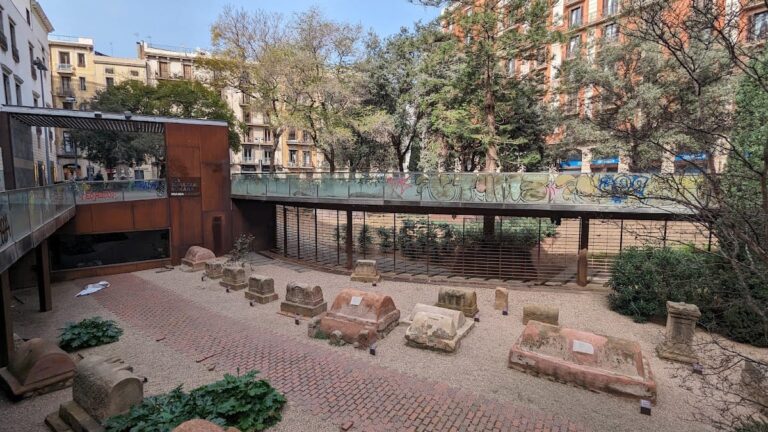
Montjuïc Castle is a historic fortress located on Montjuïc hill in the municipality of Barcelona, Spain. The earliest known structure on this strategic hill was a medieval watchtower, which served to signal the approach of incoming ships. The hill was historically known as Mons Judaicus or Mons Jovicus, a name reflecting the presence of a medieval Jewish cemetery that existed on the site from at least the ninth century through the fourteenth century. The castle’s name, Montjuïc, derives from this Jewish cemetery, linking the site closely to the religious community that once occupied the area.
In 1640, amid the Catalan revolt against the Spanish king Philip IV, a temporary earth fortification was rapidly erected on Montjuïc hill. This quadrilateral fort was faced with stone and mud, constructed within thirty days to meet the urgency of military needs. Its new defenses played a critical role in repelling a Castilian army during the Battle of Montjuïc on January 26, 1641. However, by 1643, deterioration led to the fort’s demolition, prompting the construction of a more robust structure by 1651. This new fort included two square enclosures with bastions at their corners and was protected by an external palisade. It also became the base for the Montjuïc tercio, an infantry unit formed around the same period.
In 1694, the fort underwent a significant transformation into a castle that occupied the entire flat summit of the mountain. The redesigned castle featured three bastions facing the land and a distinctive serrated battlement line overlooking the sea. The earlier fortification was preserved as an inner redoubt, an additional defensive stronghold within the larger complex. This castle witnessed fierce conflict during the War of Spanish Succession in the early eighteenth century, changing hands several times between Catalan supporters and Bourbon forces before finally falling to the Bourbons on September 12, 1714.
Military engineer Juan Martín Cermeño was commissioned in 1751 to improve the castle’s defenses, leading to the demolition of the older fortifications from 1640. He redesigned the fortress following the star-shaped defensive principles developed by the French engineer Vauban, incorporating modern military architecture of the time. Cermeño’s plan included the construction of services such as potable water cisterns and the excavation of a deep surrounding moat. Between 1779 and 1799, the castle’s facilities were expanded to accommodate a garrison of about 3,000 soldiers, including the addition of large kitchens and ovens and the installation of at least 120 cannons.
During the Napoleonic Wars, in 1808, French troops occupied Montjuïc Castle without resistance and maintained control until 1814. Throughout the nineteenth century, the castle played a role in suppressing uprisings in Barcelona, notably serving as an artillery position for bombardments under generals Espartero and Prim during revolts in 1842 and 1843.
From the late nineteenth century onwards, the fortress became a prison for political and social detainees. It housed anarchists in the 1890s who were subjected to the Montjuïc trials, as well as workers involved in the 1919 La Canadenca strike. The castle’s use as a prison continued during the Spanish Civil War, when it operated as a site for military imprisonment and executions on both sides of the conflict. Among those executed here were generals Manuel Goded and Álvaro Fernández Burriel in 1936.
Under the dictatorship of Francisco Franco, Montjuïc Castle remained a military prison until 1960. It was the site where more than 4,000 prisoners associated with republican and Catalan nationalist movements were executed, including the prominent figure and former president Lluís Companys, who was shot in 1940. In 1963, following renovations, Franco officially inaugurated the castle as a military museum. Although the city of Barcelona managed the site itself, the museum remained under military administration.
In the twenty-first century, the castle was fully transferred to the municipal government of Barcelona in 2007, initiating a new phase of restoration and reinterpretation. This transition led to the removal of Franco’s equestrian statue in 2008 and the closure of the military museum in 2009. The site was then transformed into the International Peace Center, reflecting a modern reimagining of its history and role within the city. Throughout its existence, Montjuïc Castle has witnessed numerous military conflicts, served as a place of imprisonment and execution, and come to symbolize both repression and resistance in Barcelona’s history.
Remains
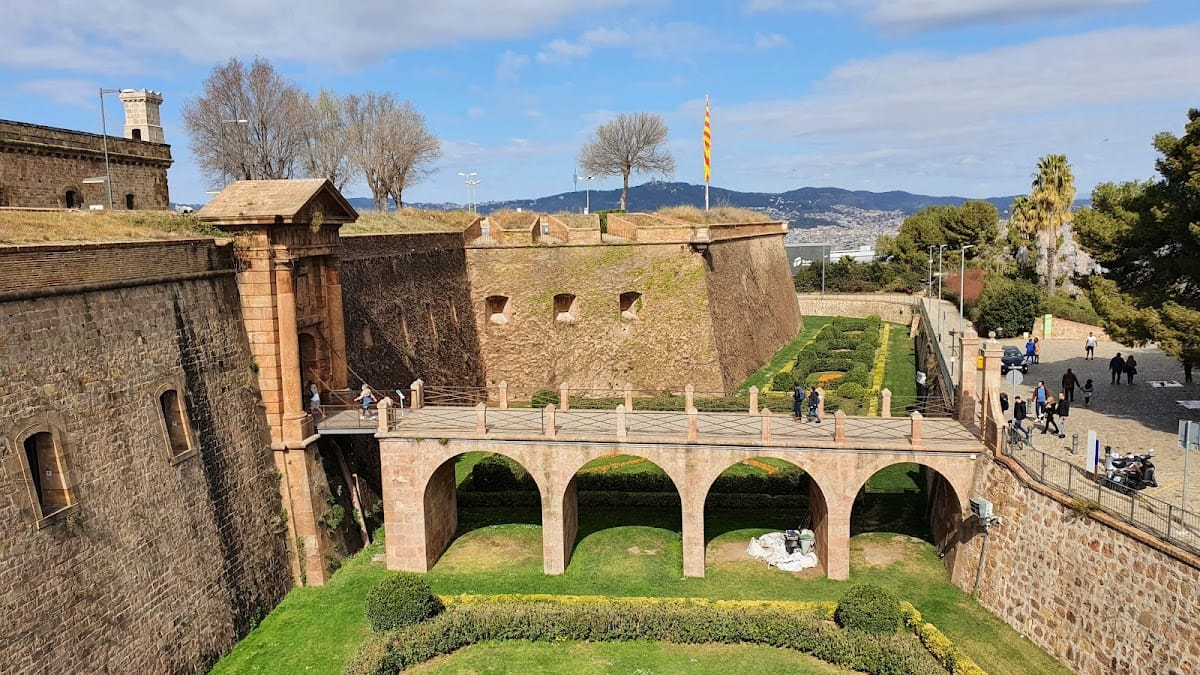
Montjuïc Castle is situated atop a rocky terrace approximately 170 to 175.5 meters above sea level on Montjuïc hill. Its current layout is a star-shaped fortress, a design introduced by military engineer Juan Martín Cermeño in 1751 following the defensive strategies popularized by the French engineer Vauban. This design features multiple bastions projecting from the walls and is encircled by a deep moat, which was excavated to enhance the castle’s protection against attackers.
The main structure of the castle is arranged around a porticoed courtyard, where various rooms are covered by semicircular vaults, providing both structural strength and aesthetic character. The 1694 castle foundation occupies the summit’s entire flat area and includes three bastions facing inland, while the battlements facing the sea have a serrated, toothlike pattern designed to increase defensive capability. The earlier fortification built in the mid-seventeenth century was preserved within the castle as an inner redoubt, serving as a last line of defense.
Surrounding the core enclosure are several exterior bastions and outworks that further fortify the castle. Among these is the Santa Amàlia bastion located on the northern perimeter, which is accessible today via a path encircling the fortress and a modern access road descending toward Avinguda del Castell.
Between 1779 and 1799, significant expansions added kitchens and ovens capable of feeding a garrison of up to 3,000 soldiers. At the same time, the castle housed extensive artillery installations, with at least 120 cannon placements being documented from this period. Some coastal artillery pieces from these defensive efforts remain in good condition at the site, including four 152-millimeter Vickers guns oriented toward the sea and the port, as well as four large 305-millimeter De Bange howitzers positioned to defend the city and the landward fort entrance.
The fortress includes service areas such as potable water cisterns, which were added during the eighteenth-century renovations to improve the self-sufficiency of the garrison. These cisterns, along with the deep surrounding moat and the star-shaped layout, illustrate the importance placed on defense and sustainability in the castle’s historic design.
Archaeological excavations conducted during recent rehabilitation projects have uncovered remains of the bastion dating back to 1650, providing physical evidence of the castle’s earlier phases. Alongside structural restoration, these works have helped preserve and reveal the site’s layered history.
In addition to the fortifications, the castle grounds once contained a military communications tower, a feature that was removed in 2009 during restoration efforts. Since the transfer of the castle to city management in 2007, multiple rehabilitation phases have taken place, including the careful restoration of fourteen rooms surrounding the main courtyard and the waterproofing of roofs and the watchtower to protect the historic fabric of the building.
Below the castle lies the Fossar de la Pedrera, a significant execution site where Lluís Companys, among others, was put to death, linking the physical context of the castle with the somber history of political repression associated with the site.
Together, these well-preserved remains and archaeological discoveries highlight Montjuïc Castle’s complex evolution as a fortress, a prison, and a place of memory within Barcelona’s urban and historical landscape.
Nearby sites