Via Sepulcral Romana: A Roman Necropolis in Barcelona



Site at a Glance
- Rating
- 4.3
- Popularity
- Low
- Country
- Spain
- Primary era
- Classical
- External website
- Open
- Eras represented
- Stone Age, Classical, Medieval
- Civilizations
- Crown of Aragon, Roman
- Site type
- Burial
- Remains
- Necropolis
On this page6 sections
History
Via Sepulcral Romana is a Roman necropolis in Barcelona, Spain, built and used from the first to the third century AD as part of the funerary landscape of Barcino, the Roman city established at the site of present-day Barcelona. Its importance comes especially from the survival of its tombs in their original archaeological context, making it the best-preserved and most extensively studied Roman cemetery of this period in the city.
A cemetery outside Barcino
Roman law prohibited burials within the city during this period. Cemeteries were therefore placed beyond the walls, beside roads leading away from urban areas. The Via Sepulcral Romana formed a secondary funerary road, a burial area away from the principal urban or monumental cemetery zones. Its distance from the walls and the character of its burials indicate use mainly by middle- and lower-class people, including slaves and freedmen, formerly enslaved people who had been legally released.
The necropolis was used until the early fourth century, when it ceased to function as a cemetery. Soon afterward, streams descending from the Collserola hills deposited layers of sediment over the area. These alluvial deposits concealed the stonework and helped protect it from being taken away and reused as building material. Elsewhere in Barcelona, Roman funerary remains generally survived only in scattered form, particularly when funerary monuments were reused during the expansion of the city walls in the fourth century.
Medieval occupation and rediscovery
The area remained largely unoccupied until near the end of the High Middle Ages. Walls dating approximately from the fourteenth and fifteenth centuries show that rooms or other spaces were later established within the urban fabric, with varied craft and domestic activities associated with them.
The necropolis came to light in 1956 during earthworks for the building on the southeast side of the present square. A first excavation campaign was followed by another in 1959, while further archaeological work took place between 2000 and 2003 during the redevelopment of Plaça de la Vila de Madrid. The current museum presentation was inaugurated in 2008. The site is managed as one of the heritage sites of the Museum of the History of Barcelona. On 7 November 1995, it was declared a Cultural Asset of National Interest as an archaeological zone, under identification RI-55-0000463 and BCIN code 2067-ZA.
Remains
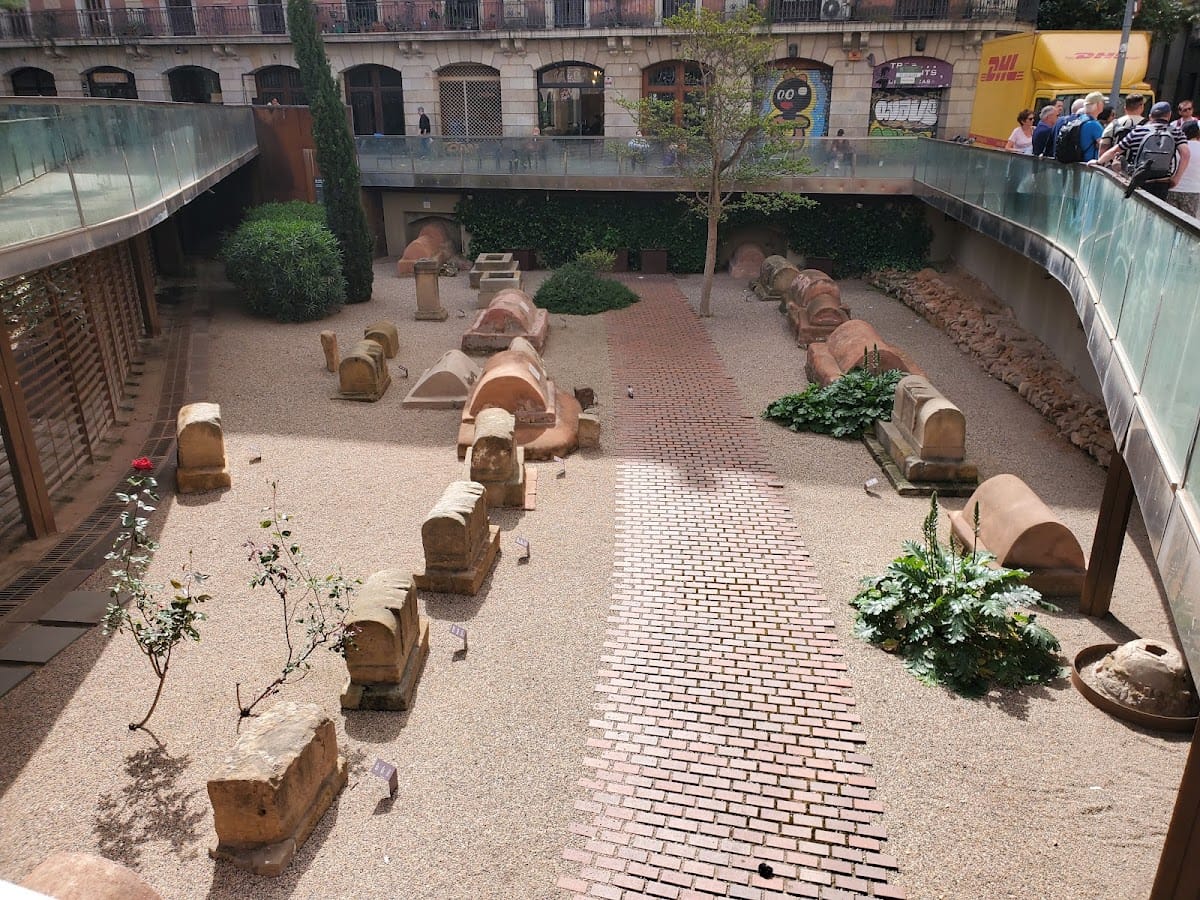
The archaeological site lies below the present level of Plaça de la Vila de Madrid, while the design of the square leaves the remains fully visible from the street. The necropolis followed a road about five metres wide. Surviving sections have been identified between present-day Portaferrissa Street and Santa Anna Street. The road departed from the southwest gate of Roman Barcino toward the area of present-day Boqueria Street and continued in the direction of Les Corts or Sarrià. Tombs stood in rows on both sides, without a regular arrangement, and a wall bounded the outer side of the cemetery.
Road and burial monuments
Eighty-five burials have been identified along the funerary road. They include six monolithic cupae, Roman funerary monuments with rounded or barrel-like forms carved from a single block, as well as six altars, one upright stele, two inscribed slabs, and thirty-three burial mounds. The remaining burials were protected by tiles and amphorae or had no surviving protective structure. Among the mounds, two were conical, while the others were square or formed as masonry cupae. These arrangements preserve different forms of Roman burial construction within the same cemetery.
Barcelona has yielded twenty-eight monolithic cupae, but the six from this funerary road are the only examples found in their original positions. Three additional monolithic cupae are displayed along the road after being recovered during excavations of the Roman wall. Installed in the late 1950s where three severely damaged masonry cupae had stood, they increase the number of visible monolithic monuments beyond the six originally discovered in the necropolis.
Earlier and later remains
A single circular funerary structure predates the Roman cemetery. It belonged to the Neolithic period and contained a cist made from limestone slabs, measuring 60 by 30 centimetres. Seven pieces of stone-working material were recovered from the burial, including four flint objects and three made of jasper. They had been placed together between the legs of the buried individual.
The later medieval phase is represented by walls dating approximately from the fourteenth and fifteenth centuries. They defined rooms or other spaces within the developing urban fabric and are associated with varied craft and domestic activities. Together with the earlier burial and the Roman cemetery, these remains show how the area acquired different uses across long periods of Barcelona’s history.