Miramare Castle: A 19th-Century Aristocratic Residence near Trieste



Visitor Information
Google Rating: 4.7
Popularity: Very High
Google Maps: View on Google Maps
Country: Italy
Civilization: Unclassified
Remains: Military

History
Miramare Castle is located near the city of Trieste in modern-day Italy. It was built in the mid-19th century by the Austrian Habsburgs, specifically commissioned by Archduke Ferdinand Maximilian of Austria, reflecting the period of Austro-Hungarian influence in the region.
Construction of the castle took place between 1856 and 1860 under Maximilian’s direct supervision. The purpose was to create a seaside residence that would complement his naval career and personal tastes. Architect Carl Junker was commissioned to design both the castle and its surrounding park. Maximilian lived there with his wife, Charlotte of Belgium, until 1864, when he left for Mexico to assume the throne as Emperor. His reign was short-lived, ending with his execution in 1867.
After Maximilian’s death and Charlotte’s departure, the castle continued to function as a seasonal retreat for various members of the Habsburg family. Noteworthy visitors included Emperor Franz Joseph, Empress Elisabeth, Archduke Franz Ferdinand, and the last Emperor Charles I. The royal occupants maintained the castle as a residence reflecting mid-19th century aristocratic life.
With the outbreak of World War I, the castle’s original furnishings and artworks were transferred to Vienna for protection. Following the war and the collapse of the Austro-Hungarian Empire, Italy took control of the property. In 1925-1926, Austria returned the castle’s furniture, allowing for restoration efforts. By 1929, Miramare Castle was opened to the public as a museum, preserving its historical interiors.
During the interwar years, the Duke of Aosta lived at the castle until 1943. In World War II, German forces used the site as an officer training school. Despite the military presence, local opposition helped prevent bombing and damage. After the war, Allied occupation forces from New Zealand, Britain, and the United States established their headquarters at Miramare until 1954.
Restoration work resumed after the Allied departure, culminating in the reopening of the park to the public in 1955. The castle was designated as a historic museum, managed by regional heritage authorities. It today stands as a carefully preserved example of a 19th-century European aristocratic residence, retaining much of its original furniture and decoration.
Remains
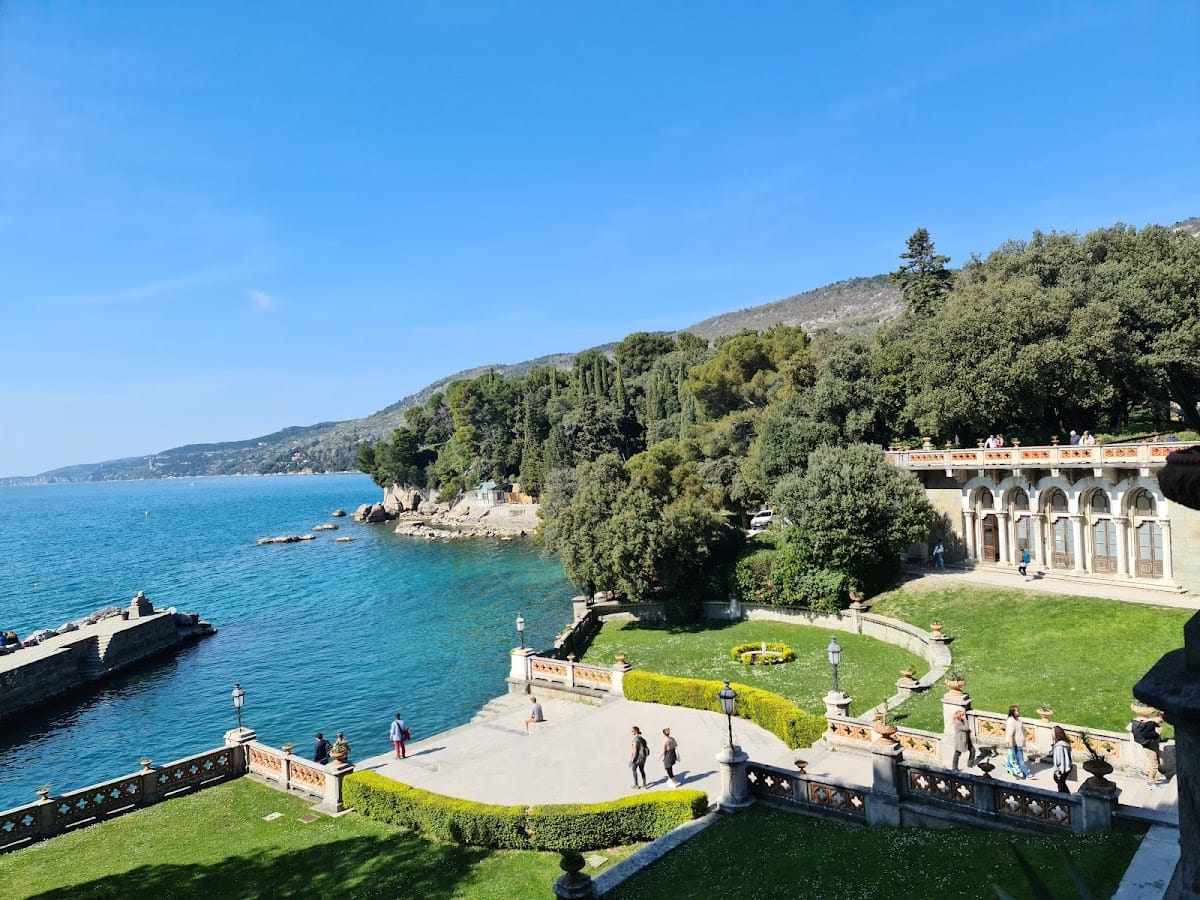
Miramare Castle is positioned on a rocky promontory made of limestone overlooking the Gulf of Trieste. Constructed mainly from white Istrian limestone, the building exhibits an eclectic architectural style with clear neo-Gothic influences. Its layout includes a ground floor, first floor, and a mezzanine level, all enjoying views of the Adriatic Sea.
The ground floor housed the private apartments of Archduke Maximilian and Archduchess Charlotte. Among these rooms is Maximilian’s bedroom and office, uniquely fashioned to resemble parts of the frigate Novara, the warship he commanded during a naval circumnavigation between 1857 and 1859. The library features walls lined with wooden shelves, while Charlotte’s chambers are adorned with delicate light blue silk tapestries.
The first floor contained formal reception areas, including a Throne Room with intricately decorated ceilings and paneling. Oriental influences appear in dedicated Chinese and Japanese salons furnished with authentic eastern-style decor. A room on this level displays paintings by Cesare Dell’Acqua that depict scenes from Maximilian’s life and events related to Miramare Castle’s history.
Throughout the interiors, much of the original mid-19th century furniture and decoration remain intact. Notably, coats of arms linked to the Second Mexican Empire, where Maximilian briefly ruled, are visible alongside stone exterior carvings featuring Aztec eagle motifs.
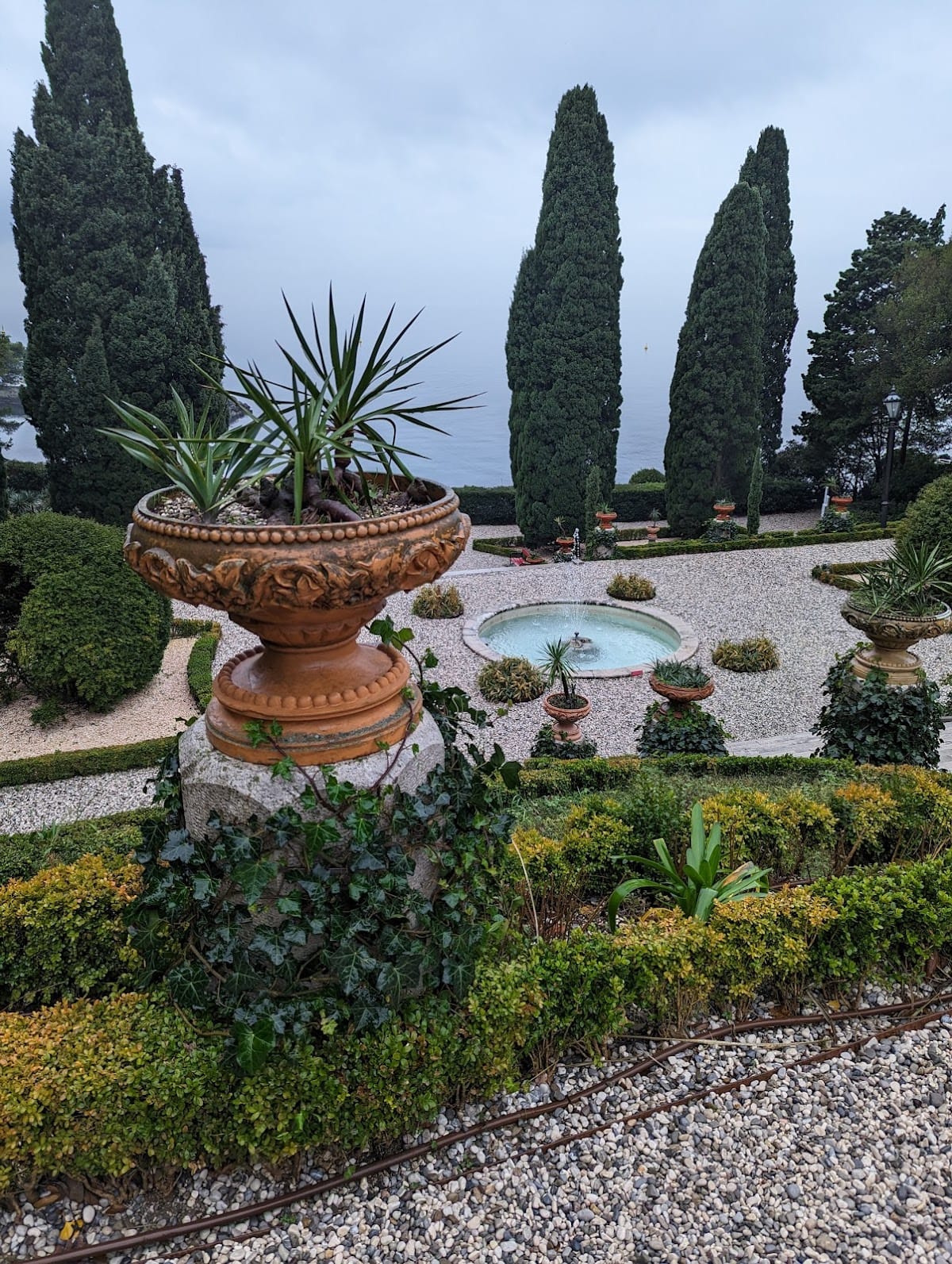
Surrounding the castle is an extensive 22-hectare park designed by Carl Junker based on Maximilian’s directives. The park follows the English garden tradition, with winding paths, small streams, and lakes arranged in a naturalistic manner. Uncommonly, the park hosts an array of tree species from different parts of the world, including cedars from Lebanon, North Africa, and the Himalayas; Spanish firs and spruces; cypresses native to California and Mexico; various pines from Asia and America; giant sequoias; and ginkgo biloba, known for its fan-shaped leaves.
Within the park stand several ancillary structures conceived by Junker. The Castelletto is a smaller building that echoes the main castle’s facade and served as a temporary residence during the castle’s construction, later becoming Charlotte’s home. Greenhouses were built for plant cultivation, and a chapel dedicated to Saint Cancian once stood with a cross made from the wood of the frigate Novara. Near Swan Lake lies a small “Swiss house” café structure designed for leisure.
The stables, constructed during the original building phase, form a U-shaped complex facing east near a sheltered bay. Each wing extends roughly 40 meters and encloses a central courtyard open toward the sea. The central section was designated for housing horses, while the two symmetrical wings contained tack rooms and staff living quarters. Kitchens were positioned close to the sea, and a large rear pavilion, accessible via two main western doors, stored carriages.
The castle’s furnishings include authentic mid-19th century pieces, with select rooms on the upper floor reflecting 1930s rationalist style furniture from the Duke of Aosta’s residency. One notable item is the fortepiano used by Charlotte, preserved in the music room and displayed in what is now room VII. Restoration has returned the Throne Room to its original grandeur.
A black marble plaque with gold lettering commemorates a birthday mass held on 6 July 1863, officiated by Pelagio Lavastida, Archbishop of Mexico, reflecting Maximilian’s ties to his Mexican emperorship. The chapel was decorated by painter E. Heinrich, featuring paintings of the twelve apostles along the sides and a depiction of the Last Supper on the altar, underscoring the castle’s religious associations.
Nearby sites