Muggia Castle: A Late-Medieval Fortress in Italy

Site at a Glance
- Rating
- 4.1
- Popularity
- Low
- Country
- Italy
- Primary era
- Medieval
- Eras represented
- Medieval
- Civilizations
- Holy Roman Empire
- Site type
- Military
- Remains
- Castle
On this page7 sections
History
Muggia Castle is a late-medieval castle in Muggia, Italy, built under the authority of the Patriarchate of Aquileia in the late fourteenth century. The patriarchate was an ecclesiastical principality whose rulers held both religious and territorial power in northeastern Italy and nearby regions. The castle developed as a fortified response to Muggia’s resistance to patriarchal rule.
Patriarchal fortress
Muggia’s territory had been a fief of the Patriarchate of Aquileia since 931. In 1372, the town and its pro-Venetian faction rebelled against patriarchal authority under Raffaele di Ser Steno. Patriarch Marquard I of Randeck responded by sending a ministerial, a dependent official or military retainer who could administer territory or command forces for a higher lord. Construction of the castle or fortress began in the area called Borgolauro in 1374 or 1375.
The original tower was expanded into a stronger complex for a military garrison. A perimeter wall and watchtowers were added, and development continued until about 1399. Muggia continued to resist the Patriarchate of Aquileia while also submitting at different times to Trieste and the Austrian dukes.
Conflict and changing control
After a later revolt, forces of the Hungarian king Sigismund captured Muggia in 1413 at the request of Patriarch Antonio Da Ponte. The town suffered extensive devastation. In 1511, the captain of Trieste and the Frankopans, commanding forces of Archduke Maximilian I, made an unsuccessful attempt to capture Muggia.
The castle was rebuilt repeatedly over the following centuries and retained a defensive function until the eighteenth century. It was then abandoned and fell into decay. Restoration began in 1701 at the initiative of Count Giovanni Polcenigo and was completed in 1735 under the government of the Republic of Venice, whose sphere of influence included Muggia at the time.
Conversion and restoration
During the nineteenth century, the castle again deteriorated. In 1900, Dr. Giacomo Derossi bought it and enlarged the interior for use as a private house. The complex remained in poor condition until near the end of the twentieth century. In 1991, the local sculptor Villi Bossi and his wife acquired the castle and carried out a professional restoration.
Muggia Castle remains privately owned and is designated Italian national heritage. Its restored spaces also serve as a venue for cultural and musical events, linking the building’s preserved fortress history with its later residential and cultural use.
Remains
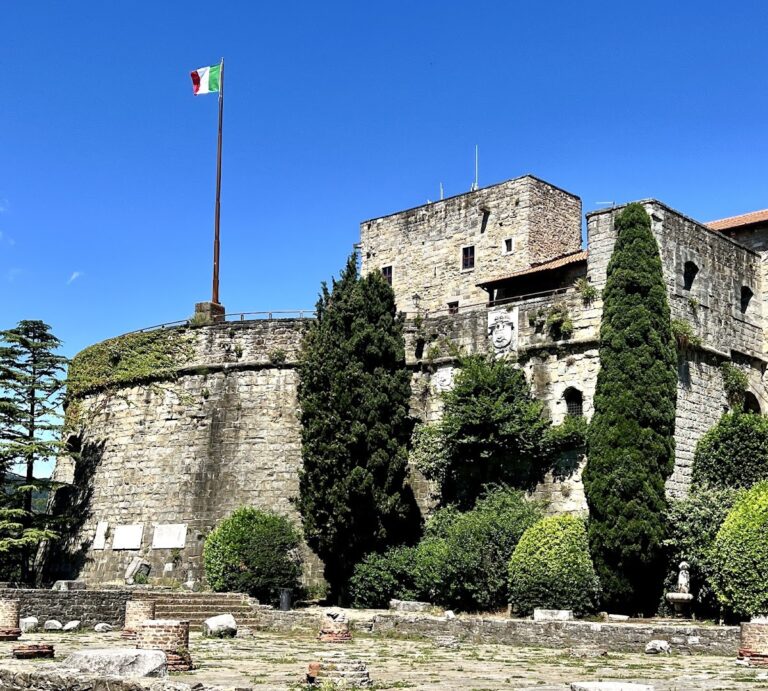
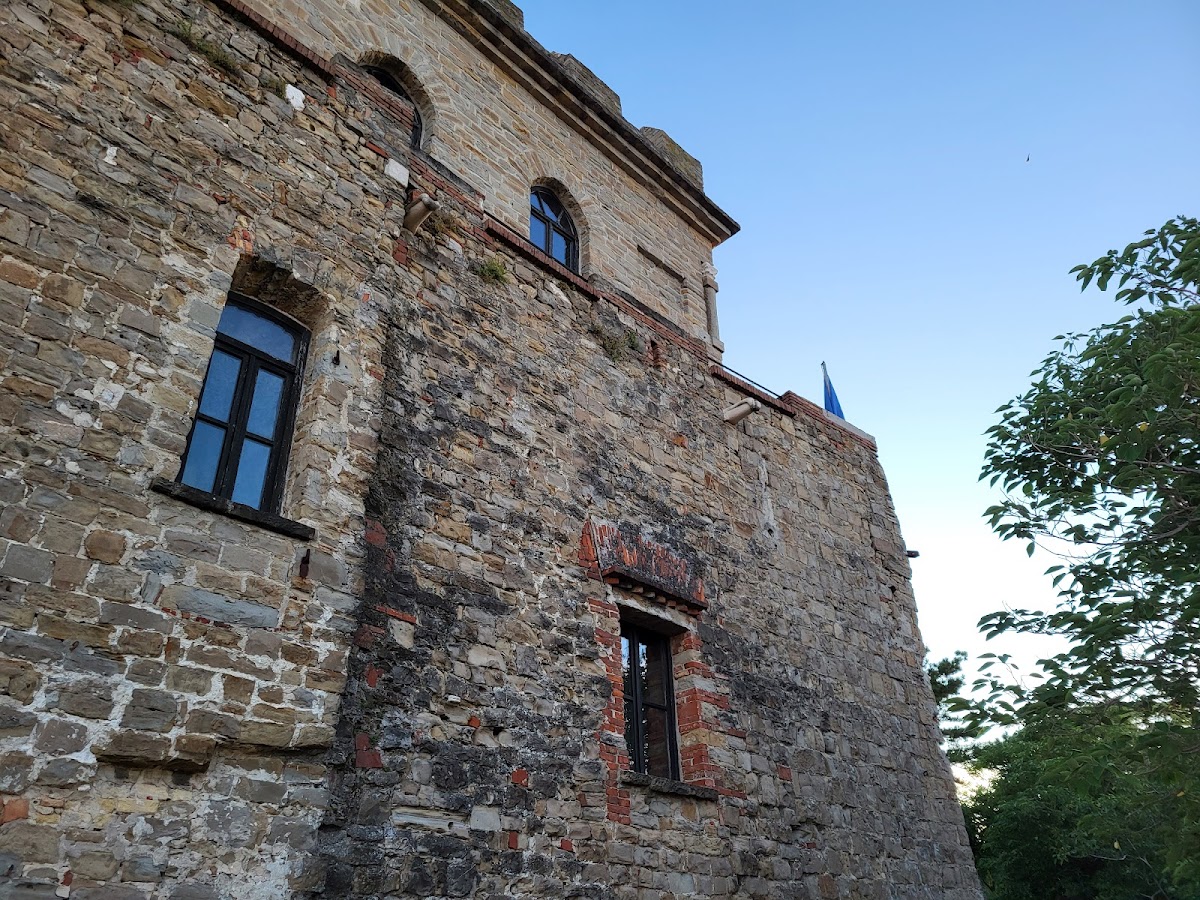
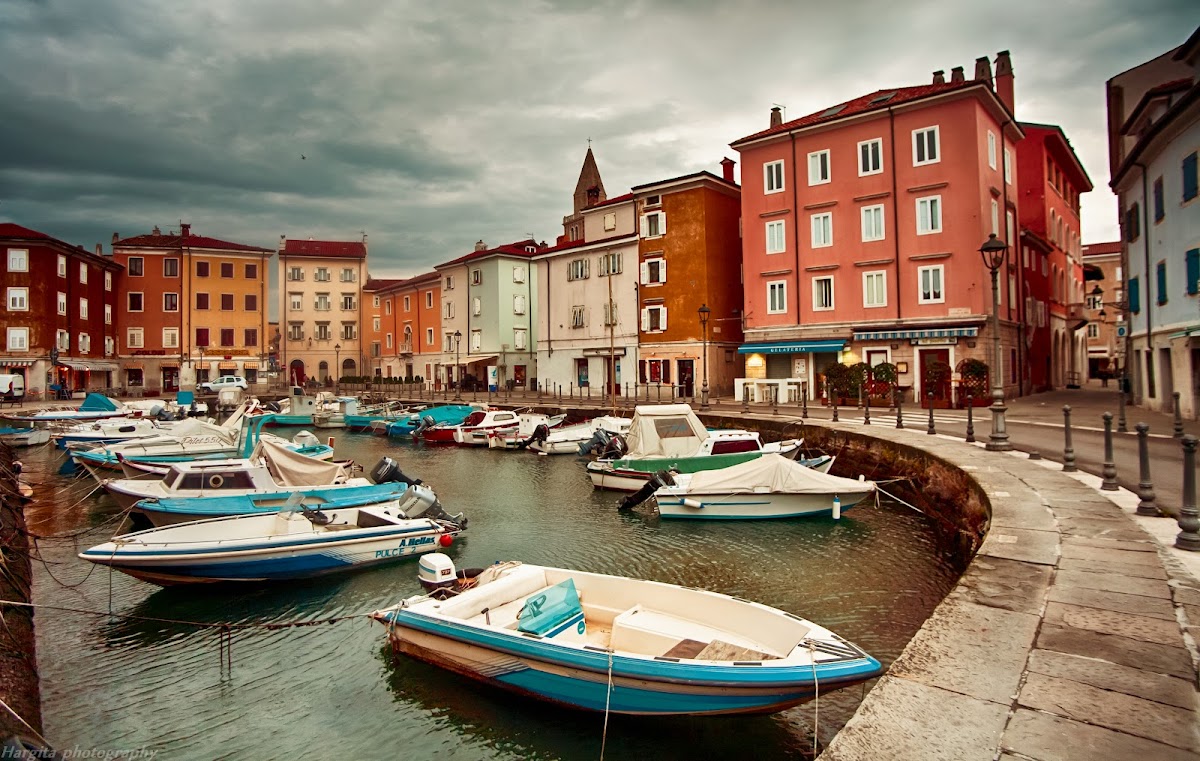
Muggia Castle occupies an elevated position above Muggia’s harbor in the central part of the town, at approximately 19 meters above sea level. It is a Gothic, late-medieval lowland castle built from sandstone ashlar, meaning regularly cut sandstone blocks laid as finished masonry. The surviving perimeter of the outer wall preserves the outline of the defensive enlargement that developed around the earliest tower.
Fortifications
The castle’s earliest core was a tower. Its defenses later included two towers and a four-sided enclosing wall with watchtowers, arranged to accommodate a military garrison. The main tower has flat Guelph-type crenellations, formed by merlons with a level rectangular profile traditionally associated with the Guelph political faction. The outer wall survives as part of the restored complex.
Residence and sculpture garden
Derossi’s nineteenth-century conversion enlarged the interior into a private residence. The restored complex contains an interior garden used for cultural events. The garden and castle are decorated with numerous sculptures by Villi Bossi, which form a permanent exhibition. The building and its grounds are maintained as private property after their earlier period of abandonment and decay.