Letoon Sanctuary: An Ancient Lycian Religious Center in Turkey


Visitor Information
Google Rating: 4.5
Popularity: Medium
Google Maps: View on Google Maps
Official Website: www.kulturportali.gov.tr
Country: Turkey
Civilization: Byzantine, Greek, Roman
Remains: City

History
Letoon Sanctuary Place, located in Kumluova within the municipality of Seydikemer in modern-day Turkey, was established by the ancient Lycian civilization as a distinguished religious site. The sanctuary served as a spiritual center dedicated to the goddess Leto and her twin offspring, Artemis and Apollo, whose worship was closely tied to the Lycian identity and culture.
Dating back to at least the 8th century BCE, Letoon was integral to both religious and political life in Lycia. It was the principal sanctuary for the Lycian League and the city of Xanthos, where rulers publicly announced important decisions and the Letoids, as the gods were called, were revered as protectors of the Lycian people. Despite periods of foreign control, Letoon remained a central place for maintaining Lycian traditions and autonomy.
During the Persian period, Lycia retained a measure of self-governance even as it came under the broader Persian empire’s influence. In the 4th century BCE, control shifted to the Carians, a neighboring group, with notable rulers such as Pixodaros evidenced by inscriptions found at the sanctuary. Following the death of Alexander the Great, governance passed through the hands of various powers; the Ptolemies and then the Rhodians had authority over the region, until Lycia regained a form of independence under Roman protection in the 2nd century BCE.
Under Roman rule, Letoon continued its religious importance. Emperor Hadrian’s visit prompted the construction of a dedicated cult room in his honor, reflecting the ongoing imperial influence and the sanctuary’s adaptation to new cultural elements. From the 4th century CE onward, the site underwent a Christian transformation. A basilical church was built on the raised altar area, reusing the cella—or inner chamber—of the Leto temple, which likely functioned as a baptistery, adapting the pagan religious space to serve Christian worship needs.
The sanctuary saw gradual desertion by the 7th century CE, which coincided with increased Arab incursions that affected the region’s stability. After this period, Letoon was largely left unoccupied, remaining in a state of ruin for centuries until modern archaeological efforts began.
Systematic excavations at Letoon began in 1962 under French leadership, unearthing much of the sanctuary’s remaining ruins despite environmental challenges such as a high water table that threatened preservation. Restoration projects starting in 2000 have included partial rebuilding of the Leto temple and other conservation efforts. Among significant discoveries was a remarkable trilingual stele bearing inscriptions in Lycian, Greek, and Aramaic, dated to 337 BCE. This artifact provided valuable insights into Lycian language and religious regulations, enhancing the understanding of the sanctuary’s role and governance.
Remains
The Letoon Sanctuary sits within a rectangular enclosure defined by porticoes—covered walkways—along two sides. Access to the site was controlled by two distinctive entrances: a western propylon serving as the main ceremonial gateway for processions, and a northern side entrance connecting directly to a road leading to the nearby city of Xanthos.
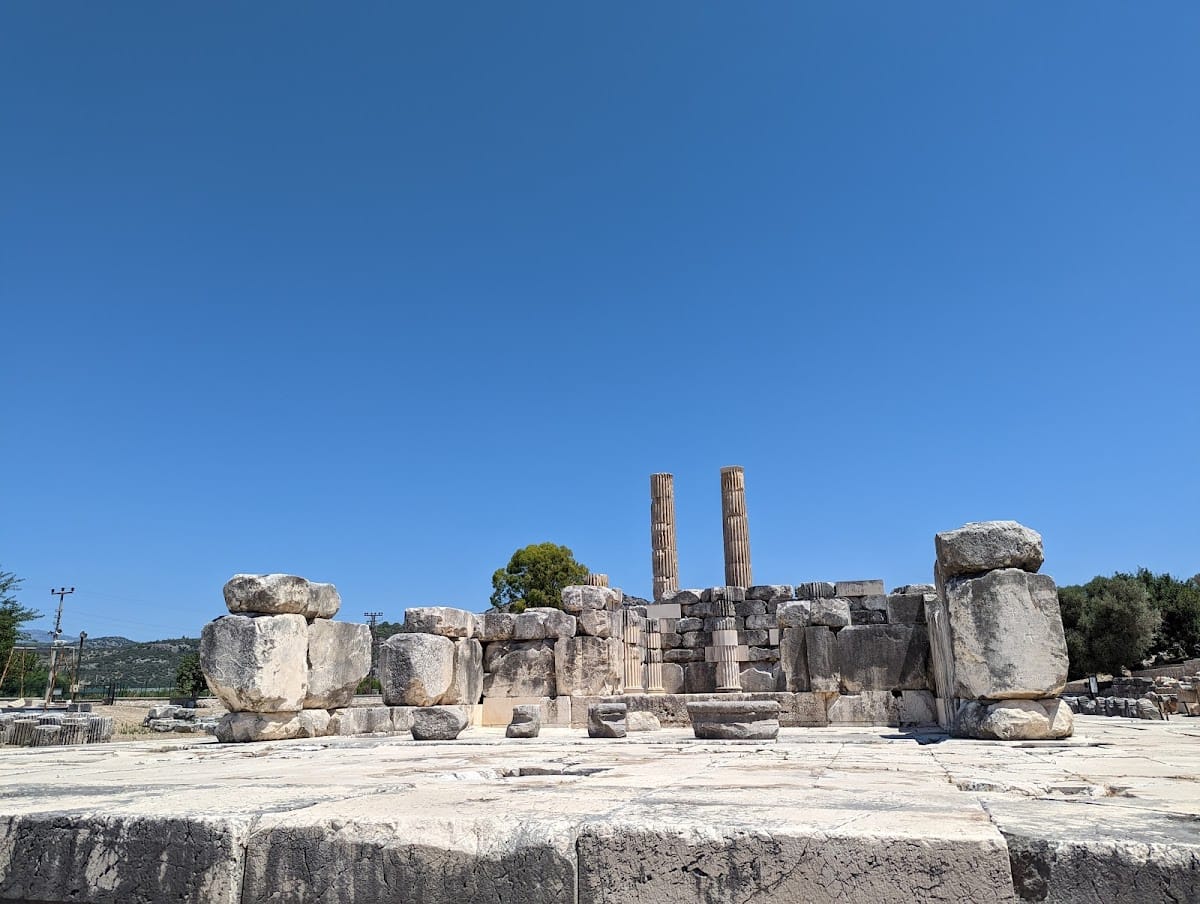
At the heart of the sanctuary are three parallel temples from the Hellenistic period, constructed in the 3rd century BCE while the region was under Ptolemaic (Lagid) rule. Each temple honors one member of the divine family central to Lycian spirituality: Leto, Artemis, and Apollo. The westernmost temple, dedicated to Leto, is notably well-preserved and features Ionic order columns arranged in a peripteral layout, meaning columns encircle the entire structure. These columns, numbering six along the short sides and eleven along the long, were fashioned from marble or marble-like limestone. Inside, the temple’s cella contains engaged Corinthian columns—columns attached to the walls—alongside remains of an earlier temple beneath the current one, indicating a tradition of rebuilding on the site.
The temple devoted to Apollo, positioned to the east, exhibits Doric order characteristics, a style recognizable by its sturdy fluted columns and simple capitals. Within its cella, foundations of a former wooden temple have been uncovered, hinting at an earlier phase of construction. Uniquely, the cella of the Artemis temple, the central and smallest building, is carved directly into the rock, setting it apart in terms of architectural technique.
Southwest of the main sanctuary lies a Roman imperial cult hall dating to the Roman era. This structure consists of a square chamber opening onto a semicircular portico—an open, columned porch—that adjoins a nymphaeum, or monumental fountain, alongside a pool. An inscription beneath where a statue of Emperor Hadrian once stood honors him, linking this hall to the cult activities associated with the emperor.
The nymphaeum itself was built over a natural spring, framed by exedras, which are semi-circular niches or recesses often used for seating or display. The visible remains at the site mostly date to the 3rd century CE, showing the continued development and embellishment of the sanctuary during Roman times.
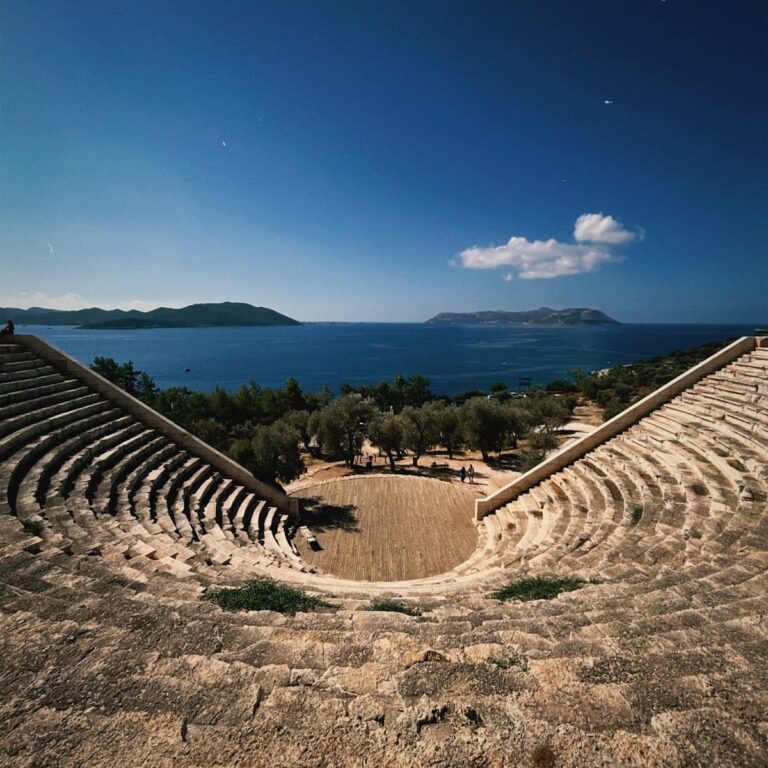
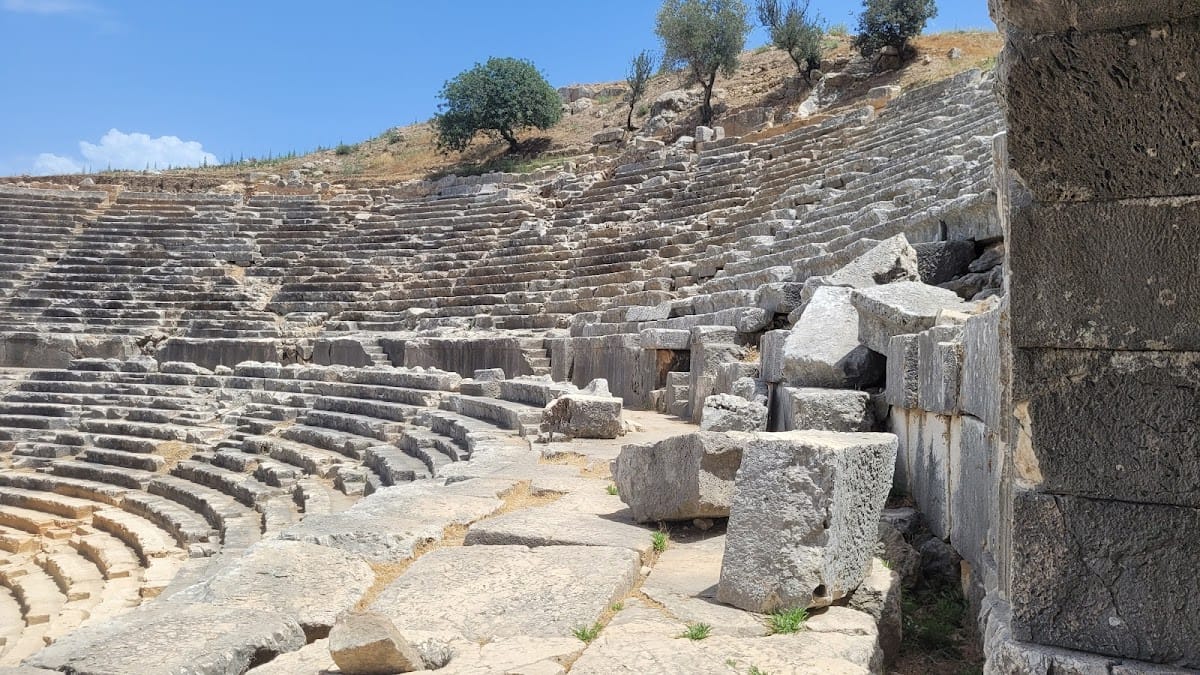
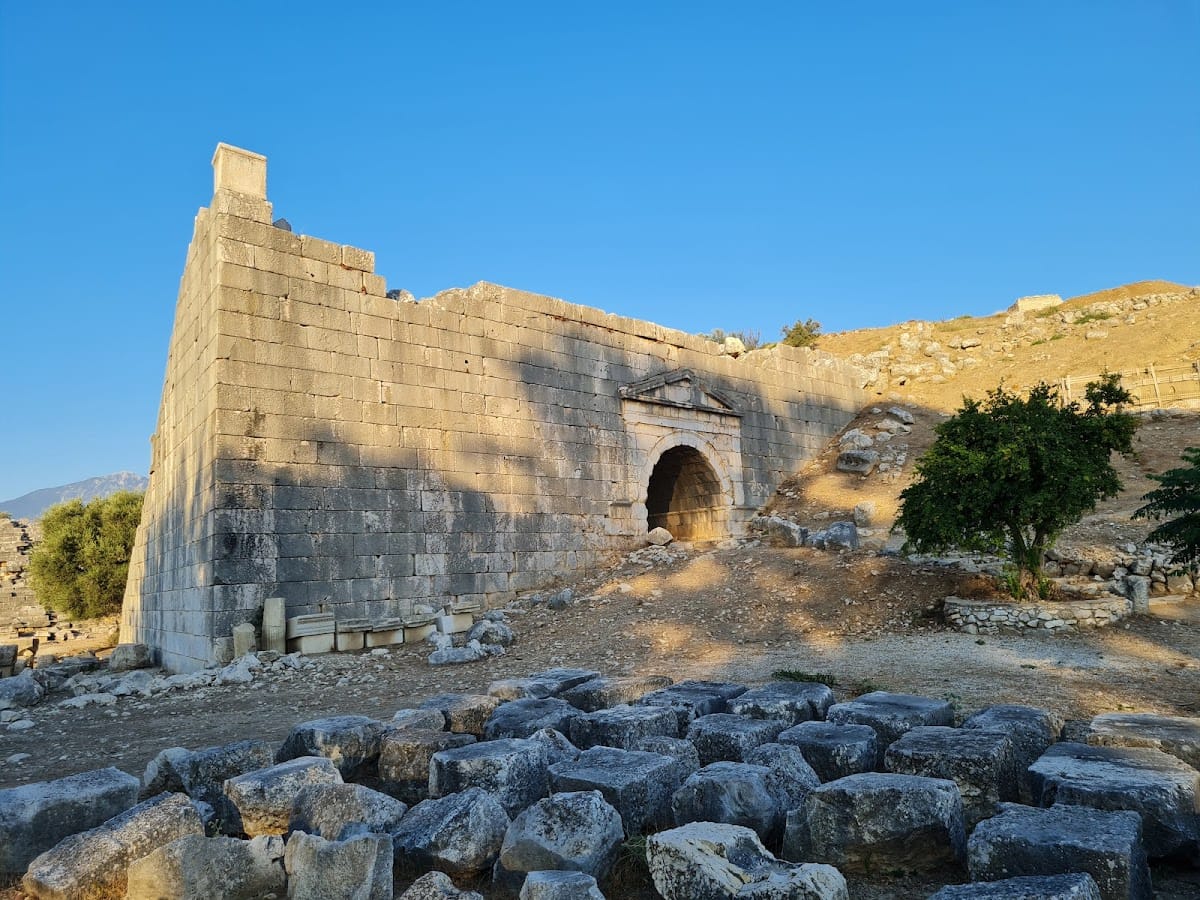
To the north of the sanctuary is a remarkably well-preserved Hellenistic theater, partly carved from the bedrock and supplemented by constructed wings. The seating area forms a horseshoe shape typical of theaters from the period. Two vaulted entrances flank the auditorium, fitted with decorated doors that add to the theater’s architectural richness. The venue could accommodate roughly 5,000 spectators, illustrating its role in public gatherings or performances. Notably, a road runs through this theater, an unusual feature that links it directly with movement and access beyond the sanctuary.
Despite enduring the passage of centuries, the ruins at Letoon have largely survived with their original plan and structures intact. Modern interventions have addressed challenges posed by seasonal rises in groundwater by channeling water away to prevent damage. Numerous inscriptions discovered at the site include a trilingual stele and several bases inscribed with dynastic names, offering invaluable written records of the sanctuary’s history. In addition, votive statuettes found near the nymphaeum’s niche dedicated to the nymphs suggest personal devotional practices as part of the cult activity at Letoon.
Together, these features present Letoon as a complex and evolving religious center, reflecting both Lycian traditions and the wider cultural influences that shaped the region across centuries.