Antiphellos Ancient City: Lycian Port and Commercial Centre in Türkiye


Site at a Glance
- Rating
- 4.7
- Popularity
- Medium
- Country
- Turkey
- Primary era
- Classical
- Eras represented
- Classical
- Civilizations
- Lycian, Roman
- Site type
- City
On this page13 sections
History
Antiphellos Ancient City is an ancient Lycian city in Türkiye, at modern Kaş on the southern coast of Lycia. Settled by Lycians by the sixth century BCE, it developed especially during the Hellenistic period as the harbour of nearby Phellos and later became the region’s largest city, a commercial centre, and a member of the Lycian League.
From Habesos to Antiphellos
The settlement was originally known as Habesos, with the earlier form Habessus also recorded. The earliest known appearance of the Greek name Antiphellos is on a tomb inscription from the fourth century BCE. The Persians occupied the site around the middle of the sixth century BCE, during a period when Persian power extended across much of Lycia and western Anatolia.
In the Hellenistic period, Antiphellos served as the port of inland Phellos. As Phellos declined, the coastal settlement expanded in importance and became the principal city in the surrounding region. It possessed one vote in the Lycian League, a political federation in which Lycian communities held defined voting rights. Its ability to mint coins also reflects a considerable degree of civic and economic autonomy.
Roman maritime and civic life
Antiphellos appears in the Stadiasmus Maris Magni, a Roman maritime guide listing coastal routes, ports, and sailing distances for navigators. Phellos is not included in that guide. Imperial coins found at Antiphellos carry the ethnic designation “of the Antiphellitans,” while Pliny the Elder remarked on the exceptionally soft sea sponges of the area. Strabo, however, incorrectly placed Antiphellos among Lycia’s inland cities.
The city was probably damaged by the earthquake that devastated the region in 141–142 CE. The disaster generated a tsunami that flooded the Lycian coast and reached far inland. Donations made by Opramoas of Rhodiapolis, a prominent benefactor whose gifts supported repairs in cities affected by regional disasters, may have helped finance work at Antiphellos after the earthquake.
Christian administration
During the Roman period, Antiphellos was a suffragan bishopric under the metropolitan see of Myra, the capital of the Roman province of Lycia. A suffragan bishopric was a subordinate diocese governed within a metropolitan’s ecclesiastical province. Bishop Theodorus attended the Council of Chalcedon in 451 and the provincial synod of 458, which addressed the murder of Proterius, bishop of Alexandria. Because of difficulties affecting Theodorus’s hands, the priest Eustathius signed the synod’s acts for him. The bishopric later ceased to be residential and is now retained by the Catholic Church as a titular see.
Decline, rediscovery, and urban change
By 1828 Antiphellos was almost deserted. The settlement was called Andifili before the compulsory population exchange between Greece and Turkey in 1922–1923, and the nineteenth-century form Andiffelo is also recorded. It began to be rebuilt during the decades that followed, eventually becoming part of modern Kaş municipality.
Sir Francis Beaufort identified and described the abandoned ruins in the 1820s, noting the theatre and groups of inscribed and plain sarcophagi. Charles Fellows visited in April 1838 and returned in April 1840, when he counted more than 100 tombs. He drew sarcophagus ends, pediments, and tomb doors in 1841. Fellows and his companions also encountered a tomb with a bilingual inscription, from which a cast was made in 1844, and he sketched the pillar tomb standing in the centre of the modern town. Thomas Abel Brimage Spratt published a plan of the ancient ruins in 1847.
Modern expansion at Kaş destroyed much of the ancient settlement. Numerous sarcophagi were dismantled, and their flat-faced stones were reused in buildings. Excavations within the modern town in 1952 produced few finds. The archaeological team concluded that fourth-century BCE Antiphellos may have consisted of only a small group of buildings concentrated near the harbour. This surviving evidence, together with the inscriptions and architectural remains, preserves the changing relationship between the ancient port and the later town.
Remains
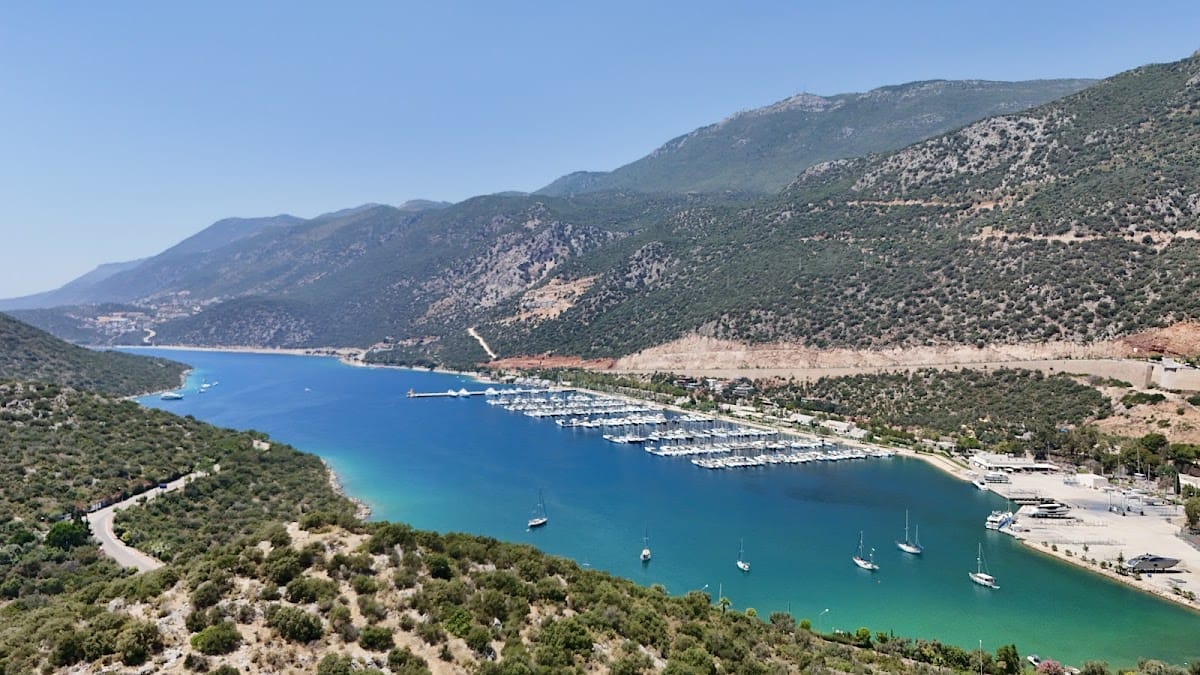
Antiphellos occupied the head of a bay on the southern Lycian coast, with its harbour on the seaward side of an isthmus. A reef extending into the sea sheltered the anchorage and may have been reinforced in antiquity. The settlement had no acropolis or enclosing city wall. Instead, a long ashlar sea wall formed an important part of its coastal structure, while tombs and other remains extended into the hills beyond the modern town.
Harbour and sea wall
A surviving section of the ashlar sea wall west of modern Kaş runs for more than 460 metres and retains six courses of blocks. Another remnant remains along the shoreline. These stretches define part of the ancient waterfront and belong to the physical setting of the harbour, whose protection was aided by the offshore reef.
Hellenistic theatre
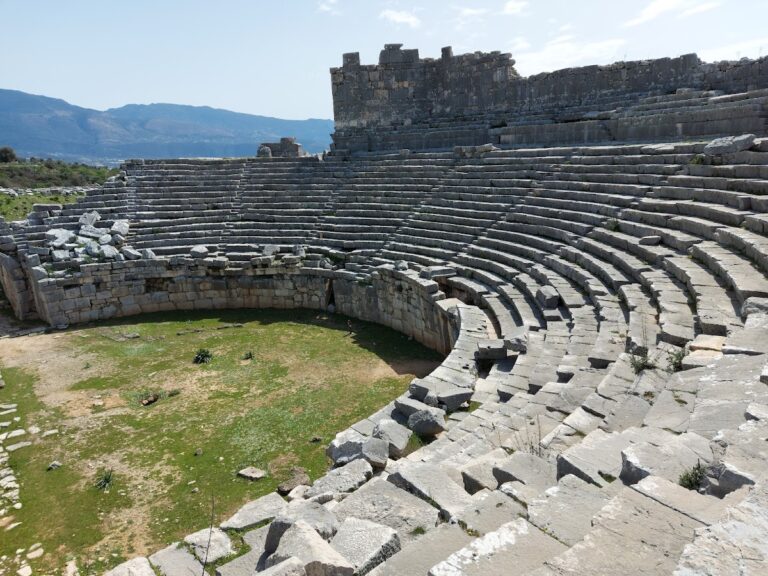
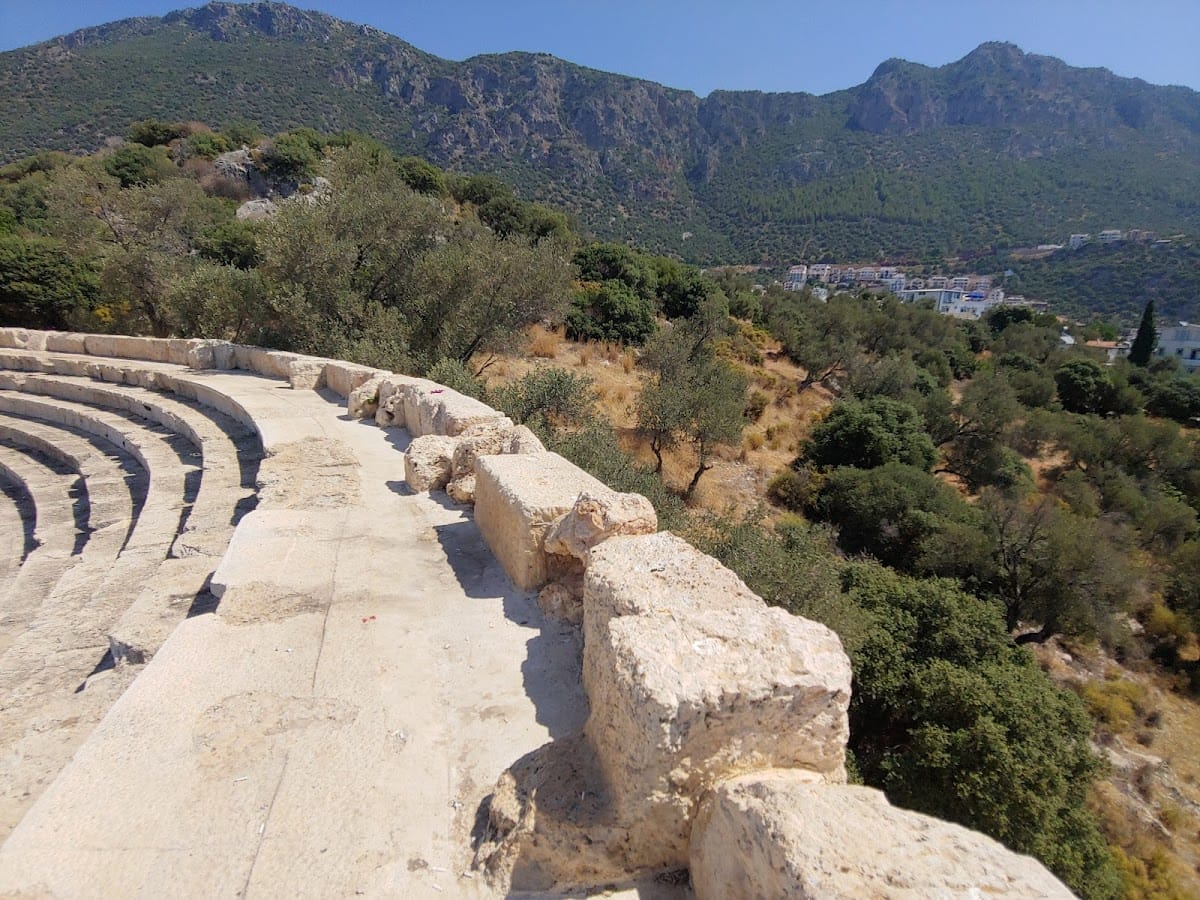
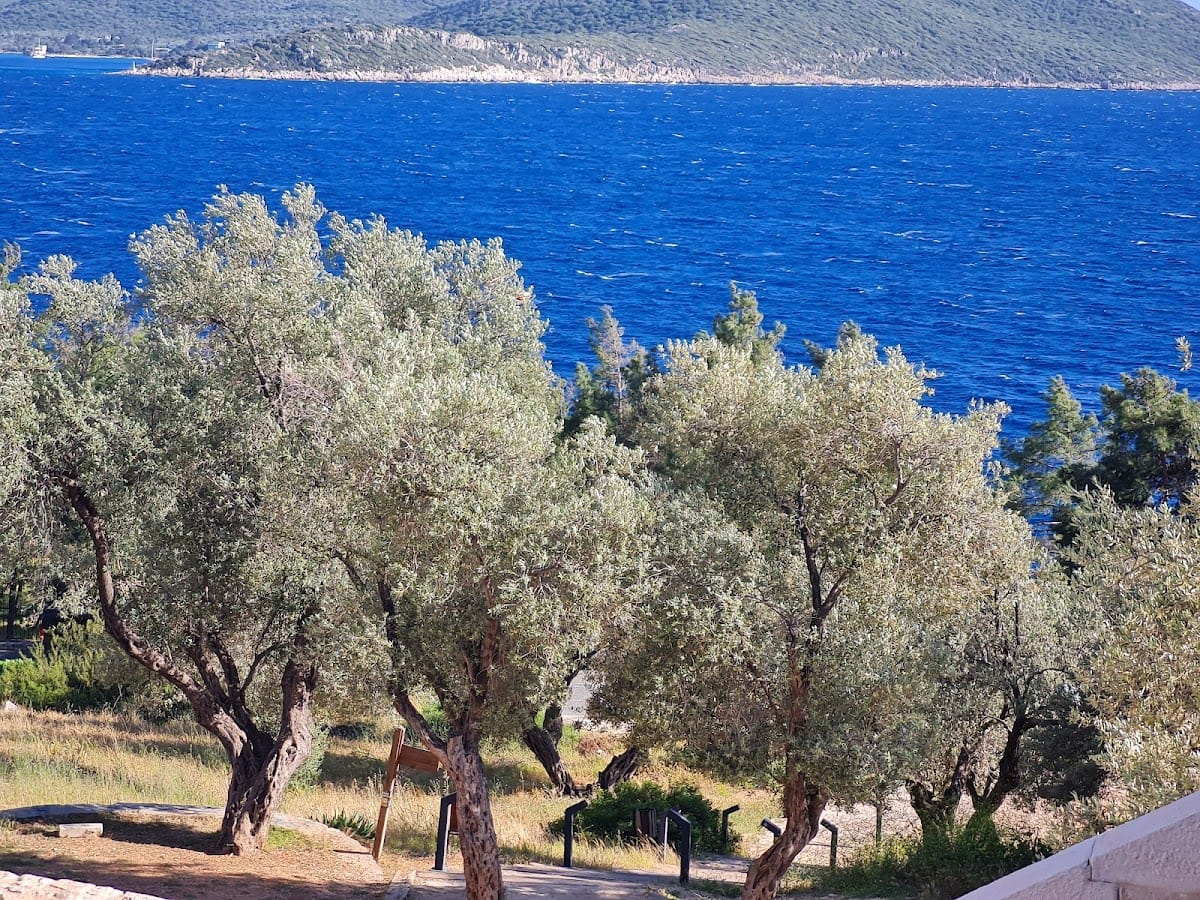
The restored Hellenistic theatre stands about 500 metres from the centre of Kaş and could accommodate approximately 4,000 spectators. It is largely complete and faces the sea, a configuration described as the only surviving Anatolian example of its type. The theatre has no permanent stone stage or proscenium, the architectural structure forming the front of a stage, and it also lacks a diazoma, the passage separating horizontal seating tiers. These arrangements left the sea visible from the performance space and seating area.
The retaining wall curves slightly beyond a semicircle and is built from irregular ashlar blocks that vary in size and shape. Its eastern side probably collapsed in the earthquake of 141. Repairs visible in the masonry were likely undertaken soon afterward, possibly with money donated by Opramoas of Rhodiapolis. The theatre therefore preserves both its Hellenistic design and evidence of an important Roman-period rebuilding phase.
Rock-cut and built tombs
Lycian Inscribed Mausoleum
The fourth-century BCE Lycian Inscribed Mausoleum, commonly called the King’s Tomb, stands on Uzunçarşı Street in the centre of modern Kaş. It remains in excellent condition. Its rock-cut hyposorium, the lower chamber beneath a Lycian sarcophagus, is about 1.5 metres high. The floor is sunken, the entrance is unsealed, and the base rises 76 centimetres.
The monument carries an unusual poetic epitaph in Milyan, also called Lycian B, an extinct Anatolian language known from only three surviving inscriptions. The text has not yet been interpreted. The open space beneath it suggests that the inscription was intended to continue, while the mason may have left too much room while attempting to economise. Above the chamber, a separate stone block forms the sarcophagus. Lion heads project from its lid, and four panels show standing figures in relief. On the front, a bearded man leaning on a staff appears beside a seated woman, representing the tomb’s builder and his wife.
The King’s Tomb entered European drawings and publications early. Luigi Mayer depicted it in Views in the Ottoman Empire, published in London in 1803. William Gell copied its inscription in 1812, followed by copies made by Charles Texier, Charles Fellows, Julius August Schönborn, and Edward Thomas Daniell between 1836 and 1842. Ernst Kalinka published an authoritative copy in 1901.
Doric Tomb
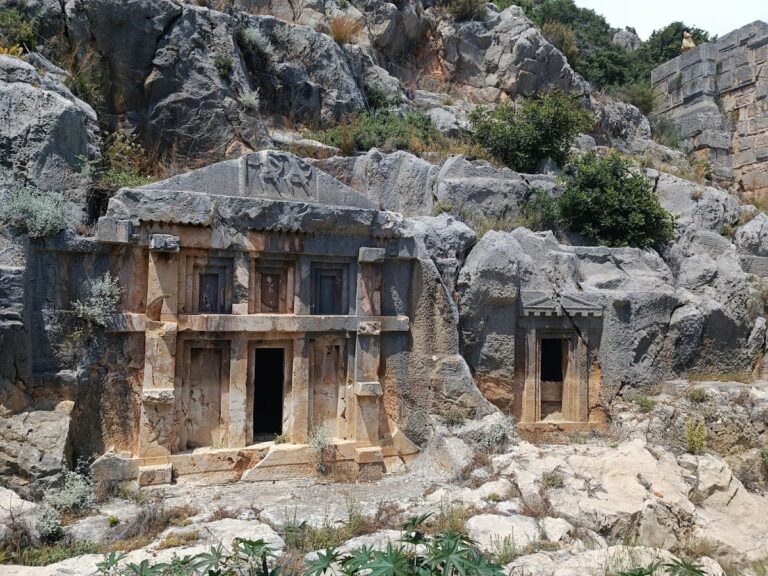
Above the theatre, the isolated Doric Tomb is cut directly into the rock as a cube about 4.5 metres on each side. Its east-facing entrance is 1.9 metres high and opens into a single chamber. A relief of dancing girls covers part of an interior wall. The figures became grimy when the tomb was used as a shepherd’s shelter, and the clothing shown in the relief places the monument in the first half of the fourth century BCE.
The tomb has a moulded base and a shallow pilaster at each corner, although only one capital survives. A band decorated with mutules, short projecting blocks, remains on the south side. The entrance was originally closed by a sliding door and retains its moulded frame.
Other tombs and inscriptions
Rock-cut tombs continue into the cliffs beyond the modern town. One contains a Lycian inscription together with a later Latin inscription. Other hillside monuments include a sarcophagus set on a high base and carrying a long inscription in Milyan. Groups of inscribed and plain sarcophagi were also among the remains described during nineteenth-century visits, although many were later dismantled for building material.
Temple and inscribed remains
The lower portion of a small temple survives to a height of five courses of rectangular ashlar blocks. It was built in the first century BCE and received additions about four centuries later. The deity to whom it was dedicated is unknown.
The earliest Lycian and Greek inscriptions associated with Antiphellos date from the fourth century BCE. An inscription copied by Fellows in 1840 includes the ethnic designation “of the Antiphellitans.” Architectural elements from the ancient city are also preserved in the Antalya Museum, extending the surviving material record beyond the remains in modern Kaş.