Letohrádek Hvězda: A Renaissance Hunting Lodge and Cultural Monument in Prague

Visitor Information
Google Rating: 4.7
Popularity: Medium
Google Maps: View on Google Maps
Country: Czechia
Civilization: Unclassified
Remains: Military

History
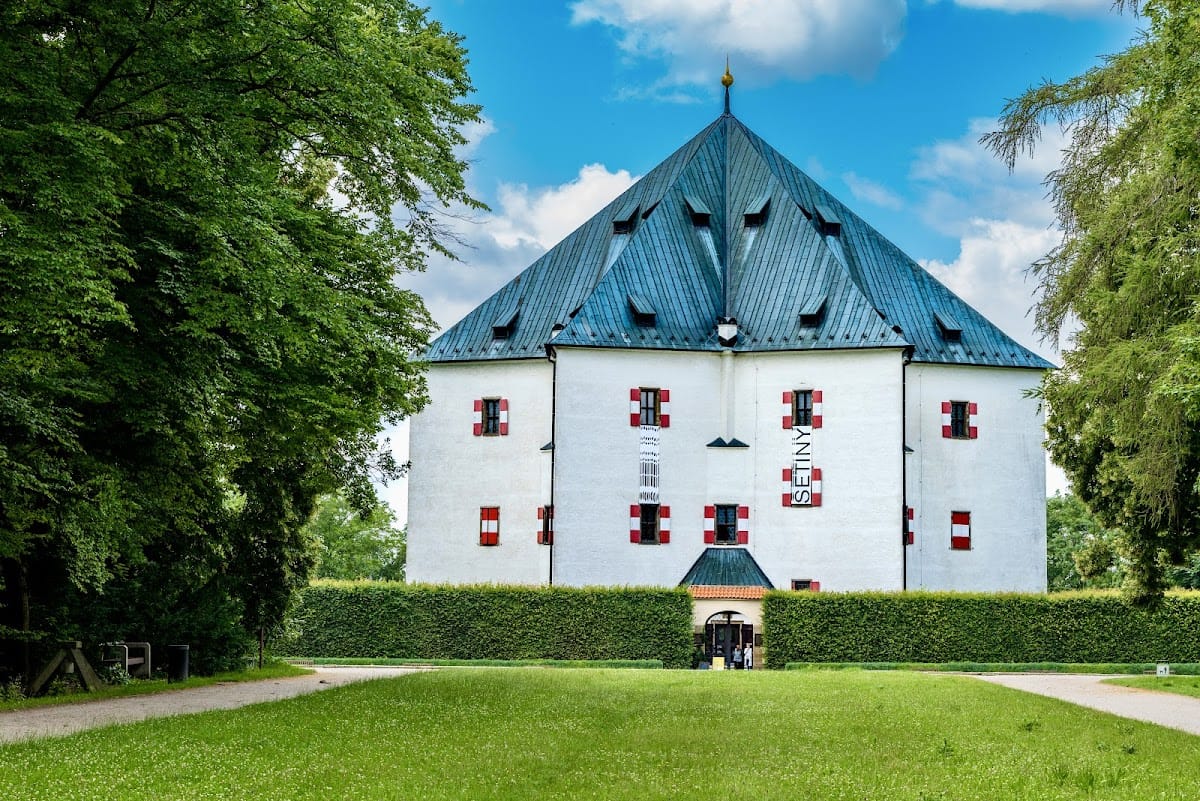
Letohrádek Hvězda is a Renaissance hunting lodge located in the municipality of Prague, Czechia. It was built by the Habsburgs during the 16th century as a summer palace within a royal game reserve.
The story of this site begins in the early 16th century when King Ferdinand I acquired a large tract of forest known as Malejov in 1534 from the Břevnov Monastery. This woodland was transformed into a royal hunting preserve called Nová královská obora, or the New Royal Deer Park. To protect the game and mark the boundaries, the area was initially enclosed by a wooden fence and subsequently surrounded with stone walls constructed between 1541 and 1563.
Construction of the palace itself started on June 27, 1555, with Ferdinand of Tyrol, son of King Ferdinand I, laying the first stone personally. The building efforts were led first by Giovanni Maria Aostralli and then Giovanni Lucchese, with overall management initially by Hans Tirol and later by Bonifác Wolmut beginning in 1556. Italian artists such as Giovanni de Spatio and Pietro de Ferrabosco decorated the lower floor with stucco and sculptures in antique styles between 1556 and 1560. The upper hall was adorned with paintings by Czech artists in 1562, though those works have not survived.
Letohrádek Hvězda gained prominence as a venue for important royal occasions. It hosted grand celebrations marking the coronation of Ferdinand I as Holy Roman Emperor in 1558, the accession of Maximilian II as King of Bohemia in 1562, and later the succession of Matthias in 1611. In 1619, the palace welcomed Frederick V, known as the “Winter King,” during his brief reign. Moreover, in November 1620, it served as a gathering place for troops preparing for the critical Catholic assault that culminated in the Battle of White Mountain.
Following the battle, Emperor Ferdinand II ordered restorations that adapted the palace for more residential and ceremonial uses. The first floor was converted into living spaces, while the second floor became a hall for court functions. In 1674, the hall was decorated with battle scenes by court painter Jonas Falck, reflecting the palace’s martial associations. Earlier, Emperor Ferdinand III had restored the building in 1652 to accommodate visiting German electors, including Charles Ludwig, son of Frederick V.
During the 18th and 19th centuries, the palace’s role shifted to military purposes. By the order of Emperor Joseph II in 1780, it was used as a military warehouse, and later served again as an ammunition depot until 1874, when it was officially recognized as a historic monument. Concurrently, the former game reserve surrounding the palace was landscaped into a park setting by the early 1800s.
In the mid-20th century, specifically in 1948, an extensive restoration was undertaken led by Pavel Janák, with the aim of creating a museum devoted to Czech cultural figures Alois Jirásek and Mikoláš Aleš. Since 1962, Letohrádek Hvězda has been protected as a national cultural monument in the Czech Republic and presently includes an exhibition focused on the Battle of White Mountain.
Remains
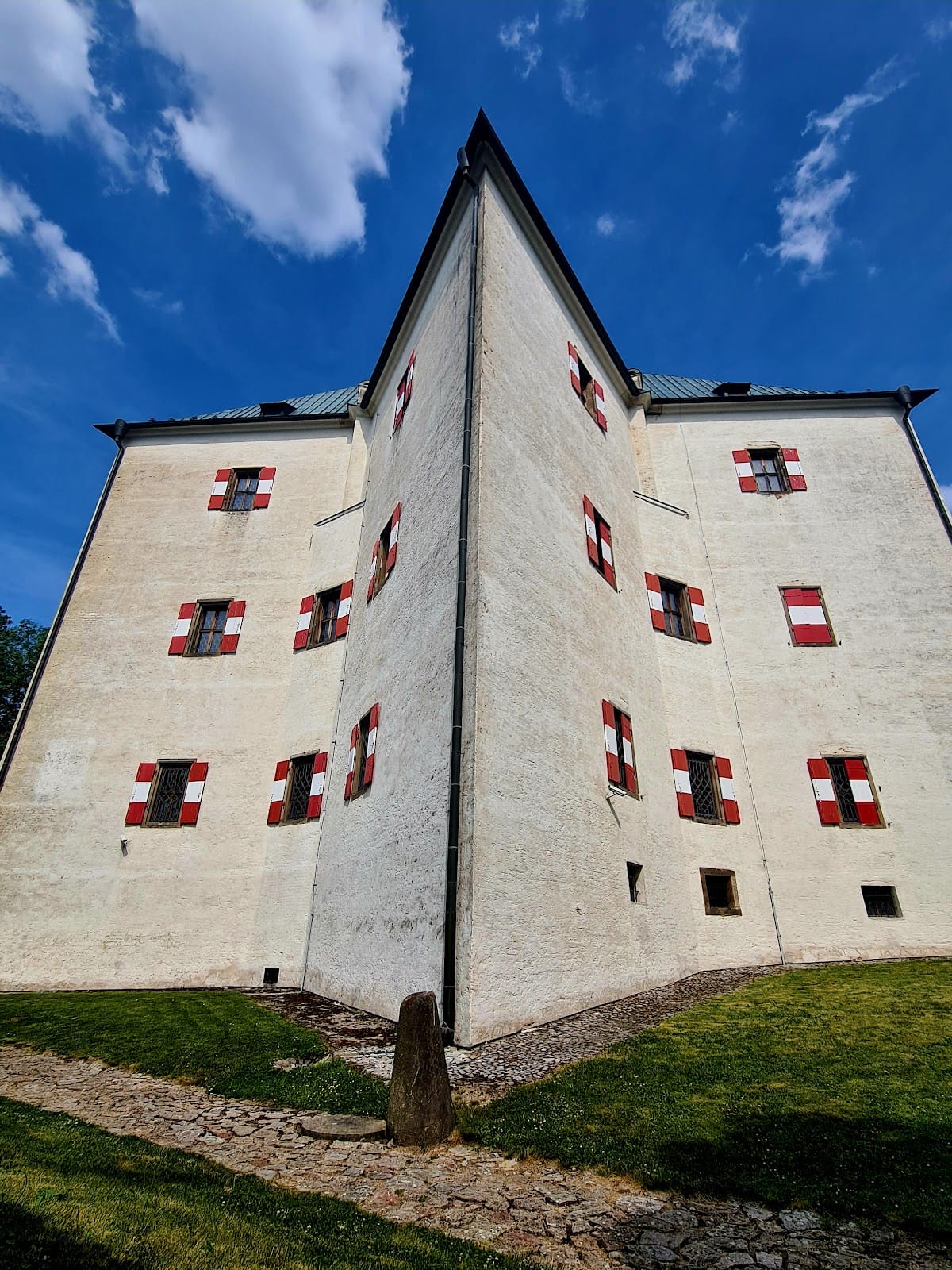
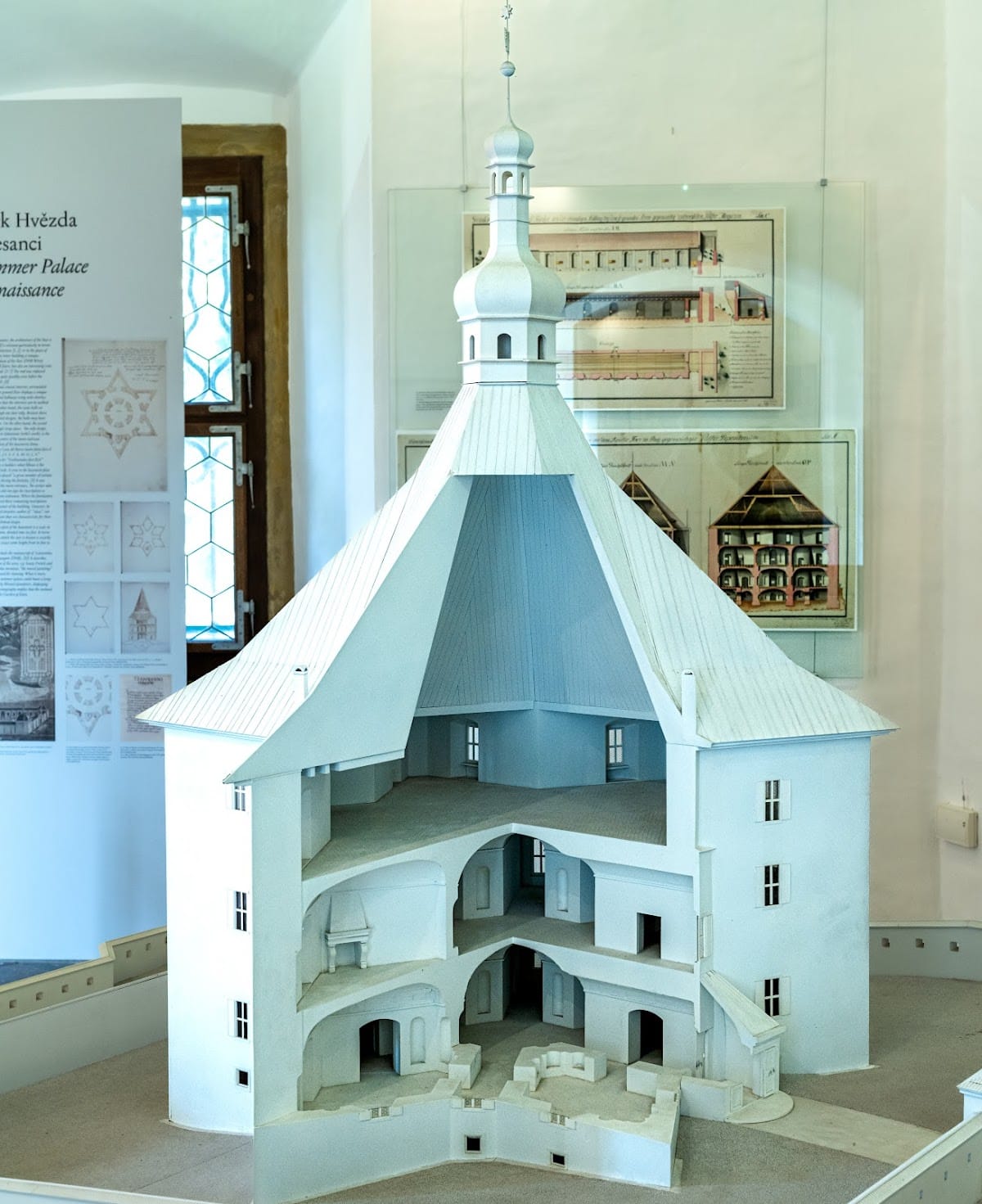
Letohrádek Hvězda stands out due to its distinct star-shaped floor plan, created by overlapping two equilateral triangles to form a six-pointed star. This design, evoking the Star of Solomon, was inspired by Renaissance ideals of the perfect fortress and reflects concepts of defense and harmony. The name “Hvězda,” meaning “Star,” derives directly from this architectural form.
The palace itself rises four stories tall and has maintained much of its original structure since the mid-16th century. Roof replacements occurred in the 17th century and again in 1780, when the earlier taller roof, featuring a lantern, was replaced by the current simpler style, which remains to this day.
Inside, the lower floor showcases elaborate stucco decorations, sculptures, and ornamental details executed by Italian artists. These include motifs drawn from classical mythology, a common theme in Renaissance and later Baroque interiors of the region. While the upper hall was once decorated with paintings by local Czech artists, these artworks are no longer extant.
Beneath the pavilion, on the terrace, a special hall was constructed by 1558 to accommodate ball games, a pastime of the period. This galleria was built under the direction of Bonifác Wolmut and is part of the palace’s original entertainment facilities.
Surrounding the palace lies the former royal game reserve, once enclosed by stone walls to protect the hunting grounds. These walls were constructed between 1541 and 1563 and extended with several gates added up to 1723. The last of these, the Saint Mark gate, was erected by Jacobo Canevale, marking a later phase of boundary enhancement for the reserve.
Today, Letohrádek Hvězda is preserved as a national cultural monument. Its historical fabric, from the unique star-shaped plan to the decorative stucco work and game reserve enclosures, remains intact and accessible, providing insight into Renaissance court life and military history in the Czech lands.
Nearby sites