Great Witcombe Roman Villa: A Roman Estate in Gloucestershire, UK
Visitor Information
Google Rating: 4.2
Popularity: Very Low
Google Maps: View on Google Maps
Country: United Kingdom
Civilization: Roman
Remains: Domestic

History
Great Witcombe Roman Villa is located near Brockworth, Gloucester, in the United Kingdom. It was built during the Roman occupation of Britain, with its initial construction dated between 150 and 200 AD. The villa was part of a group of wealthy estates in the Cotswolds, inhabited by a prosperous family along with slaves and freedmen. This settlement likely lasted for about two centuries, ending around the close of Roman Britain in the early 5th century.
The villa’s owners may have had political or economic ties to the nearby Roman town of Glevum, now Gloucester, situated roughly five miles away. This proximity provided easy access to Roman roads and markets, facilitating trade and communication. Over time, the villa expanded, with enlargements continuing into the late 3rd and 4th centuries.
Around AD 380, the villa underwent significant changes. Some walls were deliberately dismantled to reuse stone elsewhere, and the hypocaust system, an underfloor heating method, was filled in. These alterations suggest a decline in the villa’s luxury and a shift in how rooms were used, possibly repurposed for storage. This period marks the beginning of the estate’s gradual decline.
The villa was likely abandoned by the 5th century, coinciding with the end of Roman rule in Britain. This abandonment followed a time of economic hardship and military instability across the region. Nearby, a lost building believed to be a nymphaeum, a temple dedicated to water nymphs, indicates a religious connection to the villa’s natural springs. Archaeological finds, such as animal bones and a small statue near the temple’s drainage system, support the presence of ritual offerings linked to this cult.
A carved stone bearing a fish symbol was found near the site in 1966 but was later identified as a modern forgery, unrelated to the villa’s authentic history.
Remains
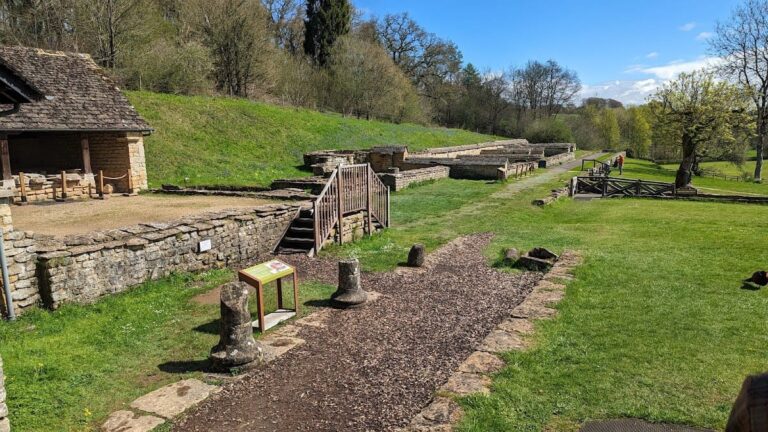
Great Witcombe Roman Villa is built on a hillside with uneven terrain, featuring small streams and natural springs. To adapt, the villa was constructed on four terraces cut into the slope and supported by strong retaining walls. Its original layout was a symmetrical U-shape with two main wings. The west wing contained two bath-houses, while the east wing housed kitchens and storerooms. A rectangular dining room extended north from the central part, possibly open on one side.
The villa had upper floors above both wings and likely above the central walkway. The main living quarters were in the large eastern wing. A long gallery connected this area to the leisure wing, which included the bath house and a temple or shrine.
The bath house, located in the north-west wing, featured an L-shaped latrine near the dressing room, known as the apodyterium. The cold room, or frigidarium, contained at least one plunge pool, possibly two, with one pool now separated due to landslides. This room also had a well-preserved mosaic floor depicting fish and sea creatures. The warm room, called the tepidarium, showed remains of an underfloor heating system known as a hypocaust.
Stone drains from the latrine remain visible today, although original sandstone fittings were removed in the late 4th century. The latrine walls were plastered and painted white with red stripes and pink patches. Access was through a passageway with a mosaic floor.
The shrine or temple room, accessible only by a staircase from a higher terrace, had stuccoed walls painted in colored panels. Niches likely held statues, and a possible altar base was present. A small cistern fed by a drainage system collected water. Animal bones and a small statue found in the drain suggest ritual offerings took place here.
A large octagonal room built in the 4th century connected to the long gallery. Its purpose is uncertain but may have served as a reception area or grand entrance rather than a religious space.
The villa’s mosaics are notable for their detailed marine designs, including an electric ray, a sea creature unique in Roman Britain. These mosaics were made from local stone and reused tiles, with very small tesserae (mosaic pieces) indicating skilled craftsmanship.
Roof and bath tiles were produced on site, as shown by discarded defective tiles found in nearby streams.
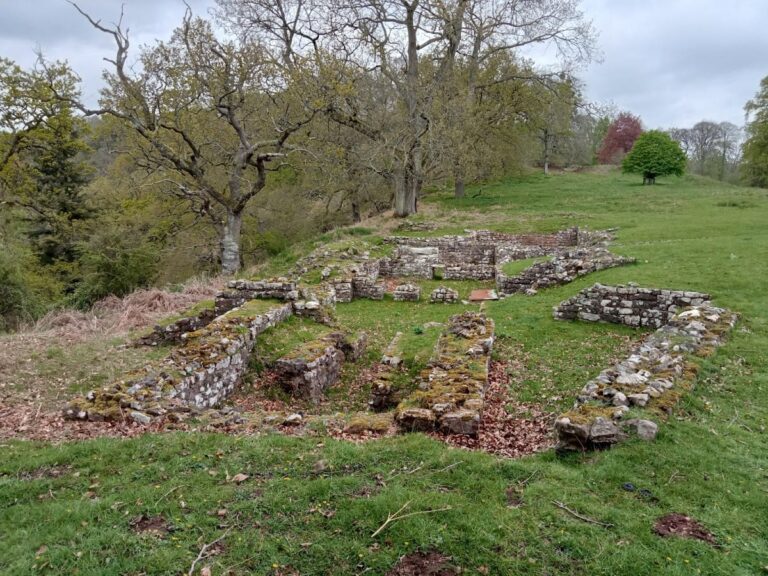
Today, the remains mainly consist of low walls outlining the villa’s shape. Two parts of the bath house are protected by small shelters and are not open to the public. Preservation has suffered due to poor conservation and weathering, with most original features like six-foot-high walls and plaster lost. Some plaster fragments remain on the latrine walls.
Nearby sites