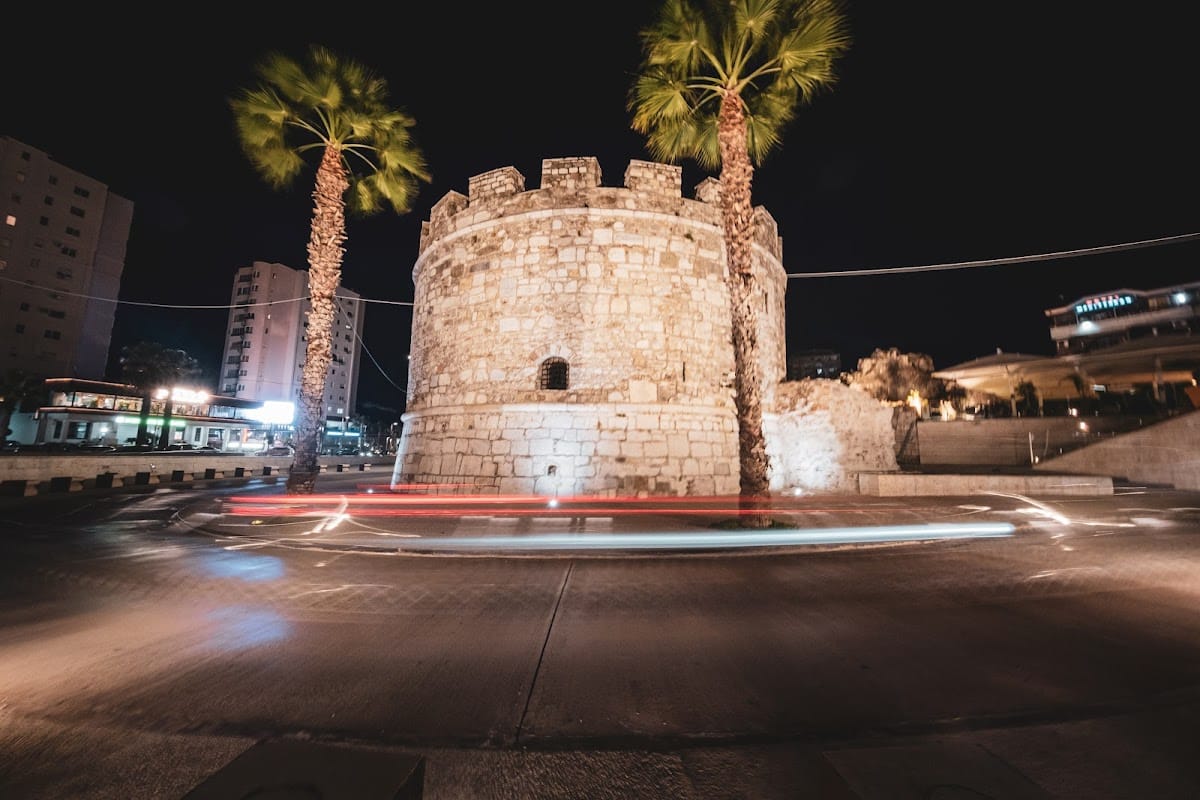
Durrës Castle: A Historic Byzantine Fortress in Albania



Visitor Information
Google Rating: 4.4
Popularity: Medium
Google Maps: View on Google Maps
Country: Albania
Civilization: Unclassified
Remains: Military

History
Durrës Castle is located in the municipality of Durrës in modern-day Albania and was originally constructed by the Byzantine Empire. The fortifications were built during the late 5th century under Emperor Anastasius I, a native of the city then known as Dyrrhachium. He reinforced the settlement to serve as one of the strongest defensive sites along the Adriatic coast.
The castle witnessed significant challenges over the centuries. In 1273, a strong earthquake severely damaged its walls, but repairs soon followed. During the Venetian period beginning in 1392, the fortifications were further strengthened with the addition of guard towers and repairs to the existing walls, adapting the defenses to new military needs. Control later passed to the Ottoman Empire from 1501 until 1912, when the fortifications were modified to protect a reduced city area. The Ottomans reused stones from older parts to build a smaller, more defensible enclosure within the original fortifications.
In the medieval era, the castle was well known and even described by the Byzantine princess and historian Anna Komnene in the 11th century, who noted the walls were wide enough to allow four horsemen to ride side by side. However, by modern times only about one-third of the original walls have survived. An important episode in the 20th century was the defense of Durrës Castle during the Italian invasion of Albania on 7 April 1939, when a small group of 360 Albanian soldiers led by Abaz Kupi and Mujo Ulqinaku resisted the Italian forces for several hours before surrendering.
Near Durrës, about seven kilometers to the north, lies a smaller fortification known as “Porto Romano.” This coastal triangular enclosure, situated on a hill, is thought to have been built during the reign of Emperor Justinian I in late antiquity, providing strategic defense related to the same historic context as Durrës Castle itself.
Remains
The remains of Durrës Castle enclose the historic city within irregular quadrilateral walls, which originally stretched approximately 1100 meters along the longest southwestern side, with other sides measuring between 700 and 800 meters. These fortifications combine construction techniques from different eras, including Byzantine and Roman influences. The walls and towers that have survived stand today at around 4.6 meters (15 feet) tall, representing roughly one-third of the initial fortification circuit.
Among the defensive structures were pentagonal and rectangular towers, some dating back to Roman times. The main entrance was located on the northeast side of the walls, historically marked by a bronze equestrian statue referenced by Anna Komnene. Tower designs from Emperor Anastasius I’s period were especially tall, reaching about 18 meters, and typically had three floors. The ground floor was windowless and used for storage, accessible internally by a rear door, and twice as high as the upper levels. The upper floors were designed for defense with multiple embrasures for firing, covered by vaulted ceilings and topped with battlements for protection.
Venetian rulers enhanced the city’s defenses by adding several guard towers and repairing sections of the walls. Later, Ottoman modifications in the late 15th century significantly altered the fortifications by reducing the defended area, incorporating newer walls resting on earlier Venetian foundations at an elevation of 59 meters. This restructuring excluded certain areas such as the acropolis, thereby focusing defense on a smaller perimeter.
The acropolis area contains the preserved Tower of Teodor Komnenos, constructed in 1225. In the mid-19th century, this tower stood about 10 meters tall and remains a key medieval feature of the site. Its sturdy construction and historical association reflect the importance of this part of the city’s defenses.
The nearby coastal fortification called “Porto Romano” is a triangular enclosure situated atop a hill about 80 meters above sea level. Built with a mix of stone and brick masonry, it includes a rectangular tower and a gate, and is attributed to the reign of Emperor Justinian I. It is an independent defensive structure connected to the broader fortification system of the region during late antiquity.
Current conservation efforts, initiated as part of the EU4Culture project, focus on the Venetian tower within Durrës Castle. These restorations aim to preserve original architectural features while integrating modern multimedia elements to highlight the site’s historical importance. This balance seeks to maintain the structural integrity of the walls and towers while allowing for educational interpretation.