Dunnottar Castle: A Historic Scottish Fortress on the North Sea Coast



Visitor Information
Google Rating: 4.8
Popularity: High
Official Website: www.dunnottarcastle.co.uk
Country: United Kingdom
Civilization: Medieval European
Site type: Military
Remains: Castle

History
Dunnottar Castle stands on a rocky headland near Stonehaven, Scotland. Its origins trace back to the Early Middle Ages, with fortifications believed to have existed on the site since that time. The area was initially controlled by the Picts, an ancient people of Scotland, as indicated by two sieges recorded in the Annals of Ulster in 681 and 694, linked to King Brude’s expansion. In 900, King Donald II of Scotland died defending the fortress against Viking invaders. Later, in 934, the English King Æthelstan raided the region, showing the site’s early strategic importance.
By the late 12th and early 13th centuries, Dunnottar served as a local administrative center under King William the Lion. It also appears in the early 13th-century Arthurian romance Roman de Fergus, reflecting its cultural presence. During the Wars of Scottish Independence, William Wallace reportedly captured the castle from English forces in 1297. According to legend, he burned 4,000 English prisoners alive in the church, a grim episode tied to the castle’s history.
In 1336, English King Edward III ordered partial reconstruction and fortification of Dunnottar. However, Scottish forces led by Andrew Murray recaptured and destroyed the castle the same year, demonstrating the ongoing conflict between England and Scotland. The Keith family acquired the castle in the 14th century. William Keith completed the tower house but was excommunicated for building on consecrated ground. This excommunication was lifted by Pope Benedict XIII in 1395. The Keiths became Earls Marischal and held Dunnottar until the 18th century.
The 16th century saw significant rebuilding under George Keith, 5th Earl Marischal, who transformed the fortress into a more comfortable residence. He added a palace and restored the chapel. The castle hosted notable visitors including James IV, Mary Queen of Scots, and James VI, marking its importance as a noble residence. During the 17th-century civil wars, Dunnottar was a stronghold for the Covenanters, Scottish Presbyterians opposing royal interference in the church. William Keith, 7th Earl Marischal, supported the Covenanters and later the Engagers, fighting at the Battle of Preston in 1648. Charles II visited the castle in 1650.
Dunnottar is famously linked to the protection of the Honours of Scotland, the Scottish crown jewels. In 1651, during a siege by Oliver Cromwell’s forces, Christian Fletcher and others smuggled the jewels out and hid them at Kinneff Church. They remained concealed until the monarchy was restored in 1660. In 1685, the castle’s vault was used to imprison 167 Covenanters who refused allegiance to King James VII. Many prisoners died or were transported to New Jersey.
In the late 17th and early 18th centuries, Dunnottar was used by both Jacobite and Hanoverian forces. The 10th Earl Marischal took part in the 1715 Jacobite Rising, which led to the forfeiture of his titles and estates. After this, the castle was sold in 1720 to the York Buildings Company, which dismantled much of the structure. Ownership changed several times until the 20th century when the Pearson family purchased and restored the site. Today, Dunnottar Castle is recognized as a scheduled monument.
Remains
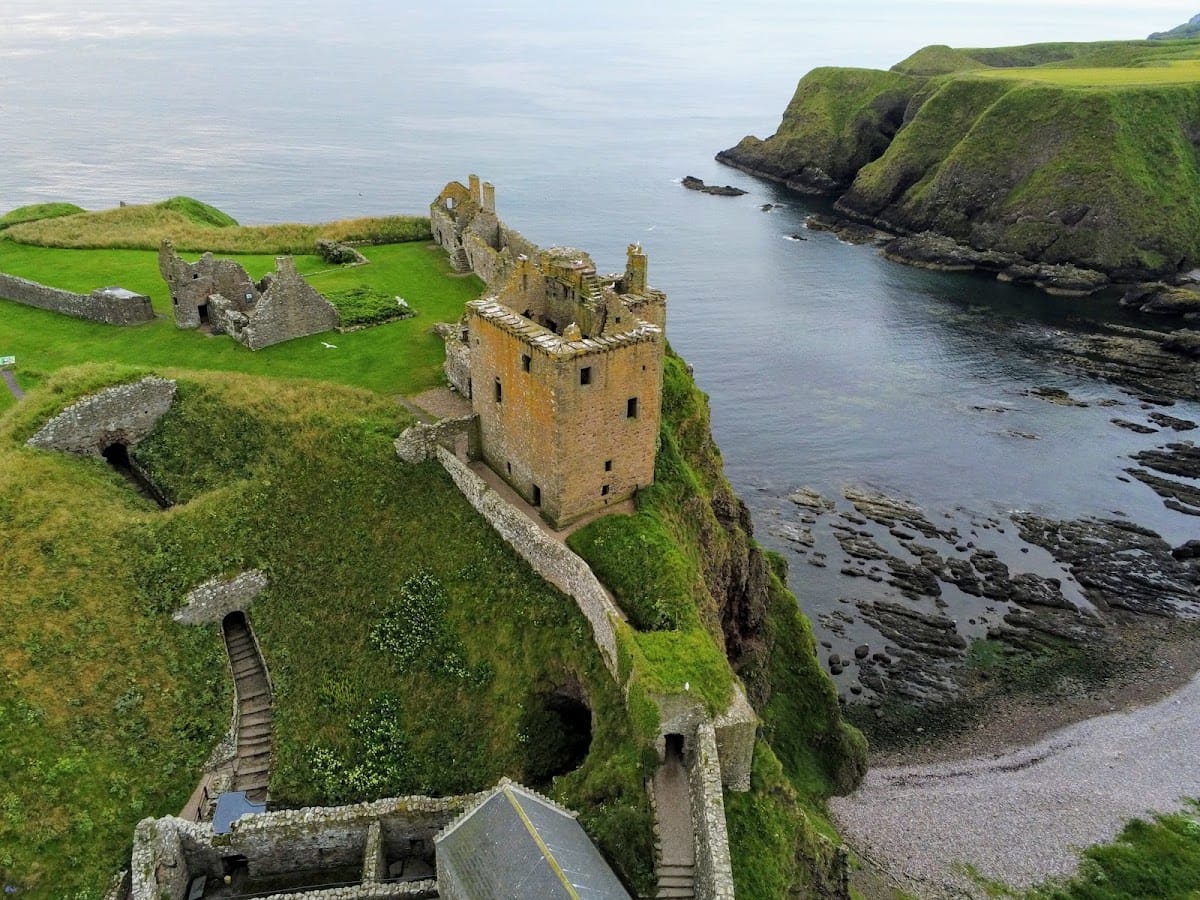
Dunnottar Castle occupies about 1.4 hectares on a headland surrounded by cliffs rising 49 to 50 meters above the North Sea. The site is connected to the mainland by a narrow strip of land with a steep path leading to the main gatehouse. The castle’s layout includes a curtain wall blocking a cliff cleft, with a heavily fortified gatehouse featuring a portcullis and partially blocked gates.
Adjacent to the gatehouse is Benholm’s Lodging, a five-storey stone building from the 16th century. It is built into the rock and contains a prison below with apartments above. This lodging has three tiers of gun ports facing outward and four facing the entrance. The entrance passage turns sharply and runs underground through two tunnels to the 14th-century tower house.
A secondary access route leads from a rocky cove and marine cave to a fortified postern gate on the cliff top. This gate connects to the Water Gate in the palace, providing a discreet entrance. Earthwork artillery defenses protect the castle’s northwest and southeast corners, with a small sentry box overlooking the eastern battery.
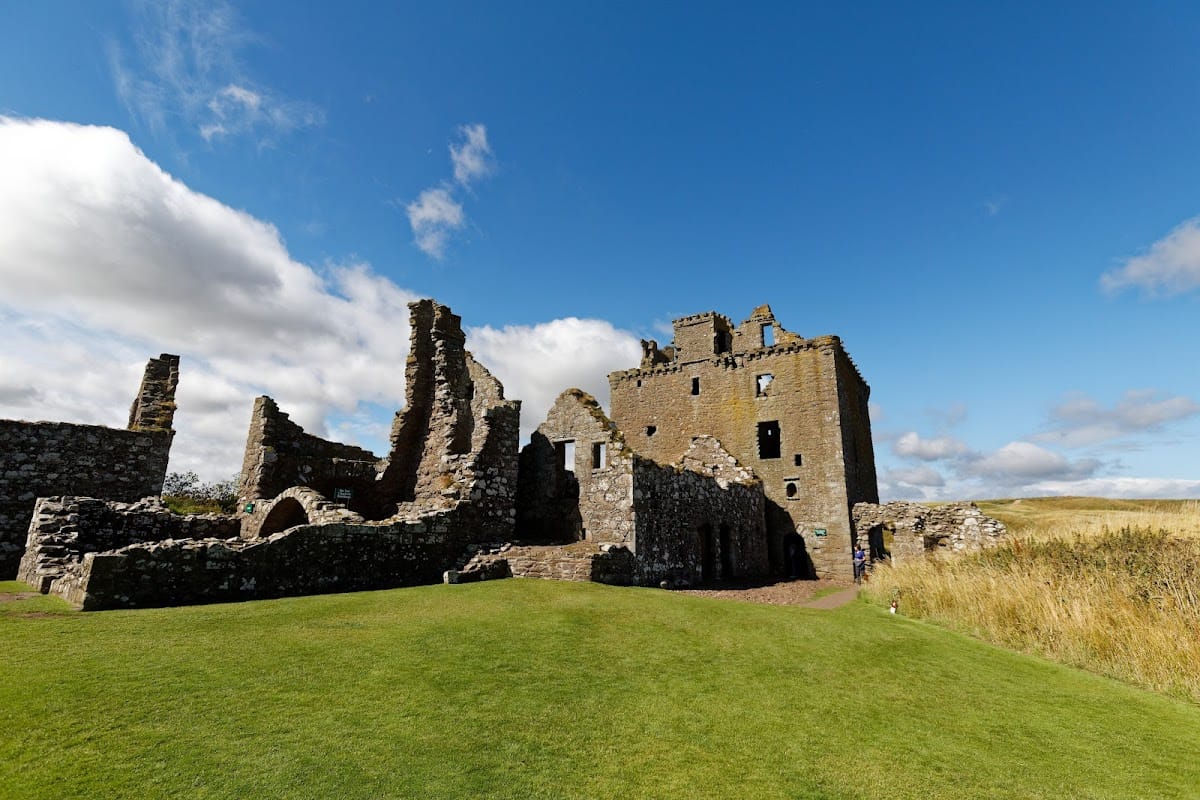
The 14th-century tower house measures roughly 12 by 11 meters and originally rose four stories plus a garret, standing about 15 meters tall. It includes a stone-vaulted basement, a great hall, private chambers, bedrooms, a storehouse, a blacksmith’s forge with a large chimney, and a stable block along the southern edge.
Waterton’s Lodging, also known as the Priest’s House, dates from around 1574. This small building contains a hall and kitchen on the ground floor, private chambers above, and a projecting spiral staircase on its north side.
The palace, built in the 16th and 17th centuries, sits on the northeast cliffs. It is arranged in three wings around a quadrangle. The west range features seven identical lodgings with windows and fireplaces, above which was a 37-meter gallery with an elaborate oak ceiling and a Roman tablet from the Antonine Wall. The palace’s north range basement housed kitchens and stores, with a dining room and great chamber above. The Water Gate at ground level connects to the postern gate.
The east range contains a larder, brewhouse, and bakery on the ground floor, with the countess’s apartments above. The northeast wing holds the Earl’s apartments, including the “King’s Bedroom,” where Charles II stayed. This room is marked by a carved stone bearing the 7th Earl’s arms dated 1645. Beneath these apartments lies the Whigs’ Vault, a cellar about 15.8 by 4.6 meters with a large eastern window and a lower vault accessed by a trapdoor.
Only the dining room and the Silver House in the palace retain their roofs, restored in the 1920s. The quadrangle’s center contains a circular cistern or fish pond approximately 15 meters in diameter and 7.6 meters deep. A bowling green lies to the west of the quadrangle.
The 13th-century chapel, consecrated in 1276 and largely rebuilt in the 16th century, retains medieval walls and two original 13th-century windows. A graveyard lies to its south. The castle is protected as a scheduled monument. Twelve structures were listed in 1972, with the keep, main gatehouse, and Benholm’s Lodging designated as nationally important, though these listings were removed in 2018 during a Historic Environment Scotland project.
Nearby sites