Drum Castle: Historic Seat of Clan Irvine in Scotland


Site at a Glance
- Rating
- 4.6
- Popularity
- Medium
- Country
- United Kingdom
- Primary era
- Medieval
- External website
- Open
- Eras represented
- Medieval, Early Modern, Modern
- Civilizations
- British, Kingdom of Scotland
- Site type
- Military
- Remains
- Castle
On this page9 sections
History
Drum Castle is a medieval castle in the United Kingdom, near Drumoak in Scotland. Its medieval core is a thirteenth-century tower house, approximately dated to 1280–1300, and the castle served for centuries as the seat of the chief of Clan Irvine. Its name comes from the Gaelic word druim, meaning “ridge.” The original tower may have been built by Richard Cementarius, a medieval architect associated with major masonry works in the Aberdeen area.
Royal grant and Irvine ownership
In 1323, Robert the Bruce, king of Scots from 1306 to 1329 and leader of the Scottish struggle for independence against English rule, granted Drum Castle and its grounds to William de Irwyn for loyal service. William, associated with the Irvines of Bonshaw, had served the king as armour bearer and secretary and was also his neighbour. The estate remained with Clan Irvine until 1975. A laird was the proprietor or territorial landholder of a Scottish estate, and the castle’s lairds shaped its history across successive generations.
Drum entered the wider political and religious conflicts of sixteenth- and seventeenth-century Scotland. In August 1564, Mary, Queen of Scots, sent a messenger to the Laird of Drum seeking provisions while travelling near Aberdeen, and she may also have visited the castle. In June 1636, Sir Alexander Irvine of Drum and his wife, Magdalene Scrimgeour, were censured for harbouring the outlaw Gilderoy. During the Covenanting Rebellion, a series of seventeenth-century Scottish conflicts involving opposition to royal religious policies, Drum Castle was attacked and sacked three times.
Expansion, conflict, and changing fortunes
The ninth Laird of Drum added a large wing in 1619. By the late seventeenth century, the Irvine family had been forced to sell much of the estate’s land, although it retained the land immediately around the castle. In 1746, government troops commanded by the Duke of Cumberland searched for Alexander Irvine of Crimond, the seventeenth Laird, who had fought for Bonnie Prince Charlie, the Stuart claimant whose 1745–1746 rising sought to recover the British throne for his family. Irvine reportedly hid at Drum in a secret room concealed by his sister Mary and allegedly remained there for three years while preparing his escape.
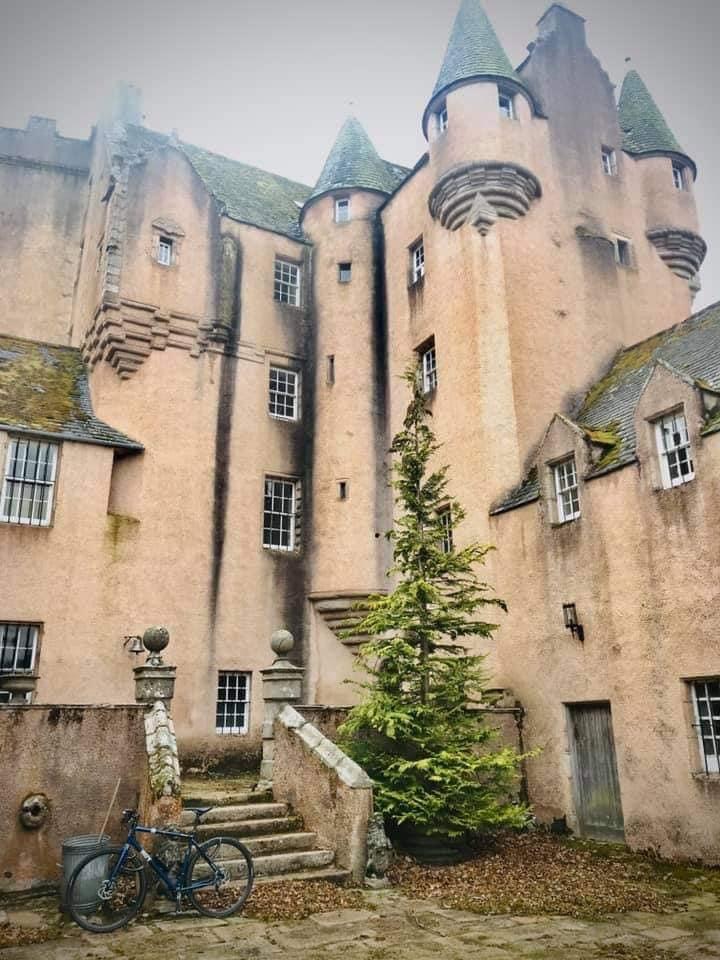
The castle underwent further alterations around 1800, 1840, and 1875, followed by additional changes during the Victorian era. Alexander Forbes Irvine of Drum inherited the estate in 1861. In 1875–1876, he arranged the restoration of the courtyard and the addition of an arched entrance and an angle tower, and he was partly responsible for restoring the chapel.
Transfer and archaeological discoveries
In 1964, H. Q. Forbes Irvine, the twenty-fourth Laird, agreed to transfer the property to the National Trust for Scotland. The agreement came into force in 1976, after 650 years of Irvine ownership, and the castle is now owned by the National Trust for Scotland. Drum Castle and its grounds were included in Scotland’s Inventory of Gardens and Designed Landscapes in 1987, and the castle has held Category A listed status since that year. The chapel, walled garden, and East Lodge have Category B status.
Archaeological work in 2013 uncovered two rooms that had been walled up in the 1840s. Their discovery prompted speculation that they may have been used to conceal Alexander Irvine in the mid-eighteenth century. Restoration work also revealed a hidden passage leading to the main hall. A Garden of Historic Roses was established in 1991. The castle was formerly served by Drum railway station on the Deeside Railway, whose service ended in 1951.
Remains
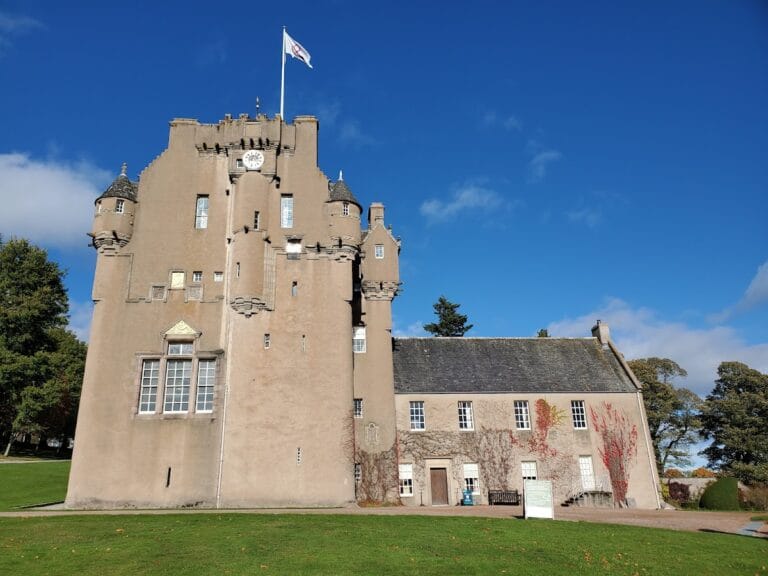
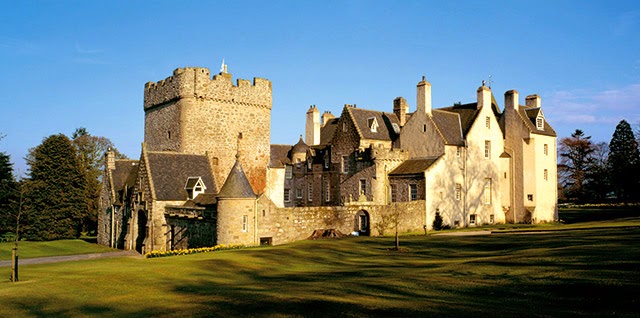
Drum Castle is organized around a medieval stone tower house, a later Jacobean wing, a courtyard, a chapel, and landscaped grounds. Its setting was associated with the Elsick Mounth, an ancient route across the Grampian Mountains that ended at a ford of the River Dee. This position is thought to have influenced the castle’s siting as a place from which traffic along the route west of Netherley could be monitored.
Medieval tower and later wings
The thirteenth-century tower house forms the medieval core. A tower house is a fortified residence centred on a tall stone tower, combining domestic accommodation with defensive features. Drum’s tower is approximately dated to 1280–1300 and is regarded as one of the three oldest tower houses in Scotland, with notably little alteration. The large wing added in 1619 is Jacobean, a style associated with the reign of James VI of Scotland and James I of England in the early seventeenth century.
Later work altered the castle’s outer appearance and internal arrangements. The courtyard was restored in the nineteenth century, while an arched entrance and an angle tower were added in 1875–1876. Other modifications took place around 1800 and 1840, with further changes during the Victorian era. The grand Victorian library contains more than 4,000 books.
Chapel
The chapel developed from an older church on the site. Its history includes medieval origins, modifications during the sixteenth and seventeenth centuries, and extensive renewal in the eighteenth century. In 1857, the west window was enlarged, a cross was added, a new roof was installed, and parts of the interior were restored. The chapel contains a stained-glass window and an Augsburg silver Madonna.
Sealed rooms and hidden passage
Two rooms discovered in 2013 had been sealed during the 1840s. Their form and later discovery have been associated with the tradition that Alexander Irvine of Crimond was hidden at Drum after the 1745–1746 rising. A concealed passage leading to the main hall was also found during restoration work.
Gardens and designed grounds
The grounds contain eighteenth-century gardens, a Garden of Historic Roses, an arboretum, and a walled garden. The rose garden is arranged in four distinct areas. The arboretum, a collection of trees cultivated for display and study, contains trees described as originating from regions of the former British Empire.