Château de Remilly-Aillicourt: An 18th-Century French Estate
Visitor Information
Google Rating: 4.7
Popularity: Very Low
Country: France
Civilization: Unclassified
Site type: Military
Remains: Castle

History
The Château de Remilly-Aillicourt is located in the commune of Remilly-Aillicourt in modern France and was constructed during the late 18th century by French builders. Its origins are tied to the independent initiative of Antoine Raulin, a textile manufacturer from nearby Sedan, who began erecting the residence in 1774 on a sizeable estate of thirty-five hectares.
Before Raulin could complete the château in 1777, ownership transferred to François Collin de Curemont, a Parisian lawyer who held the title of lord of Villers-devant-Mouzon. This change of hands marked the beginning of a lineage where the estate passed mainly through female heirs, connecting several notable families tied to regional governance and industry.
In the following decades, ownership merged with families involved in both the judicial and military spheres. Jean François Félix Dorival, who served as president of the Court of the Duchy of Bouillon, became an owner, linking the property to local judicial authority. Later, Louis Samuel Béchet, who served as an officer under Napoleon and was ennobled as General Béchet de Leocour, inherited the château, tying it to France’s military history.
The estate continued to remain prominent through successive heirs active in the local administration. Joseph Marie Lamour, who served as mayor of Remilly, held the property, followed by his descendants Albert Félix Lamour-Béchet de Léocour and Louis-Félix Lamour, the latter holding the title of marquis of Sainte-Valière and serving as a general councilor—a regional administrative position.
By the 20th century, the château experienced a period of transition. It was sold in 1933 and briefly used as a vacation home before being left unused for several decades. Restoration efforts began when Claudine and Philippe Mathieu purchased the estate, dedicating thirty-four years to its rehabilitation. Their work culminated in the château’s recognition as a historic monument in 1984, ensuring its preservation under French heritage protection.
Remains
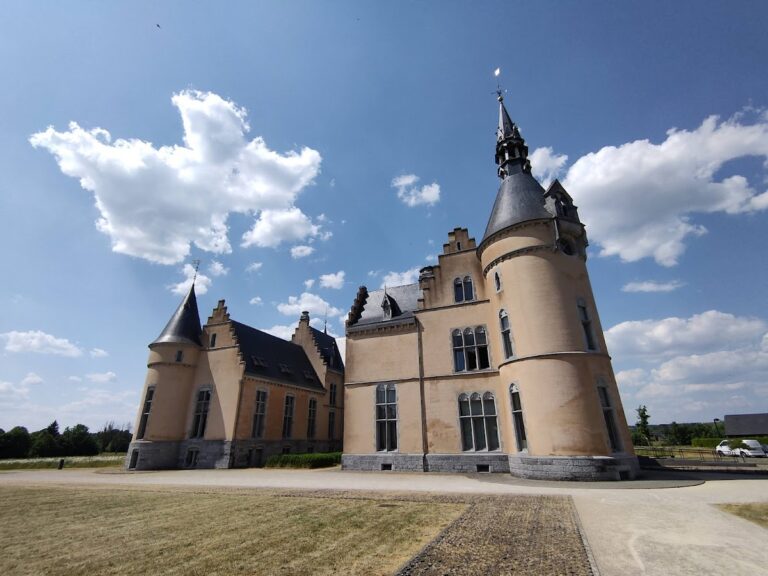
The château’s layout centers around a nearly square main residence topped with a Mansard roof, a style characterized by a double-sloped roof that creates additional living space under the eaves. The façade is crafted from carefully dressed stone blocks, presenting a refined appearance. Windows are accented with molded frames, and the central entrance is distinguished by recessed panels. Both windows and doors feature sculpted cartouches—decorative keystones carved to embellish the architectural openings.
Two curved, low wings, each comprising three bay divisions, extend from the main building and connect the central structure to smaller square pavilions made from rendered rubble stone. These wings and pavilions create a U-shaped configuration enfolding an entrance courtyard. This courtyard is enclosed by a perimeter wall and accessed through a gate framed by two ringed columns, adding a formal aspect to the approach.
Around 1870, an additional wing was appended to the left side of the entrance, modifying the original layout and expanding the château’s footprint. The estate occupies a landscape that includes gardens and five hectares of land descending toward the Meuse River, providing a scenic setting that integrates the natural environment with the built heritage.
The château stands on the main road D4B connecting Sedan and Mouzon, preserving both its structured architecture and its relationship to the surrounding territory, which historically combined industrial, administrative, and residential functions. The building is largely restored, reflecting the extensive preservation work that followed its period of abandonment.
Nearby sites