Château de La Cueille: A Historic Medieval Castle in Poncin, France

Visitor Information
Google Rating: 4.4
Popularity: Very Low
Country: France
Civilization: Unclassified
Site type: Military
Remains: Castle

History
The Château de La Cueille is located in Poncin, France, and was originally established by members of the Coligny family during the medieval period. The site first appears in written records from the 13th century under the names La Cuolly and La Cuyllie, reflecting its early identity as a fortified residence.
In the 13th century, the castle was described as a fortified house, or domus de Cuoli, under the ownership of the Coligny family, a prominent noble lineage. During this time, the castle was placed under the protection of the powerful Sires of Thoire and Villars, who were often called the “kings of the Mountains.” This political alliance was significant in maintaining the castle’s security and influence. In 1299, Etienne de Coligny sold Château de La Cueille to Humbert de Luyrieux, who in 1304 swore fealty to the sire of Thoire-Villars, demonstrating the shifting loyalties and feudal relationships of the era.
The Luyrieux family retained control of the castle for more than two centuries. Around 1500, ownership passed through marriage when Phillippa-Françoise de Luyrieux, daughter of Humbert and Catherine de Bourgogne—herself an illegitimate daughter of Philip the Good and half-sister to Charles the Bold—wed François Mareschal. This alliance brought the château into the Mareschal family as part of Phillippa-Françoise’s dowry. The oldest construction phases preserved at the site, dating from the 14th and 15th centuries, are attributed to the Luyrieux family’s tenure.
Later in the early modern period, the château passed to the La Chambre family. In 1639, ownership transferred to the La Poype de Granet family. By the 18th century, the de Quinson family held the estate, maintaining it through the time of the French Revolution in 1789. The castle’s role during these generations is linked to regional nobility and estate management rather than documented military conflict.
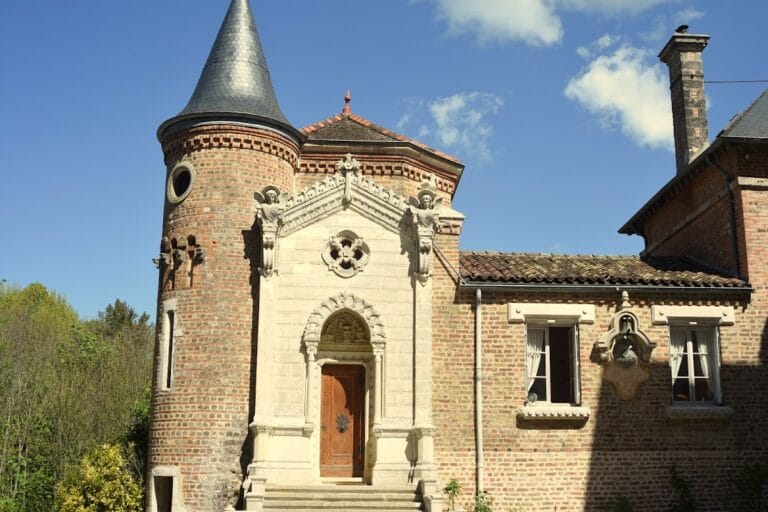
In the 19th century, the château belonged first to the de Seyssel family, then to Joachim Chavent, who initiated restoration efforts around 1860. These renovations were carried out with the assistance of architects Giroud from Saône-et-Loire and Savy from Lyon. After Joachim Chavent’s death, his widow continued the work to preserve the château’s historic character.
In the 20th century, the property passed to the heirs of the Chavent family, the de Montalembert family. A notable event during this period was the 1947 marriage of Philippe de Gaulle to Henriette de Montalembert, who lived at La Cueille. Since 2021, the château has been owned by the Poret family, who have begun restoration aimed at making the site more accessible in the future.
The château’s strategic location atop a promontory approximately 70 meters above the Ain River allowed it to control an important stretch of the waterway. Historically, the Ain River marked the border between Bresse and Bugey regions and served as a key route for transporting fir logs from the forests of Bugey and Jura to the markets of Lyon and the Mediterranean coast. This position contributed to the castle’s significance in overseeing trade and local territorial boundaries throughout its history.
Remains
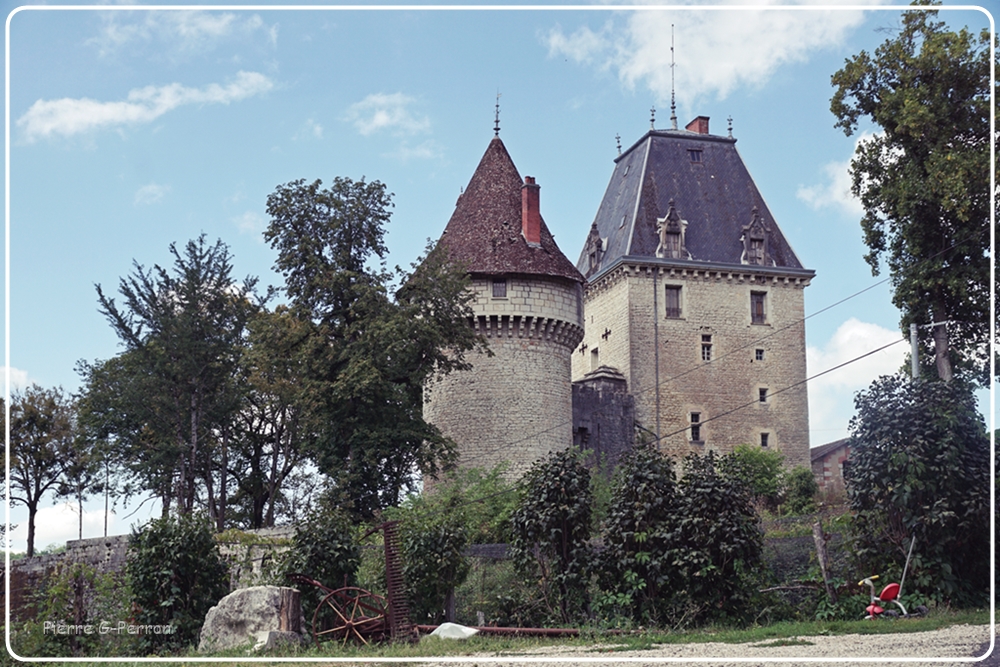
The Château de La Cueille is built on an almost triangular plan, with each side measuring roughly 65 meters in length. Originally, the site featured a fortified enclosure highlighted by at least seven defensive towers: one at each corner of the triangle and one positioned at the midpoint of each side. The most prominent among them was the donjon, or keep, situated on the northern side facing a nearby hamlet.
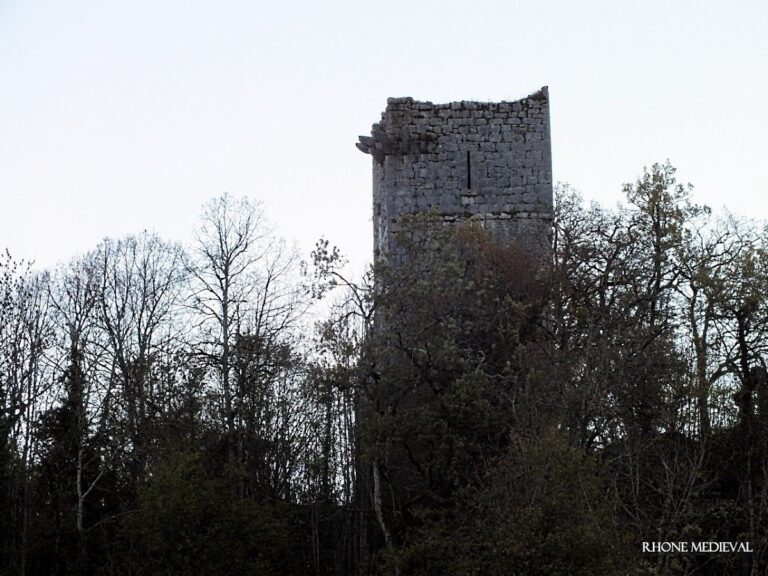
Today, three towers remain standing. Among these are two corner towers—one square and one round—and the square donjon. The donjon is believed to have been constructed in the 14th century, likely under the direction of a member of the Luyrieux family. This tower is distinguished by sculpted heraldic arms depicting a gold shield with a black chevron, a decoration that marks the family’s emblem. Inside the donjon is a notable hall, once referred to as an aula, which features two bays covered with rib vaulting—a form of arched ceiling that provides both structural support and an aesthetic pattern. This hall also includes a large fireplace, indicating its function as a heated reception or living space.
At the close of the 18th century, significant alterations were made to the château’s layout. The interior courtyard was leveled to create a more open surface, and two towers located on the southeastern and western curtain walls were partially demolished. These modifications aimed to open a large terrace with expansive views over the Ain valley, replacing earlier defensive structures with a landscape-oriented feature.
In the 19th century, additional buildings were erected against the north side of the château, outside the original enclosure. These outbuildings were constructed on the site of former moats and were intended to support vineyard activities on the estate. This development reflects an adaptation of the château grounds to regional agricultural practices, especially given the proximity to a small village known for producing Cerdon AOC wine. Nearby stands a Gothic chapel, which together with the vineyards, situates the château within a rural and viticultural environment that has characterized the area for centuries.
The remaining structures and landscape modifications at Château de La Cueille bear witness to its continuous evolution—from a medieval fortress controlling river traffic and regional borders to a noble estate embracing agricultural uses and later restoration efforts aimed at preserving its historical heritage.
Nearby sites