Château d’Usson: A Historic Fortress and Residence in France


Visitor Information
Google Rating: 4.4
Popularity: Low
Google Maps: View on Google Maps
Official Website: www.patrimoines.hauteariege.fr
Country: France
Civilization: Unclassified
Remains: Military

History
Château d’Usson is located in the hamlet of Usson-les-Bains within the municipality of Rouze in France. This fortress was originally constructed by medieval European nobility, with its earliest known records dating back to 1035 and probable origins in the 10th or early 11th century.
During the early Middle Ages, Château d’Usson formed part of the eastern frontier of the County of Foix. It was under the ownership of noble families, notably those of So and Alion, who held feudal authority in the region. In the 13th century, the castle became significant in the context of the Albigensian Crusade, a campaign against the Cathar religious movement. Bernard d’Alion, lord of Usson and a vassal to the Count of Foix, resided there. Though he appeared to submit to Simon de Montfort, a leader of the crusade, Bernard secretly supported the Cathars by sending troops and supplies during the siege of Montségur in 1244.
One day before Montségur’s fall on March 16, 1244, historical accounts indicate that some Cathars escaped to Château d’Usson. It is believed that the Cathar treasure had been transferred to the castle months earlier, making it a refuge during this final stand. Bernard d’Alion’s association with the Cathar cause led to his condemnation for heresy, culminating in his execution by burning in Perpignan between 1257 and 1258.
Following the religious conflicts, Château d’Usson served as a military border fortress amid ongoing disputes between France and Spain. This role persisted until the political landscape shifted with the Treaty of the Pyrenees in 1659, and the marriage of Louis XIV to Maria Theresa of Spain in 1660 sealed peace between the two kingdoms. Soon after these events, in 1638, Cardinal Richelieu ordered the dismantling of the castle since it no longer held strategic importance due to the revised border lines.
In the early 18th century, the castle underwent transformation from a military stronghold into a noble residence. In 1711, Louis XIV sold the property along with the Donezan region to the Marquis de Bonnac. Between 1712 and 1713, the Marquis enlisted architect Victor Canas to remodel the fortress, resulting in the addition of three towers and alterations to suit residential purposes.
The onset of the French Revolution led to the expulsion of the noble owners. Subsequently, Château d’Usson was sold and used primarily as a source of building stone. In the late 20th century, the ruins received legal protection as a historic monument starting in 1978, with modifications to this status in the 1990s. Restoration and conservation programs have since been carried out, revitalizing key parts of the castle and establishing a museum in the former stables to preserve its heritage.
Remains
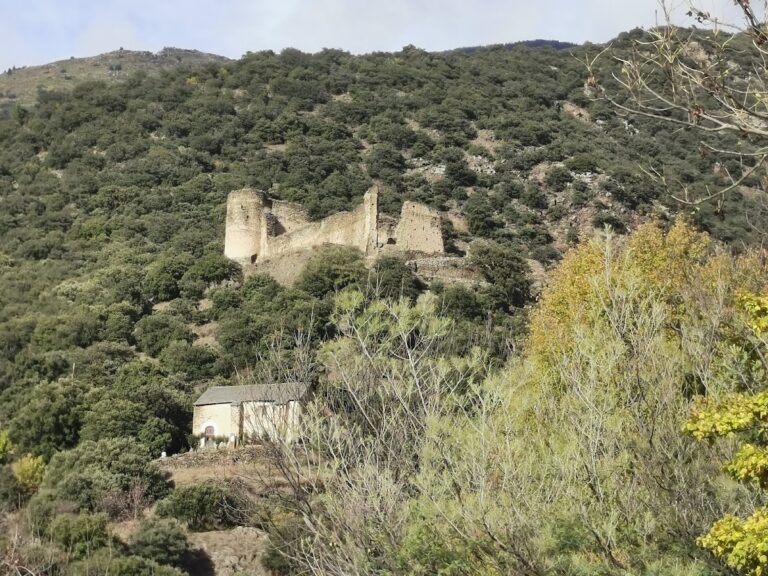
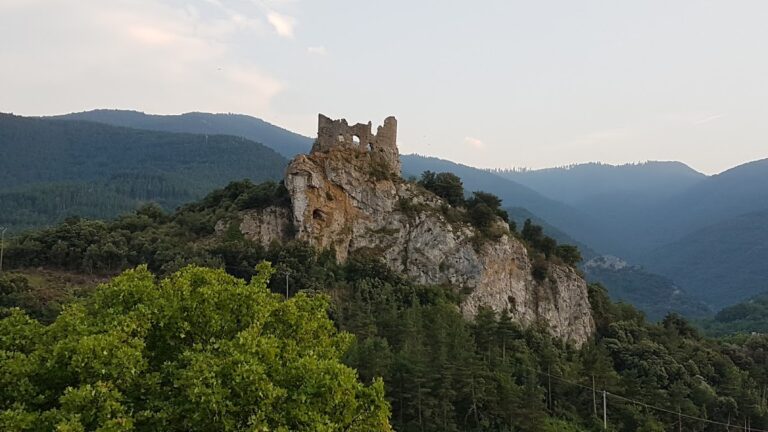
The ruins of Château d’Usson sit atop a rocky outcrop near the Aude River at roughly 920 meters above sea level, offering strategic views of the surrounding landscape. This elevated position suited its original defensive purpose while shaping its irregular layout conforming to the spur’s contour.
Among the surviving structures is a pentagonal donjon, or keep, which served as the stronghold’s central defensive tower during the medieval period. Its unusual five-sided plan reflects adaptations to the site’s topography rather than a standard design. Adjacent to the donjon stands a residential tower, indicative of the castle’s evolution toward habitation beyond purely military functions.
Remnants of the castle palace, once the noble family’s quarters and administrative center, remain visible within the complex. The walls seen today display construction techniques typical of medieval fortifications, with substantial masonry built to withstand siege and time.
In the early 18th century, the fortress was remodeled into a residence under Victor Canas’s direction. This phase introduced three towers that modified the castle’s silhouette and internal spaces, accommodating the needs of domestic life rather than warfare. These additions are integral to understanding the site’s transformation from fortress to noble manor.
Close to the main castle lies the 18th-century stable buildings, which have been restored and adapted to house a museum focusing on the local heritage. Archaeological excavations within the castle grounds have uncovered various artifacts, now exhibited there to illustrate the site’s long history and the daily life of its former inhabitants.
Preservation efforts over recent decades involved stabilizing the ancient masonry to prevent further decay. In particular, the tower located on the spur received careful consolidation, ensuring structural integrity and allowing it to be opened for educational purposes. These interventions respect the historical layers of the site while making its features accessible and understandable.
Château d’Usson today stands as a composite of medieval fortification and early modern adaptation, embodying centuries of regional history through its enduring stone remains.
Nearby sites