Castle Vicomtal Saint-Pierre de Fenouillet: Medieval Viscount’s Castle in France


Site at a Glance
- Rating
- 4.5
- Popularity
- Low
- Country
- France
- Primary era
- Medieval
- Eras represented
- Medieval
- Civilizations
- Unclassified
- Site type
- Military
- Remains
- Castle
On this page7 sections
History
Castle Vicomtal Saint-Pierre de Fenouillet is an 11th-century medieval hilltop castle in Fenouillet, France, built for the Viscount of Fenouillèdes. A viscount was a medieval noble who governed a territory, usually under a higher-ranking ruler. The castle served as the viscount’s seat and formed part of the Saint-Pierre castrum, a fortified settlement combining a stronghold with its surrounding community.
The Viscount’s Stronghold
The Saint-Pierre castrum stood at a crossroads of communication routes and dominated the castle settlement around it. Its position placed it opposite Sabarda castle, which was built in the early 12th century. The nearby ruins of Sabarda and Castel Fizel remain directly beside the site, illustrating the concentration of medieval fortified places in this part of Fenouillet.
Archaeology and Heritage Protection
Archaeological excavations have taken place at the site since 2000. The castle and castrum entered the French register of historic monuments on 27 October 2015. This designation is a French legal form of protection for buildings, structures, and archaeological sites recognized for their historical or architectural importance. The commune of Fenouillet currently owns the site.
Remains
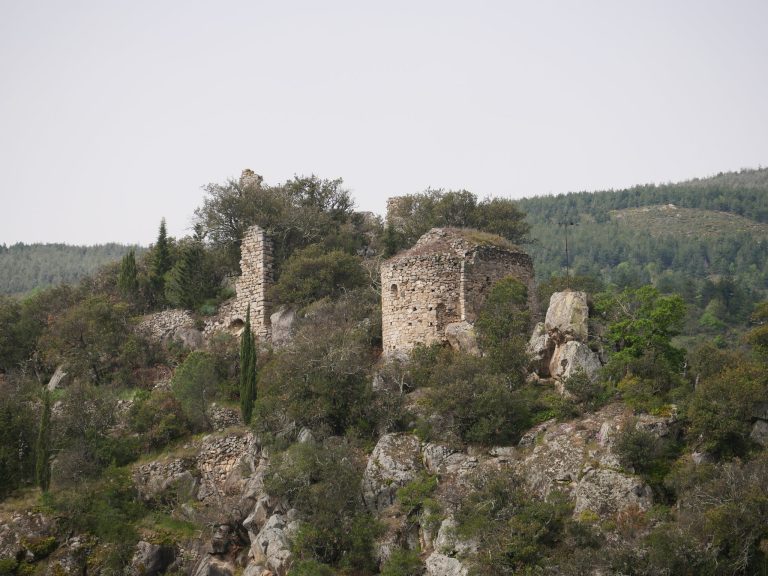
The castle complex occupies a rise beside the village and was arranged in terraces along the mountainside. Surviving elements preserve parts of the outer enclosure, internal buildings, and an 11th-century church, allowing the remains to be understood as a layered hilltop settlement rather than a single isolated structure.
Castle Enclosure and Internal Buildings
Outer Walls and Cellar
Sections of the outer walls survive around the medieval enclosure. Inside the castle, a vaulted cellar remains, together with fragments of walls belonging to internal buildings. These elements preserve parts of the complex’s defensive boundary and its built spaces across the terraced slope.
Romanesque Church
The enclosure also contains the remains of an 11th-century Romanesque church. Romanesque architecture is a medieval style associated with substantial masonry, rounded arches, and often thick walls. The church forms a distinct religious element within the fortified complex.