Kynžvart Castle Ruins: A Medieval Stronghold in the Czech Republic
Visitor Information
Google Rating: 4.4
Popularity: Low
Official Website: turistickamapa.cz
Country: Czechia
Civilization: Medieval European
Site type: Military
Remains: Castle

History
The Castle ruin of Kynžvart is located in the municipality of Lázně Kynžvart in the Czech Republic. It was established by medieval Bohemian builders as a defensive stronghold on the borderlands, likely shortly after 1242, serving to protect the boundary of the kingdom and the important trade route between Plzeň and Cheb.
The foundation of the castle is commonly attributed to King Václav I, with some evidence suggesting that its completion may have occurred during the reign of his successor, Přemysl Otakar II. However, alternate theories propose that an earlier wooden fortress existed at the site, possibly erected by a noble family or ecclesiastical authority before the royal construction. The castle first appears in written records in 1287, known to be in possession of a family of royal servants called the Hartenberks, who acted as the castle’s custodians.
For nearly a century, Kynžvart stood as a key military post in a region marked by frequent conflict. This turbulent status changed in 1322 when the territory of Chebsko, near the castle, was officially returned to Bohemian control under an imperial charter issued by Emperor Ludwig of Bavaria. However, the castle’s fortunes declined dramatically in 1347 when Emperor Charles IV ordered its complete destruction. This was a consequence of the then-owners engaging in outlawed activities, leading to the prohibition against rebuilding the fortress and its abandonment as a residence.
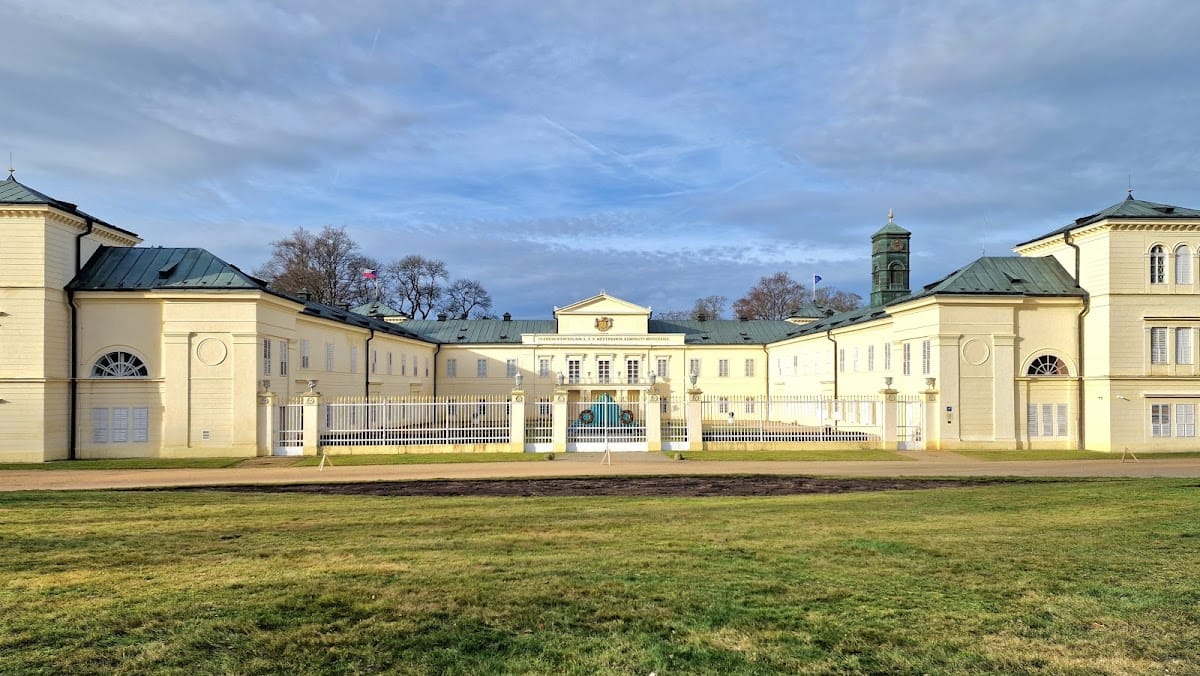
After this decree, control of the ruined castle shifted among various noble families over the following centuries, including the prominent Metternich family. The defensive role of the site effectively ended, and it suffered further during the Thirty Years’ War when, in 1647, it was besieged and destroyed in combat by both Swedish and imperial armies. Following this final devastation, the castle was never restored. Its stones were repurposed in the 17th century for the construction of the nearby Kynžvart Chateau and for local buildings, with documented reuse in a house rebuilt in 1770.
Remains
The castle originally featured a well-planned layout centered on a fortified core roughly trapezoidal or oval in shape. This inner section was defended by a strong earthwork rampart and encircled by a water-filled moat. Thick curtain walls formed the main defense, and within the heart of the castle stood a likely two-room tower palace, typical of a bergfried type—a tall tower serving as both a residence and fortification. Surrounding this core was a double parkán wall, an outer defensive barrier designed to provide layered protection. Access to the inner castle was granted through two drawbridges leading to a gate housed in a square bastion positioned at a corner of the walls.
Near the northwest gate stood a semicircular tower, which functioned not as a free-standing bergfried but as an integrated bastion, reinforcing the stronghold’s defensive line. Around the close of the 14th century, circa 1398 to 1400, the fortress was expanded with the addition of an outer bailey—a courtyard separated from the core by a rock-cut moat. This area was further secured by parkán walls, two substantial moats, and earthen ramparts. A tall rectangular tower was constructed to guard the western entrance of this bailey, strengthening the castle’s defenses.
The castle’s protective walls reached approximately nine meters in height, crowned with wooden platforms used by defenders during combat. The overall design was tripartite, dividing the space into the inner core with its principal fortifications and residential tower, the outer bailey serving as an additional fortified courtyard, and extended artillery positions developed later during the Thirty Years’ War siege.
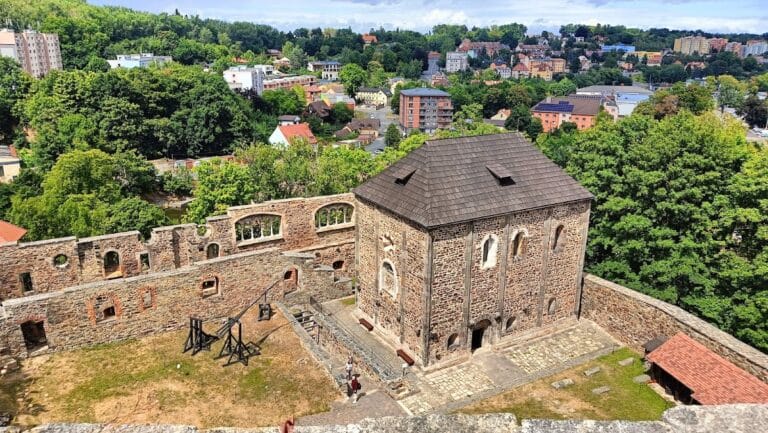
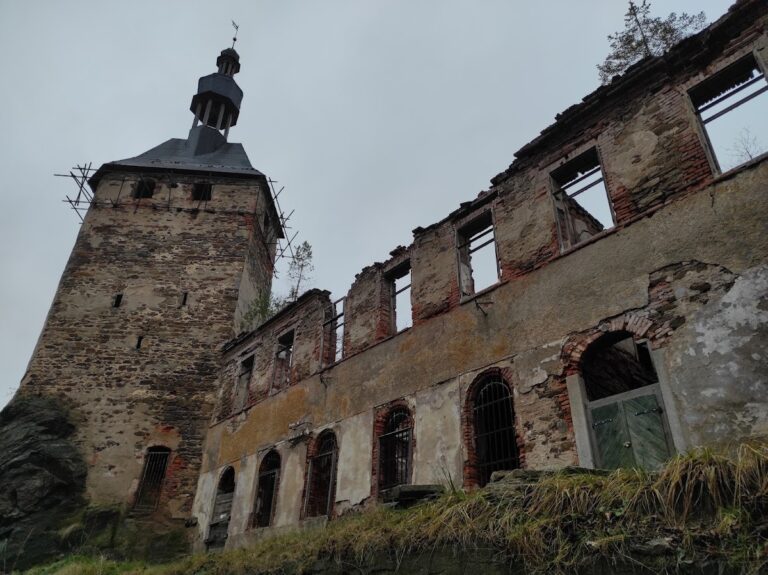
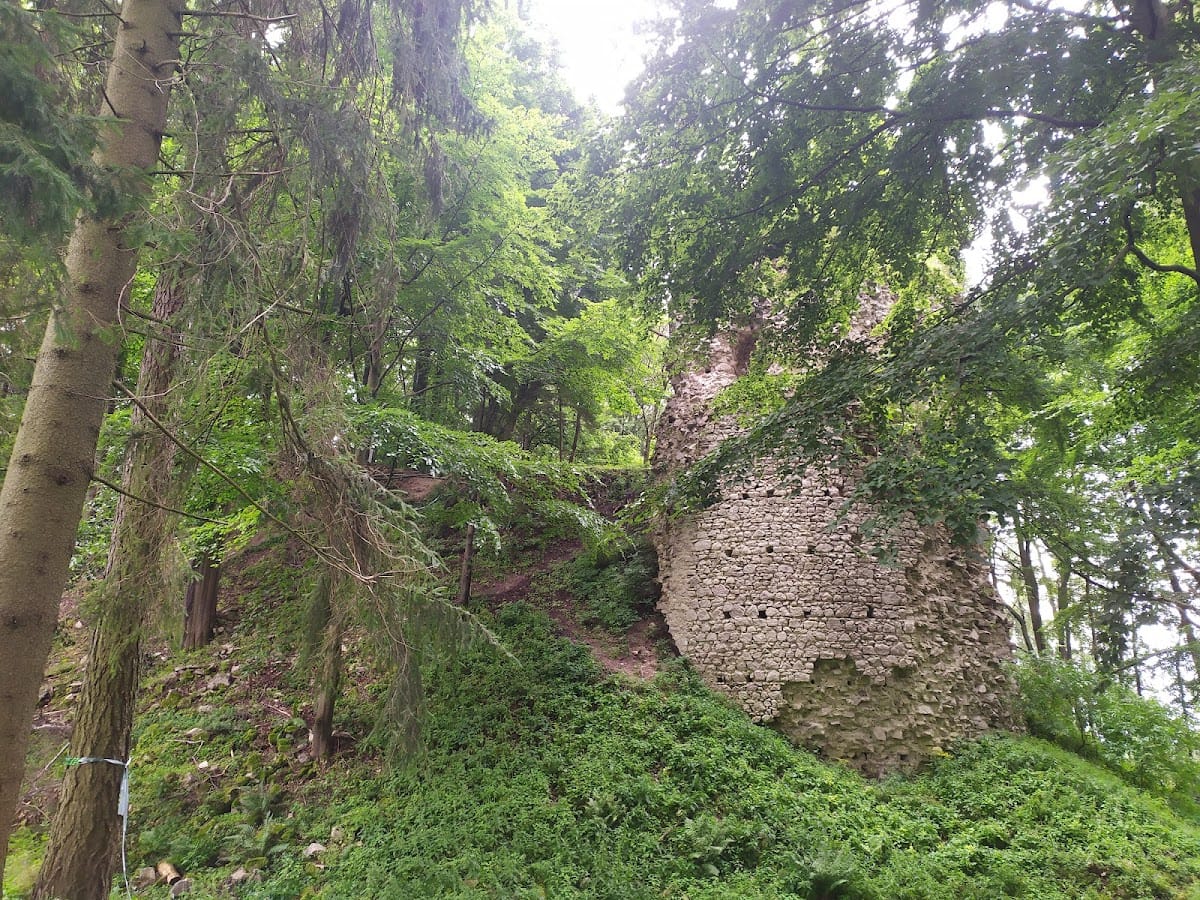
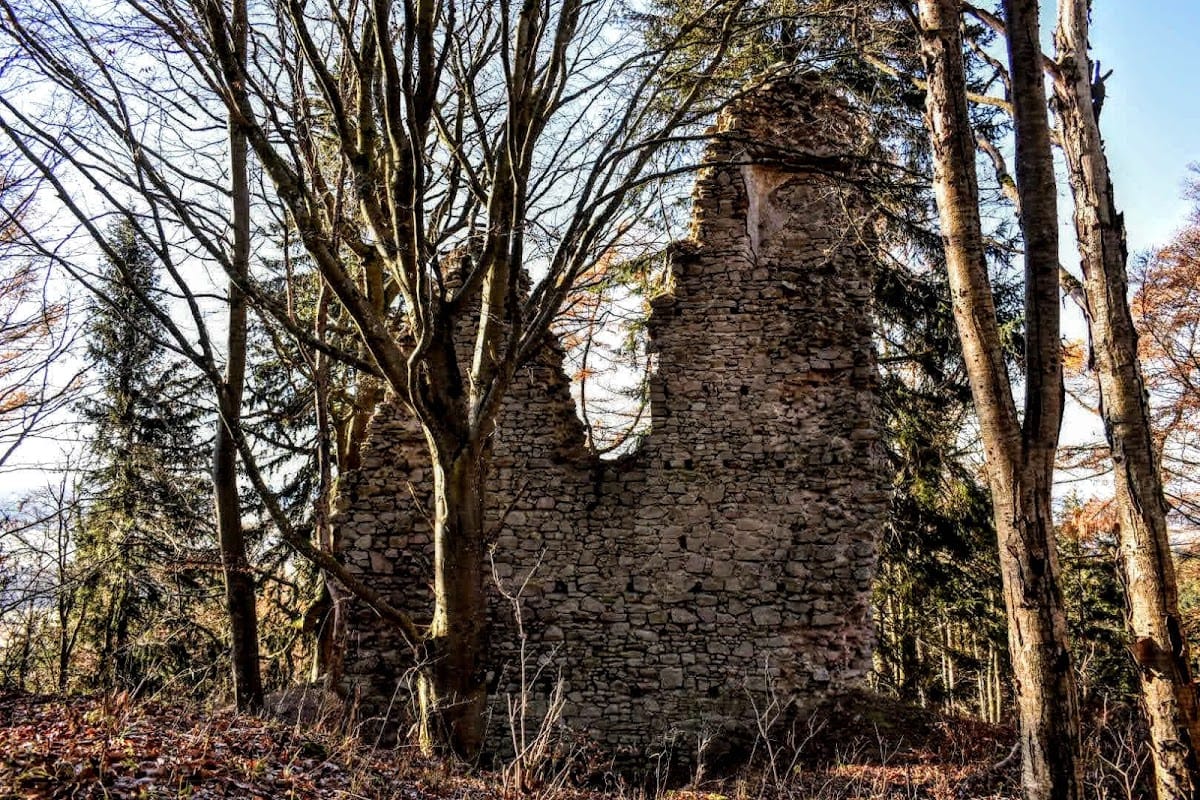
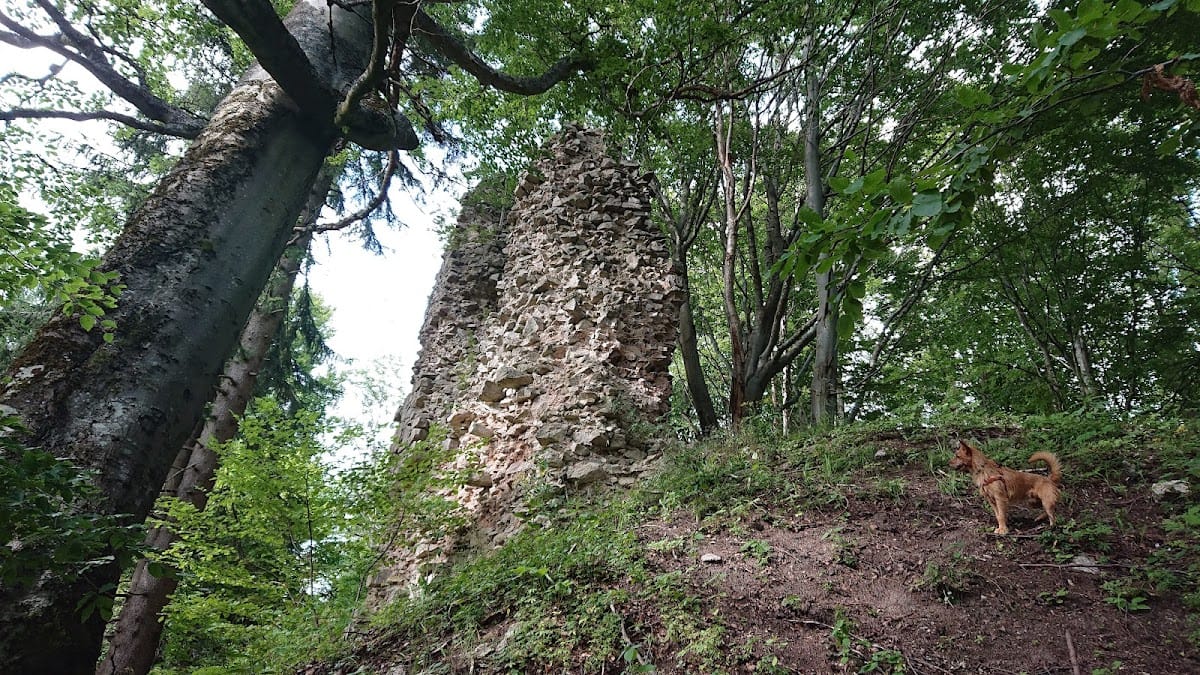
Today, the ruin preserves significant stone structures despite damage. Notable surviving elements include a large corner bastion that has suffered heavy deterioration, fragments of the palace walls, sections of the outer defensive walls, and the lower portion of the front square tower located within the bailey. Other components of the castle remain visible only as faint traces in the terrain. The site’s current condition is classified as deteriorating, reflecting centuries of exposure and partial dismantling for building materials in the surrounding area.