Castle of Torrelobatón: A Medieval Fortress in Spain


Visitor Information
Google Rating: 4.5
Popularity: Medium
Google Maps: View on Google Maps
Official Website: www.provinciadevalladolid.com
Country: Spain
Civilization: Unclassified
Remains: Military

History
The Castle of Torrelobatón is located in the municipality of Torrelobatón, Spain. It was constructed by the Castilian kingdom during the Middle Ages to secure strategic control over the Hornija valley.
Construction began in the 13th century with the initial purpose of overseeing and defending the surrounding territory. The castle’s development spanned several centuries, reaching completion in the mid-15th century under the direction of Gómez de Isla, an architect influenced by the Valladolid school of castle design, a style characterized by robust and compact military structures.
In the mid-15th century, ownership of the castle was held by the Enríquez family, who served as Admirals of Castile from 1455 to 1473. Their heraldic emblems are prominently displayed on the façade of the main tower, known as the keep or torre del homenaje. Notably, Don Fadrique, a member of this family, installed the principal coat of arms on the keep following formal approval from King Juan II of Castile.
The castle gained historical prominence during the Revolt of the Comuneros, also called the War of the Communities of Castile, a major uprising against royal authority. In February 1521, the fortress was the scene of a critical victory for the comuneros. After an eight-day siege, defenders loyal to the crown were trapped within the keep, which underscored the castle’s strategic and defensive significance.
Following the conflict, the castle underwent repairs in 1535. Among these restorations, the battlements were reshaped into their current distinctive “mailbox” form, a design modification reflecting evolving military architecture.
The Enríquez family retained ties to the castle until the 19th century, though they lost possession of the village of Torrelobatón and the castle itself during the 18th century. In the mid-20th century, the fortress found a new function as a grain warehouse managed by the National Wheat Service, part of the Ministry of Agriculture, adapting its spaces to agrarian storage needs.
In 1949, the castle was officially recognized as a site of historic heritage. Subsequently, in 2003, ownership passed to the local municipality. After rehabilitation works, it has housed since 2007 the Interpretation Center of the War of the Comuneros, highlighting its continued cultural and educational importance. The castle also served as a filming location for the historical epic “El Cid,” starring Charlton Heston, representing the town of Vivar in the film.
Remains
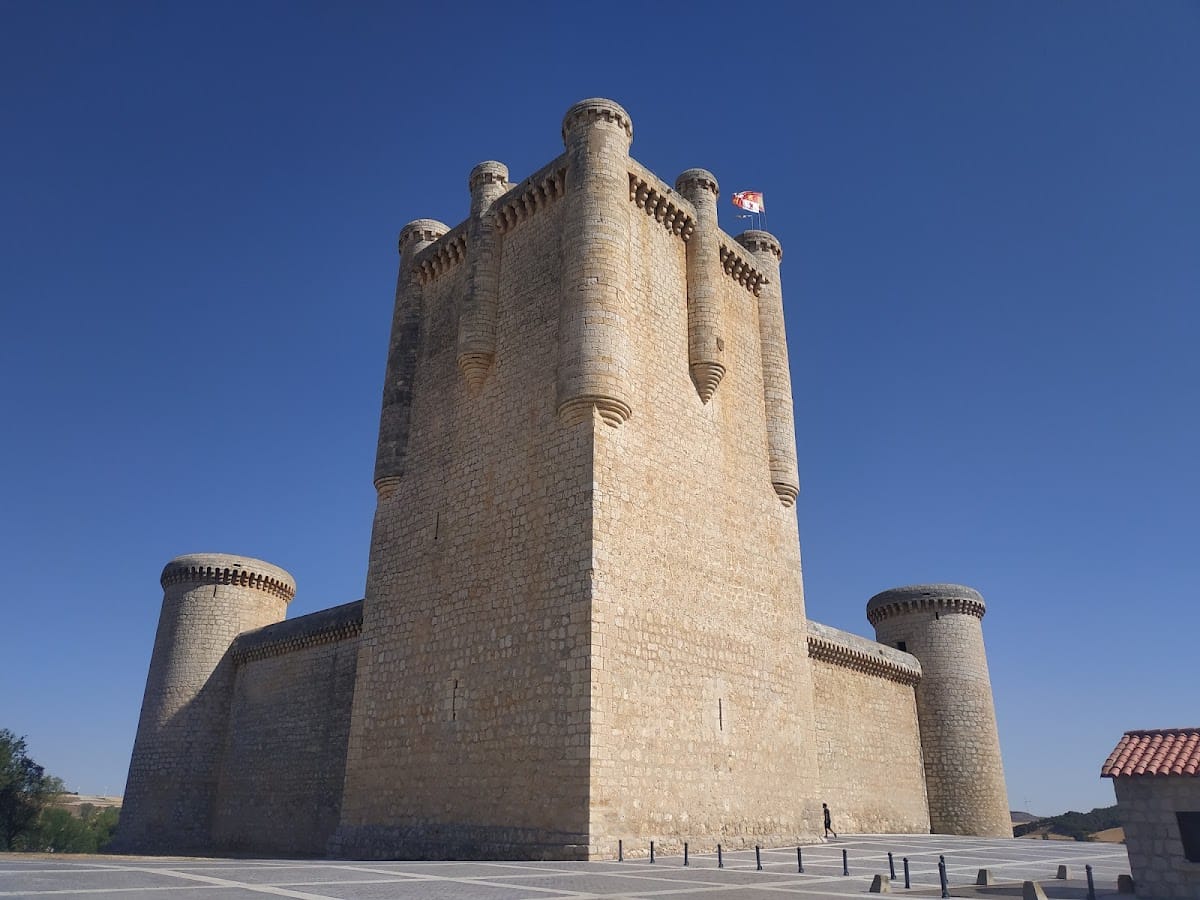
The Castle of Torrelobatón presents a fortified complex built according to the Valladolid school’s castle design principles. It features a nearly square layout enclosed by very high walls. At three corners rise massive circular towers, locally called cubos, each approximately 20 meters tall and 10 meters wide, providing watch and defense points. A commanding feature is the large square keep, or torre del homenaje, which stands about 40 meters in height, 20 meters wide, and 5 meters thick, dominating the castle silhouette.
The keep is uniquely topped with eight smaller circular turrets, placed on its corners and the midpoints of each wall. These turrets rest on accordion-shaped supports, allowing defenders to surveil and protect the structure from all sides. The entire complex was constructed from finely cut limestone ashlar combined with strong concrete to ensure durability.
Originally, the castle was encircled by an outer defensive wall known as a muralla and protected by a moat. Today, only fragments of these remain, with clear remains of a barbican—an outer defensive gate structure—still visible on the western side.
Defensive elements include battlements, which once ascended all levels but were remodeled in the 16th century to their current mailbox-like shape. Narrow arrow slits designed for the use of crossbows and early firearms, such as arquebuses, are strategically placed along the walls and towers. The angular towers were purpose-built to accommodate roughly ten soldiers each, enhancing the castle’s defensive capacity.
The main gate leading into the courtyard is distinguished by a semicircular arch and retains vertical arrow slits alongside a slot designed for a portcullis, a heavy, vertically sliding barrier used to secure the entrance. This gate gave direct access to the courtyard. Additionally, a discreet and hard-to-detect entrance existed in the moat wall at the northern side, providing a secret point of access.
Inside the keep, three vaulted floors are arranged vertically, accessed by a staircase of 143 steps that are interrupted by several doors, as indicated by the presence of arches along the ascent. The keep’s original entrance door was located midway up the tower and connected to the wall walk, or adarve, via a bridge.
The lowest floor of the keep features a pointed barrel vault ceiling and includes an antechamber facing the wall, which served as the first entrance from the courtyard. This part corresponds to the original tower constructed by Alfonso Enríquez and exhibits clear Portuguese architectural influences from the late 14th century. The second floor, added during the late 15th century, contains a ribbed vault, a style that enhances structural support while adding aesthetic appeal. The third floor encompasses a large vaulted hall, which was likely divided into two separate levels in later configurations.
After the siege and repairs of 1521, the keep’s entrance doors were replaced, adopting conopial arches—a type of pointed arch with a more elaborate shape characteristic of Gothic architecture.
Approximately 50 meters from the castle, opposite the Church of Santa María, there is a stone cistern (aljibe) constructed from ashlar masonry and topped with a barrel vault. This cistern currently functions as a private wine cellar. Tradition and architectural clues suggest it may have been connected to the castle through an underground passage, though the precise details of such a link remain a matter of historical conjecture.
Nearby sites