Simancas Castle: A Royal Prison and General Archive in Spain



Site at a Glance
- Rating
- 4.4
- Popularity
- Low
- Country
- Spain
- Primary era
- Medieval
- External website
- Open
- Eras represented
- Medieval, Early Modern
- Civilizations
- Crown of Castile, Spanish
- Site type
- Military
- Remains
- Castle
On this page14 sections
History
Simancas Castle is a fortified complex in Simancas, Spain, rebuilt in the late fifteenth century by the Enríquez family, the powerful Castilian aristocratic house that held the hereditary office of Admirals of Castile. The castle later became a royal prison and was transformed into the General Archive of the Kingdom, giving it an enduring role in the preservation of Spain’s political and administrative history.
From Islamic fortress to royal stronghold
An older fortress from the Islamic period occupied the site before the Enríquez reconstruction. In the fifteenth century, the family, who were also lords of Simancas, rebuilt the castle as a fortified residence. Soon afterward, Isabella I of Castile and Ferdinand II of Aragon, known jointly as the Catholic Monarchs, reclaimed it for the Crown. Their joint monarchy expanded royal authority across their territories in the late fifteenth century, and the castle was converted into a state prison.
During the reign of Charles I, who was also the Holy Roman Emperor Charles V, Simancas continued to hold detainees. Two prisoners became closely associated with the castle’s history. Pedro de Navarra, a Navarrese marshal captured in 1516 during the second counteroffensive to recover the Kingdom of Navarre after its conquest, was murdered there on 24 November 1522.
Antonio de Acuña, Bishop of Zamora and a captain of the Comuneros, was imprisoned and executed at Simancas in 1521 on the express orders of the king. The Comuneros were members and supporters of the Castilian revolt against royal authority in 1520 and 1521. Acuña had taken an active part in the Battle of Villalar. After strangling the castle’s warden and trying to escape, he was recaptured. The alcalde, a magistrate with judicial and administrative responsibilities, Rodrigo Ronquillo y Briceño ordered his death by garrote vil, an execution method involving strangulation by a tightened collar or cord. The execution took place in a tower now known as the Bishop’s Tower.
Creation of the General Archive
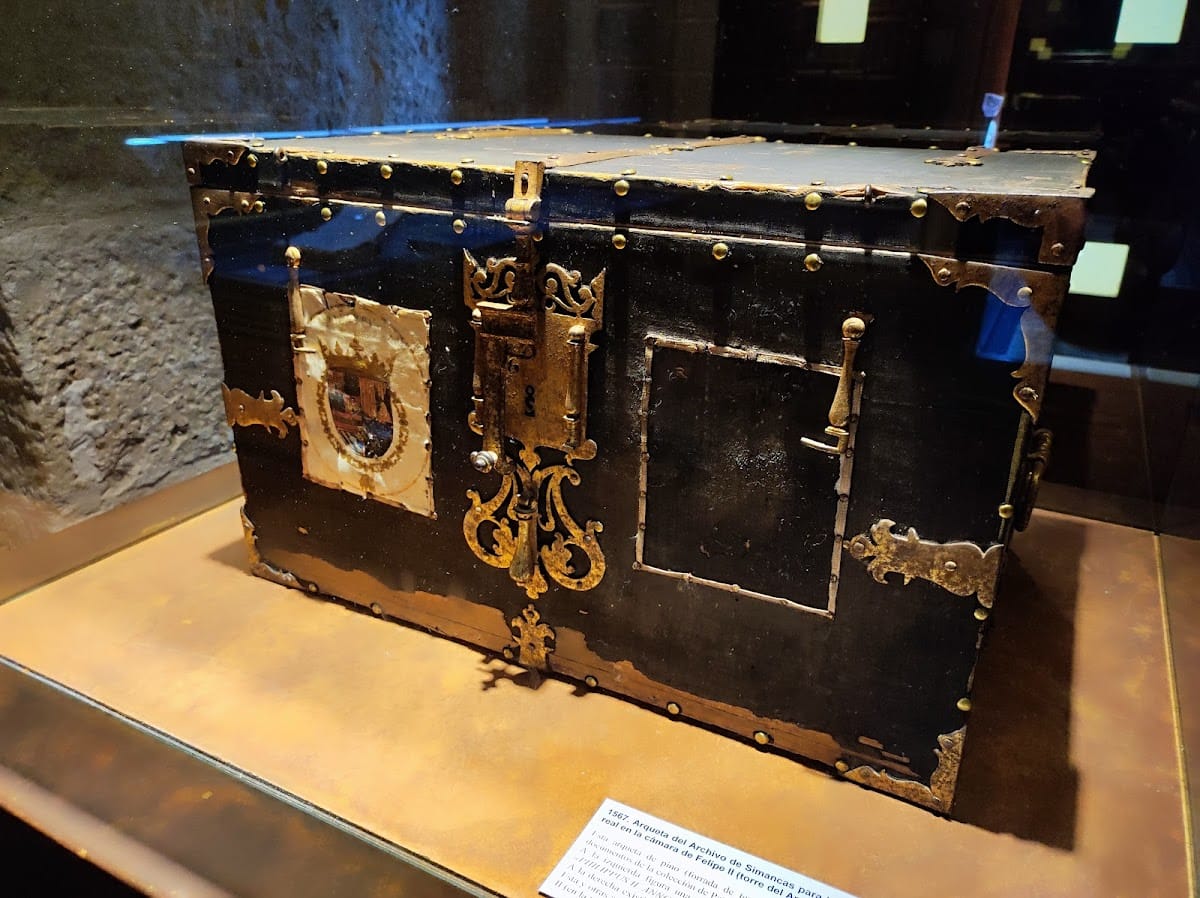
In 1540, Charles I ordered one of the towers to be converted into an archive for the principal documents of the Spanish kingdom. Under his son and successor, Philip II, the entire castle was adapted as the General Archive of the Kingdom, and an archivist was appointed to supervise the preservation of its records.
The archive holds approximately 35 million documents. Its collections include diocesan expenditure registers, municipal registers, land registers, orders issued by city governments, and records concerning privileges. About 400,000 documents relate to the Spanish Inquisition. The scale and historical range of these holdings have made the archive one of Europe’s most important.
Reforms and modern heritage status
The archive conversion and later reforms produced much of the castle’s present appearance. Further alterations took place during the sixteenth, seventeenth, and eighteenth centuries. The principal sixteenth-century works were undertaken by Juan de Herrera, a leading Spanish architect associated with the austere style known as Herrerian architecture, and from 1588 by Francisco de Mora, who continued several of Herrera’s projects. Pedro Mazuecos and Diego de Praves completed later work in the seventeenth century.
Major conservation works maintained the building in its archival function. Simancas Castle was declared a Spanish Site of Cultural Interest within Spain’s historical heritage on 10 October 1997, under the category of archive. The property belongs to the Spanish state and is administered by the Ministry of Culture.
Remains
Fortified enclosure
Walls, towers, moat, and bridges
The medieval enclosure dates mainly from the late fifteenth century and is built chiefly of light-colored stone. Its defenses include a surrounding wall, projecting towers or bastions, battlements, a moat, an entrance, and two bridges. Battlements are defensive parapets formed by regularly spaced raised sections, while the bastions are projecting fortified masses that strengthen the perimeter. The dark roof covering contrasts with the pale walls, and the principal tower carries a high Baroque dome.
Bishop’s Tower
The Bishop’s Tower forms part of the castle’s surviving defensive fabric and preserves the memory of Antonio de Acuña’s execution in 1521. A bell-shaped lantern was designed for the tower during the later architectural reforms.
Chapel and interior features
Chapel
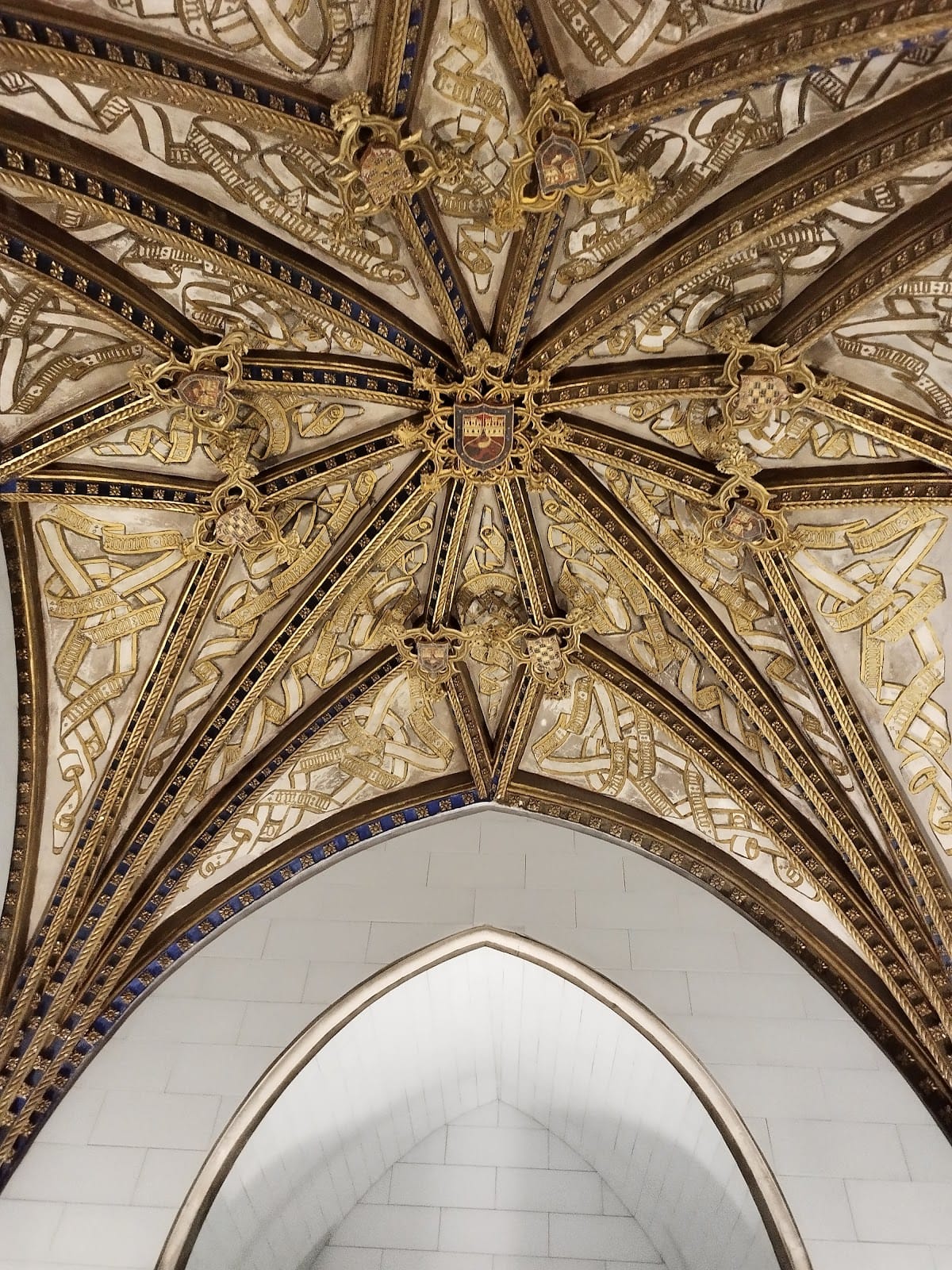
The chapel originated in the fifteenth-century rebuilding associated with the Enríquez family. Its present form results from a renovation carried out in the 1950s. A painted star vault covers the chapel, with intersecting ribs forming a star-shaped pattern and displaying the arms of its founders, Alonso Enríquez and María de Velasco.
Torture chamber
A torture chamber survives within the castle, preserving a physical reminder of its period as a state prison.
Archive architecture
Courtyard and principal entrance
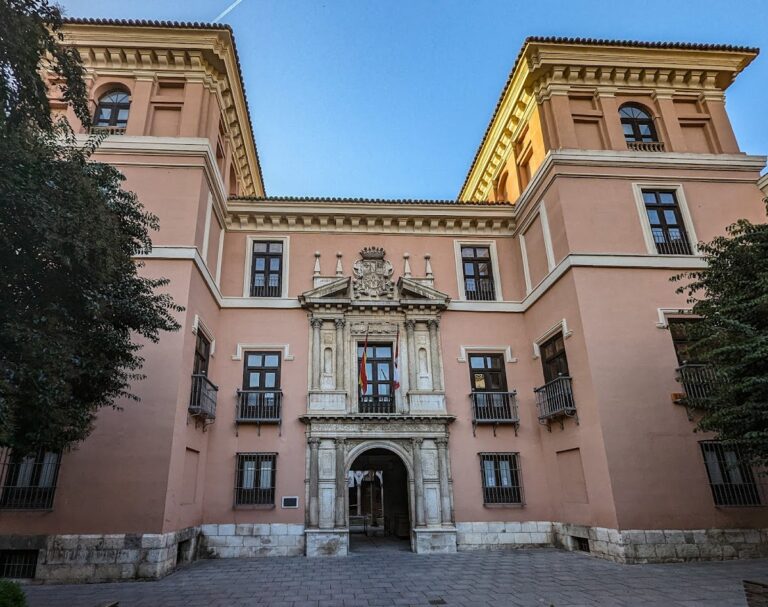
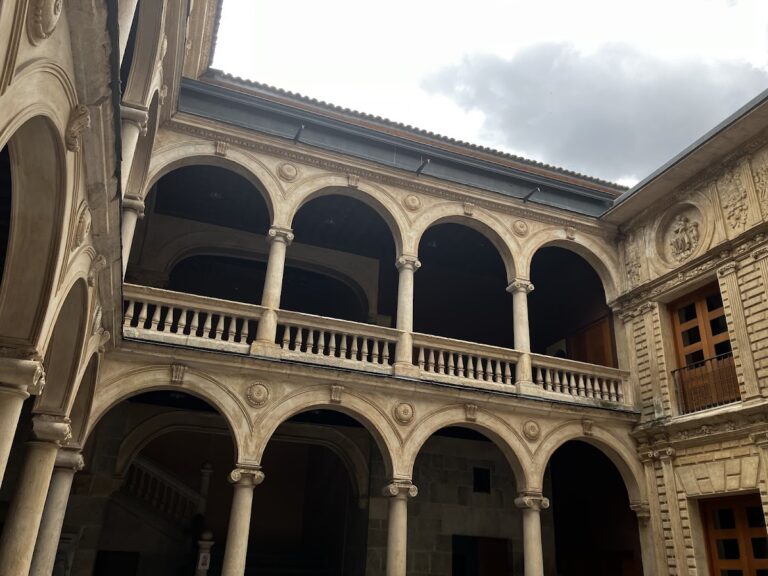
Juan de Herrera reshaped the central area by demolishing a wall, removing vaults, and regularizing the courtyard. The building was raised above a pre-existing well. Francisco de Mora created the courtyard, the principal staircase, and the entrance portico, integrating these elements into the castle’s adaptation for archival use.
Archive rooms and fireproof chamber
The archive occupies four large formal rooms designed for storing records. The ground floor of the archive bastion, known as Philip II’s Bastion, together with two rooms on the eastern side, was reserved for documents most directly connected with the rights of the Crown. Most of the records are housed in a fireproof chamber, a feature that reflects the building’s continuing purpose as a repository for state documents.