Villalonso Castle: A Fifteenth-Century Castle-Palace in Spain


Site at a Glance
- Rating
- 4.5
- Popularity
- Low
- Country
- Spain
- Primary era
- Medieval
- External website
- Open
- Eras represented
- Medieval, Early Modern
- Civilizations
- Crown of Castile, Order of Alcántara, Spanish
- Site type
- Military
- Remains
- Castle
On this page13 sections
History
Villalonso Castle is a medieval castle in Spain, near the village of Villalonso in Zamora Province. Rebuilt in the fifteenth century as a castle-palace associated with the Valladolid school of castle architecture, it formed part of a defensive line that also included Mota del Marqués, Torrelobatón, and Tiedra.
The Order of Alcántara and the Ulloa lordship
An earlier fortification on the site belonged to the Order of Alcántara, a medieval military order that held land and operated fortified religious and military establishments in Iberia. The order was one of the castle’s principal lords, and its earlier work stood on the site by 1235. Archaeological evidence also points to an occupation associated with the order, probably extending from the eleventh to the fifteenth century.
Alonso Pérez de Vivero acquired the property from the Order of Alcántara and exchanged it with Juan de Ulloa in 1449. Juan received the title of lord of Villalonso in 1470, established a mayorazgo, and built the castle that survives today. A mayorazgo was a hereditary estate arrangement designed to keep property within a family line by restricting its division or sale.
War and succession
Juan de Ulloa served as a municipal councillor and castellan of Toro. During the Castilian War of Succession, the late-fifteenth-century conflict over the Castilian throne, he supported the Portuguese cause and died defending Villalonso Castle in 1476. His widow, María Sarmiento, continued the struggle before being defeated and forced to surrender Toro, Mota del Marqués, and Villalonso.
The Catholic Monarchs, Isabella I of Castile and Ferdinand II of Aragon, later granted María Sarmiento a royal pardon and allowed her to retain Villalonso Castle. Her son Diego, the second lord of Villalonso, subsequently joined the Comunero side during the Revolt of the Comuneros, an early-sixteenth-century uprising in Castile against the rule and policies of Emperor Charles V. Sentenced to death in 1524, Diego secured the commutation of his sentence by paying 10,000 ducats. He recovered his property, including the castle, and incorporated it into the Ulloa mayorazgo in 1529.
Later history and restoration
In the twentieth century, the castle belonged to Ángela María Téllez-Girón, Duchess of Osuna. During the 1970s, it served as a filming location for more than one medieval-themed film, including Robin and Marian. On 27 February 1984, the duchess sold the property to Jesús and Elizabeth Cueto Vallejo.
Restoration and archaeological work began in 2006 after the enclosure had remained closed for several years. The intervention, carried out with the participation of the Historical Heritage Foundation of Castile and León, was completed in 2011. Archaeology revealed changes made in the early sixteenth century, including major alterations to the eastern moat, as well as evidence of the earlier occupation connected with the Order of Alcántara. Villalonso Castle is designated an Asset of Cultural Interest, Spain’s formal category for protected cultural heritage.
Remains
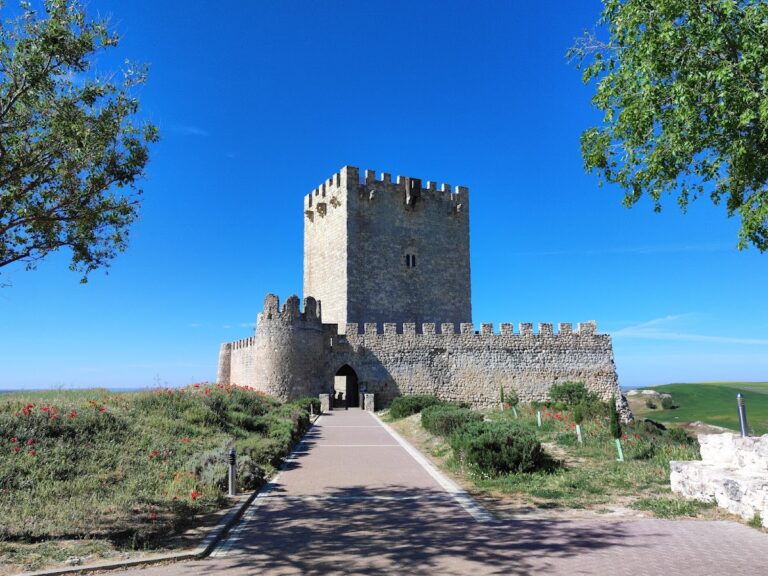
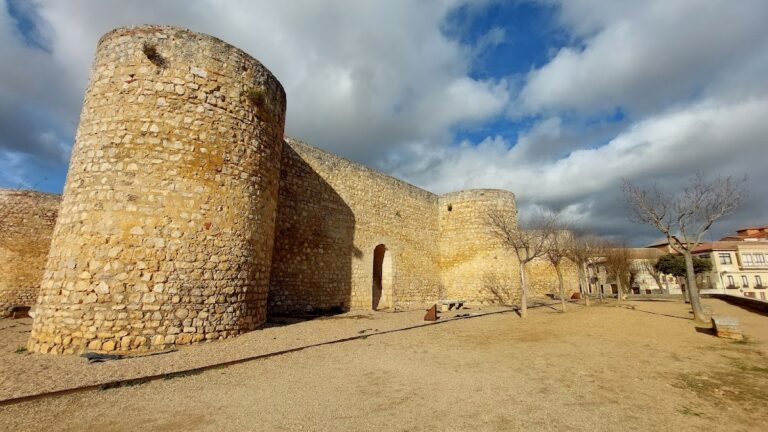
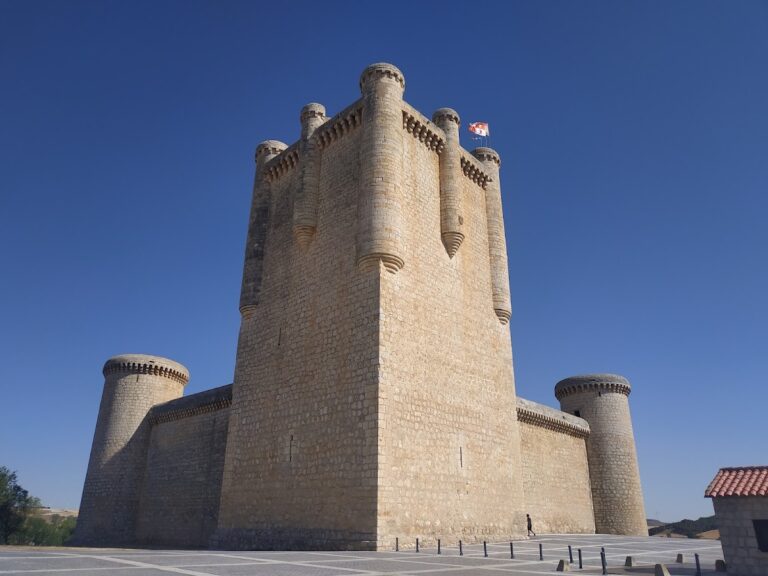
Villalonso Castle is a fifteenth-century castle-palace with ashlar masonry walls and defensive features arranged around an enclosed courtyard. Turrets or towers strengthen the corners, while the keep occupies the northern curtain wall. The surviving fabric combines residential and military architecture in the tradition associated with the Valladolid school.
Walls, towers, and entrances
The keep and defensive walls
The keep rises from the northern curtain wall. Its battlements and machicolations, projecting openings through which defenders could attack people below, reinforced the northern side of the enclosure. Cylindrical supports carry machicolations around the walls, and small projecting turrets called garitones rise above them.
The liza entrances
The entrance to the liza, the defended space immediately outside the main enclosure, is positioned between the keep and a turret. The entrance once carried the coat of arms of María Sarmiento, Juan de Ulloa’s wife, together with the arms of the Ulloa lineage. In 1529, Diego added his own arms above those of his parents.
A second entrance to the liza was revealed when a modern pediment on the southern side was removed. This discovery added to the understanding of how access was arranged around the castle’s outer defensive space.
The eastern moat
The eastern moat was altered in the early sixteenth century. It was deepened to as much as four metres, widened, and lined with ashlar blocks. Some of those blocks were recovered during excavation. The work changed an older moat that had been smaller and narrower, showing how the castle’s defensive arrangements were adapted after the fifteenth-century rebuilding.
Courtyard and domestic remains
Courtyard rubbish pit
A pit in the courtyard had been used as a rubbish dump. Its contents included kitchen and table pottery from the fifteenth and early sixteenth centuries, animal bones, and glass bracelets. Together, these finds provide material evidence of activity within the castle during the period of Ulloa ownership and its early-sixteenth-century alterations.
Earlier occupation outside the castle
Archaeologists identified domestic structures outside the castle that may belong to an occupation dating from the eleventh to the fifteenth centuries. They were classified as houses belonging to the Order of Alcántara and included underground silos. These remains relate to the earlier fortified establishment that preceded the castle-palace visible today.
Outer defensive barrier
The castle also retains the archaeological context of an outer barrier or wall intended to provide a second line of defence. This feature was left untouched during the restoration and excavation works of 2006 to 2011, leaving open the possibility of further work on that part of the enclosure.