Castle of the Counts of Gruyères: A Medieval Fortress in Switzerland



Visitor Information
Google Rating: 4.6
Popularity: High
Google Maps: View on Google Maps
Official Website: www.chateau-gruyeres.ch
Country: Switzerland
Civilization: Medieval European
Remains: Military

History
The Castle of the Counts of Gruyères is situated in the municipality of Gruyères in Switzerland. This medieval fortress occupies a site with a long record of human habitation, tracing back to the Mesolithic period, between 8000 and 5000 BCE. Archaeological findings indicate the presence of Roman settlements followed by a period of control by the Vandals, reflecting the region’s complex early history before the medieval era.
Construction of the initial castle began in the 11th century when an ancestor of the Counts of Gruyères established a fortified residence after acquiring land around the Zane river valley. Over time, the castle developed into the principal home of the family and lent its name to the adjacent town. The oldest remaining part of the castle, a chapel apse fragment, dates from the mid-13th century, highlighting early ecclesiastical connections within the fortress.
The principal phase of building took place between 1270 and 1280 during the rule of Count Pierre II de Gruyère, shaping much of the castle’s medieval form. Subsequent rebuilding projects continued over the following centuries, culminating in its current appearance by the late 15th century. These modifications correspond with the counts’ status as sovereign rulers in the area.
In the mid-16th century, financial difficulties beset the last reigning count, Michel de Gruyère, compelling him to sell the castle and his lands in 1555 to the city of Fribourg. Following this transfer, the castle became the residence of the city’s appointed bailiffs, known as vogts, a role it fulfilled until 1798. Later, it housed prefects until the regional administrative seat moved to Bulle in 1848.
After its governmental use ended, the castle was purchased in 1849 by the Bovy brothers from Geneva, who transformed it into a summer home and cultural hub. This period brought notable artistic renovations, especially under Daniel Bovy’s direction, enriching the castle’s interiors and gardens. The city of Fribourg repurchased the property in 1938, establishing it as a museum that offers exhibitions and cultural events to the public.
Throughout its history, the castle carries associations with local medieval legends, such as the tale of the Beautiful Luce. This story is commemorated within the castle’s artistic decoration, linking the site closely with regional folklore and the counts’ historical narrative.
Remains
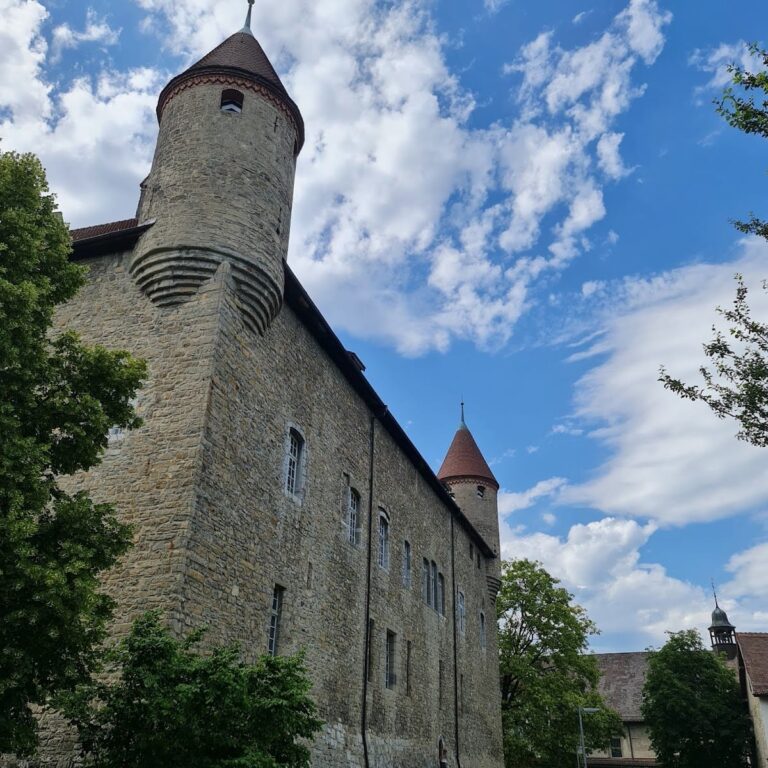
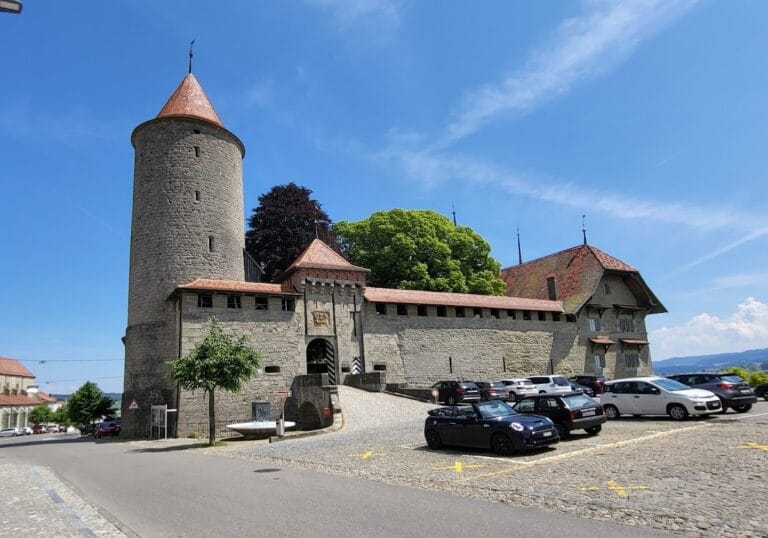
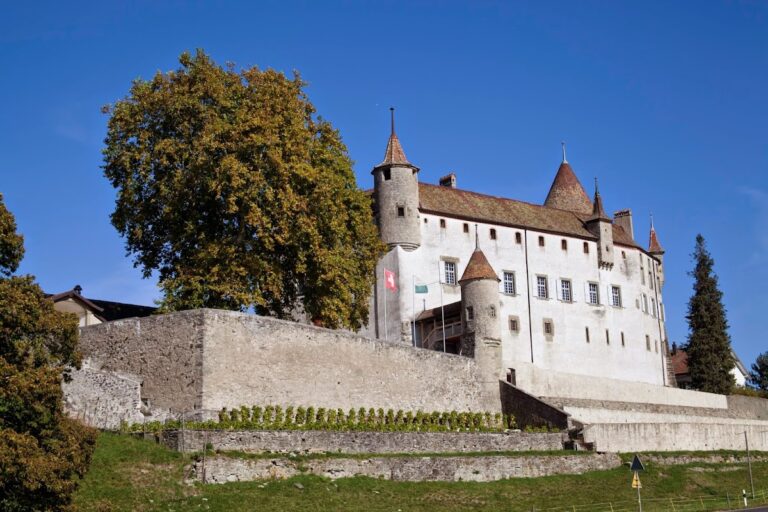
The Castle of the Counts of Gruyères sits atop a hill rising prominently about 115 meters above the Sarine valley, offering a commanding view of its surroundings. Its layout follows the “Savoyard square” style, a nearly square plan featuring a large round main tower, or bergfried, over 11 meters in diameter, positioned on the southeast corner, reflecting its defensive purpose.
Originally, the castle had three additional towers at the other corners of the inner curtain wall, although today only their lower sections survive. The thick defensive walls, constructed up to four meters wide, speak to the fortress’s military strength. During the later medieval period, these wooden galleries on the walls were replaced by stone structures, including a stair tower linking different levels; this work was halted around 1540.
The inner courtyard is enclosed by stone galleries and bordered on its northern and western sides by a 17th-century esplanade containing a well and the chapel of Saint John the Baptist. This chapel, integrated into a tower of the defensive walls, dates to 1480. Its stained glass windows from 1482 depict scenes such as Saint John baptizing Christ and the Virgin of Pity, including heraldic symbols linked to Count Louis de Gruyère and his consort.
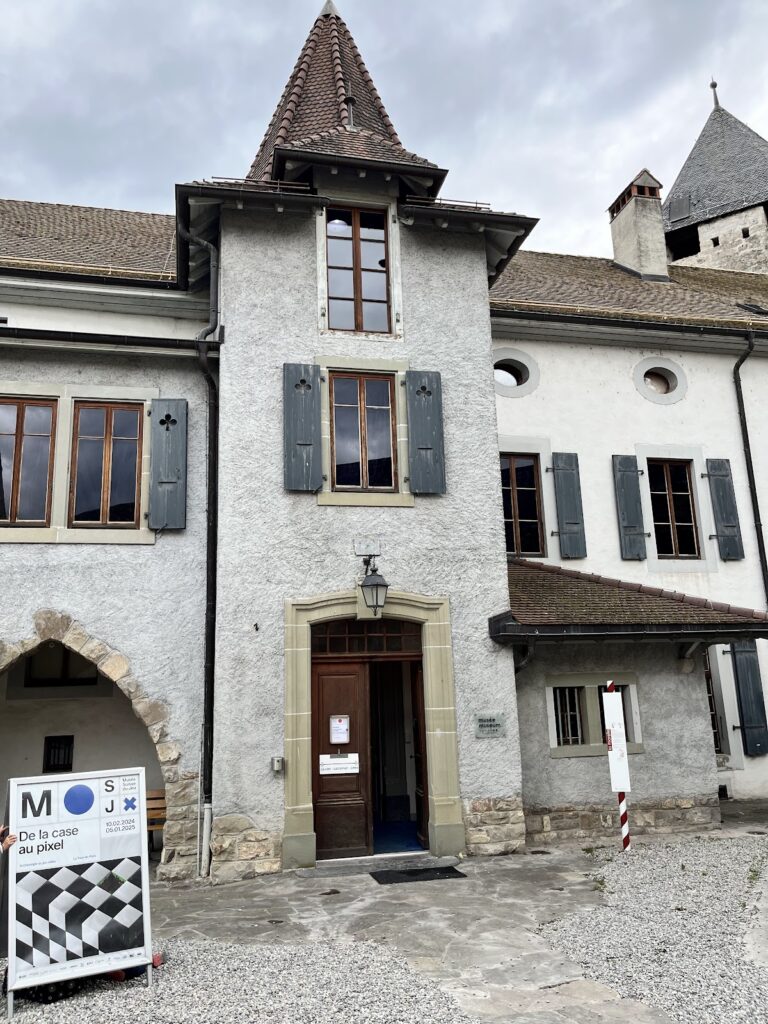
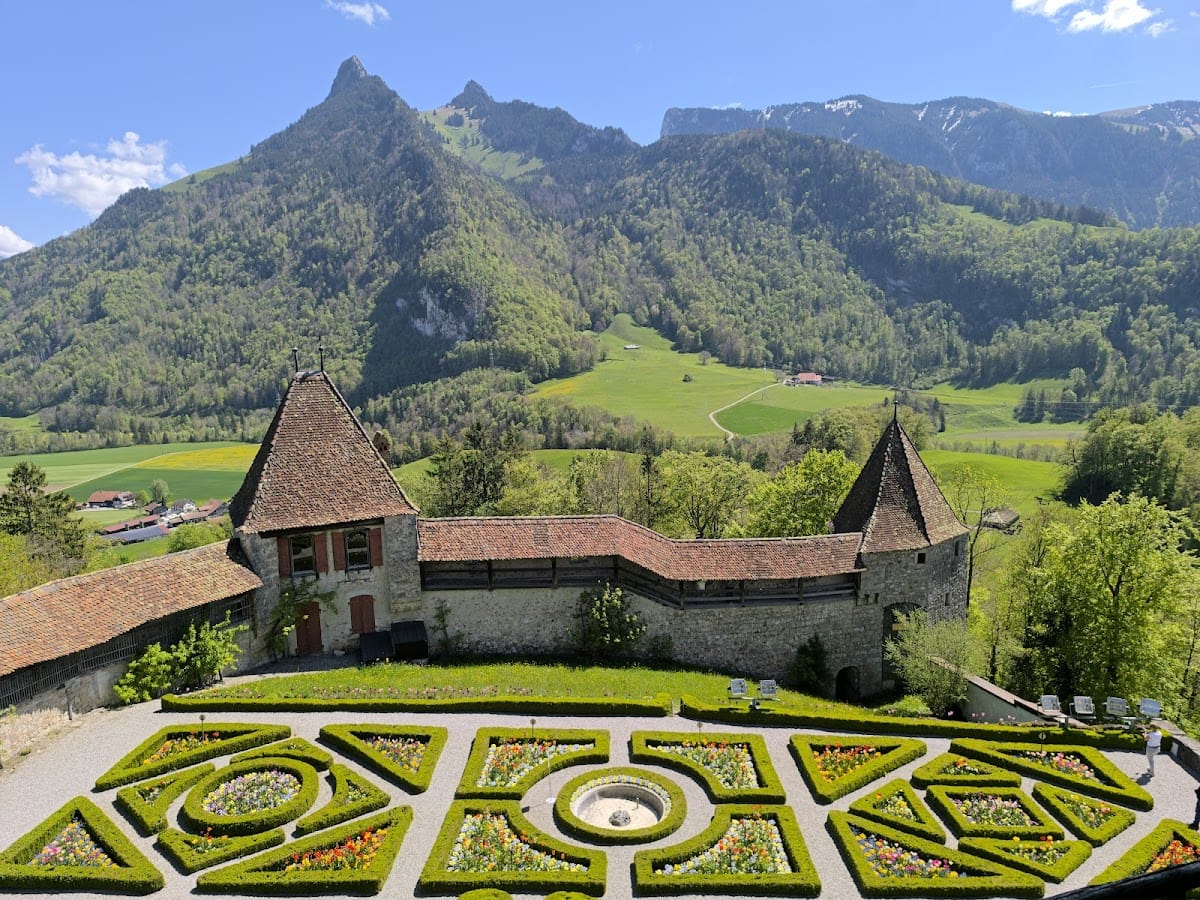
East of the courtyard, a French-style garden was created in the 17th century, replacing earlier medieval garden spaces and reshaped again during the 19th century by the Bovy family into a formal promenade area. Nearby, a mid-14th-century building near the southwest entrance originally served as quarters for the armed guards and today functions as a museum ticket office.
At the castle entrance stand two bronze sculptures, “Shield of Mars” and “Shield of Venus,” by the English artist Patrick Woodroffe, adding a modern artistic element to the historic site. The castle’s interior includes several notable rooms across multiple floors: on the ground level, a medieval kitchen has been reconstructed, featuring a pebble floor made from stones sourced from the nearby Zane river.
The southern wing has historically housed the residential quarters, while the eastern wing contains living spaces that were fully rebuilt during the counts’ tenure. On the second floor, accessible by a spiral staircase, several distinguished rooms are found. These include the Burgundy Hall, which displays ceremonial robes of the Order of the Golden Fleece; the Corot Salon, decorated with contributions from the French painter Camille Corot; and the Count’s Hall, furnished with medieval items such as a chair once owned by the counts.
Also on this floor is the Chamber of the Beautiful Luce, inspired by a local medieval legend. The Bailiff’s Hall preserves elements from the 16th and 17th centuries, including stained glass, wall paintings, furniture, and a faience stove connected to the castle’s period under Fribourg’s bailiffs.
The top floor houses the Fantastic Art Hall, showcasing contemporary artworks linked to the castle; the Baroque Hall, featuring a decorated ceiling from the 17th century and works by medallist Antoine Bovy; the Music Salon with an 1835 piano made for Franz Liszt; the Hunting Hall displaying hunting trophies; and the Knights’ Hall, considered the artistic centerpiece, decorated with fourteen murals illustrating both historical and legendary episodes related to the castle and its counts.
Among the defensive features, two main towers stand out: a square tower and a pentagonal tower, the latter having served as a powder magazine at one time. North of the courtyard lies the so-called Prisoner’s Tower, which is believed to have functioned as a prison, although its precise use remains uncertain.
Within the courtyard arcades, a mural painted around 1900 by Francis Furet depicts the legend of the Beautiful Luce, accompanied by wooden benches added in 1904 bearing the coats of arms for the Gruyère, Bovy, and Balland families. These elements reflect the continuing appreciation and reinterpretation of the castle’s history well beyond the medieval period.
Nearby sites