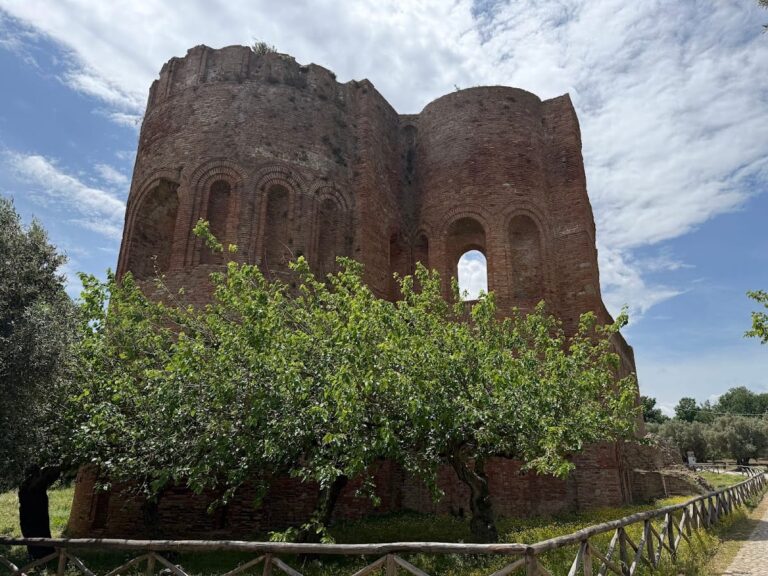
Castle of Santa Severina: A Historic Fortress in Italy



Visitor Information
Google Rating: 4.7
Popularity: Medium
Google Maps: View on Google Maps
Official Website: www.aristippo.it
Country: Italy
Civilization: Unclassified
Remains: Military

History
The Castle of Santa Severina stands in the town of Santa Severina, Italy, built originally by the Normans in the 11th century. This imposing fortress was founded by Robert Guiscard, a Norman leader who obtained the duchy of Apulia and Calabria in 1076. He chose a rocky promontory that overlooked the ancient settlement of Siberene, a town inhabited by Greeks under Byzantine rule for nearly two centuries before Norman dominance.
Long before the Normans constructed the castle, the site had a deep and varied history. Archaeological evidence reveals continuous occupation dating back to the Bronze and Iron Ages, when early populations including the Oenotrians lived there. The area subsequently came under Greek-Italic influence, then Roman control, followed by the Byzantines and later the Arabs. Between approximately 840 and 886, the location functioned as an Arab military complex, known as a kastron, which combined defensive and religious structures. This period underscored the site’s strategic importance in the region.
Following the Norman era, the castle entered a new phase under the Angevin rulers who took control after 1266. Rather than fully transferring the castle to private aristocrats, the Angevins incorporated it into the royal domain, though some feudal grants persisted. They enhanced the fortress by adding large cylindrical towers and surrounding it with four curtain walls around the central keep, strengthening its defenses in line with military developments of the time.
In 1444, the Aragonese dynasty assumed control, with Alfonso V investing in the city’s privileges and opting to preserve and restore the castle despite local calls for its demolition. His successor Ferrante I reaffirmed the town’s autonomy and governance, reinforcing Santa Severina’s regional standing and the castle’s role as a symbol of authority.
A significant transition occurred in the early 16th century when the Carafa family seized the fortress after a siege in 1506. Under Andrea Carafa, the lordship became marked by oppressive rule until his death in 1526. Later members of the family brought periods of political calm and cultural renewal, though their accumulation of debts eventually led to the loss of the fief. The Carafas undertook notable renovations, including strengthening the walls, completing the Belvedere bastion, and installing unique battlements known as “merli tribolati,” visible on the castle walls and heraldic symbols.
After the Carafa tenure, the fiefdom reverted to royal hands and was granted to the Ruffo family in 1608, followed by Carlo Sculco in 1650, who was elevated to duke by King Philip II of Spain. The castle changed hands again in 1691 when it was auctioned to Cecilia Carrara and later inherited by her son Antonio Greuther, connecting the site to a merchant lineage from Westphalia.
The final feudal lord was Gennaro Greuther. The abolition of feudalism in 1806 by Joseph Bonaparte ended the noble dominion over the castle and town, after which church authorities administered the area until the unification of Italy in 1860.
During the 18th century, the Greuther family transformed the fortress into a noble residence, adding vaulted ceilings on the first floor, constructing a large hall near the spiral staircase, and embellishing the interiors with decorative paintings, including a significant hall painted by artist Francesco Jordano around 1750. In the 20th century, the castle served as a boys’ boarding school from the 1930s until the 1970s. This adaptive reuse contributed to preserving the structure until its restoration in the late 20th century revealed its multi-layered past.
Between 1994 and 1998, meticulous restoration and archaeological study uncovered the castle’s foundation atop the ancient acropolis of Siberene and brought to light artifacts from Byzantine and Swabian times. These findings illuminated the castle’s long-standing strategic and cultural importance over many centuries.
Remains
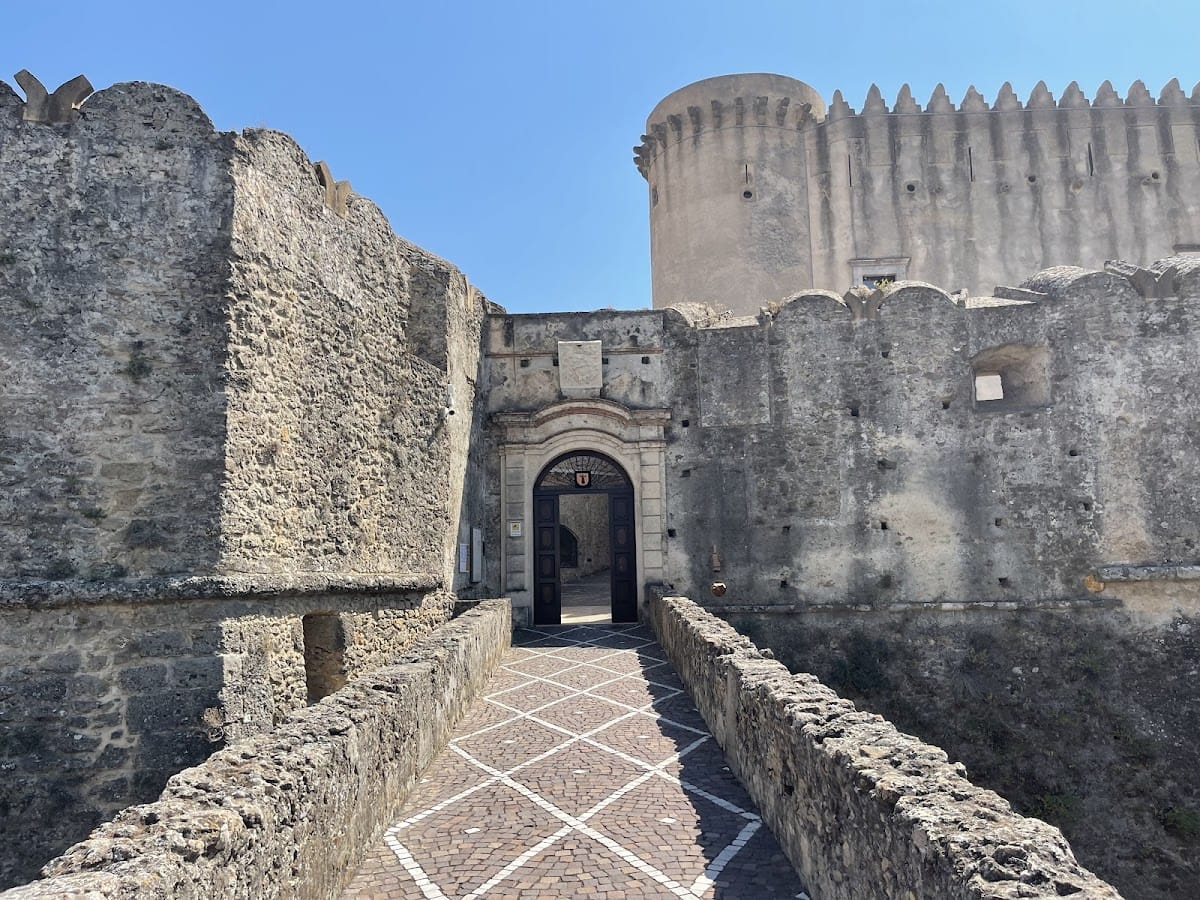
The Castle of Santa Severina occupies roughly 10,000 square meters, rising prominently over the Neto valley and the nearby hills around Crotone. Its design reflects centuries of architectural evolution, showcasing distinct construction phases across Norman, Angevin, and Carafa periods.
At the heart of the castle is a square keep, known as a donjon, flanked by four cylindrical corner towers. Each tower features a scarped base, a sloping stonework technique that strengthens the foundation against attack. Around this central structure stands a formidable curtain wall with four bastions extending outward, aligning closely with the layout of the towers. These curtain walls and towers reveal Angevin contributions aimed at modernizing the fortress’s defenses during the 13th century.
Archaeological excavations within the castle uncovered a vaulted cistern, a large underground water reservoir that was vital for sustaining occupants during sieges. Nearby, remains of a Byzantine ecclesiastical complex testify to the site’s religious significance when it operated as a kastron, a fortified military and religious center. This confirms the castle’s layered function in the medieval period beyond purely military use.
A burial ground dating to the Byzantine era was also discovered close to the fortress, including a notable tomb where a skeleton was found with a 3rd-century BCE coin placed in the jaw. This detail provides evidence of the site’s long habitation and the importance attached to funerary customs over many centuries.
Traces from the Swabian period emerged in various parts of the castle, including the old round tower, the cut tower, the spiral staircase tower, and the quadrangular battlements. While detailed records of these features are limited, their presence illustrates another notable phase of occupation and modification during the medieval era.
In the 18th century, under the Greuther family’s ownership, the castle underwent significant changes to convert it from a medieval fortress into a more comfortable noble residence. Modifications included the addition of vaulted ceilings on the first floor and the creation of a spacious hall adjoining the existing spiral staircase. The central hall of the keep was adorned with paintings by Francesco Jordano, executed around 1750, adding an artistic dimension to the castle’s history.
Today, the castle houses the Santa Severina Museum, which exhibits archaeological finds from the site and surrounding areas. Among its collections are protohistoric bronzes dating from the 15th to the 8th centuries BCE, illustrating the region’s ancient past. The complex also contains the Documentation Center for Calabrian Castles and Fortifications as well as the Museum of Contemporary Art of Santa Severina (MACSS). The restoration completed in 1998 was accompanied by scholarly publications that document the extensive architectural and cultural research conducted on the castle, preserving its significance for future study.
Nearby sites