Castle of Rovereto: A Historic Fortress in Italy



Visitor Information
Google Rating: 4.6
Popularity: Medium
Google Maps: View on Google Maps
Official Website: www.museomitag.it
Country: Italy
Civilization: Medieval European
Remains: Military

History
The Castle of Rovereto stands in the municipality of Rovereto, Italy, on a site that has been fortified since prehistoric times, with evidence of a Roman tower once occupying the location. The first written record of the castle dates back to the 14th century, when it was held by the Lords of Lizzana. In the middle of that century, ownership passed to the influential Castelbarco family, who undertook significant rebuilding work, including the addition of defensive walls and residential spaces.
By 1416, following a short siege, the castle and the surrounding city came under the control of the Republic of Venice. This marked the beginning of nearly a hundred years of Venetian rule. After suffering damage from a siege and fire inflicted by Austrian forces led by Sigismund of Austria, the castle underwent a transformation starting in 1487. Venetian architects, notably Giacomo Coltrino and Bartolomeo d’Alviano, redesigned the medieval fortress to suit Renaissance military needs, strengthening its defenses with new walls, bastions, and artillery towers suited for cannon warfare.
The Venetian era ended in 1509 after the Battle of Agnadello, when Emperor Maximilian I captured the castle and incorporated it into the County of Tyrol. From then on, the fortress served as the residence of the imperial district captain. For several centuries, the structure remained largely unchanged until 1782, when Emperor Joseph II ordered partial demolition that included filling in the moat and removal of the drawbridge.
During the Napoleonic period between 1796 and 1815, the castle was occupied briefly and suffered fire damage. Following this period of instability, it was looted and gradually fell into neglect. Between 1833 and 1859, the site was repurposed for social institutions, functioning successively as a poorhouse and a forced labor camp. Afterward, the Austrian military used the castle as barracks up until the First World War.
In World War I, the fortress was on the front lines, housing soldiers of the 3rd Kaiserjäger Regiment and heavy artillery units. This frontline role made it a target for Italian artillery, which caused significant damage to the structure. After the war, the Italian military converted the castle into a prisoner-of-war camp. During this time, prisoners dismantled wooden interior parts for heating purposes. Restoration efforts began in 1920 to establish a museum dedicated to the history of war, which officially opened in 1921 and remains in the castle today.
Starting in 2001, the castle underwent extensive renovations aimed at preserving and highlighting its historical features. This work included restoring the Malipiero and Marino rondelles—circular defensive towers—and reconstructing the Malipiero tower’s wooden roof to reflect its original 15th-century design. Renovation continued through phases extending to 2016, with plans to finalize efforts around 2018 to create a dedicated path through the castle that educates visitors on its rich past.
Remains
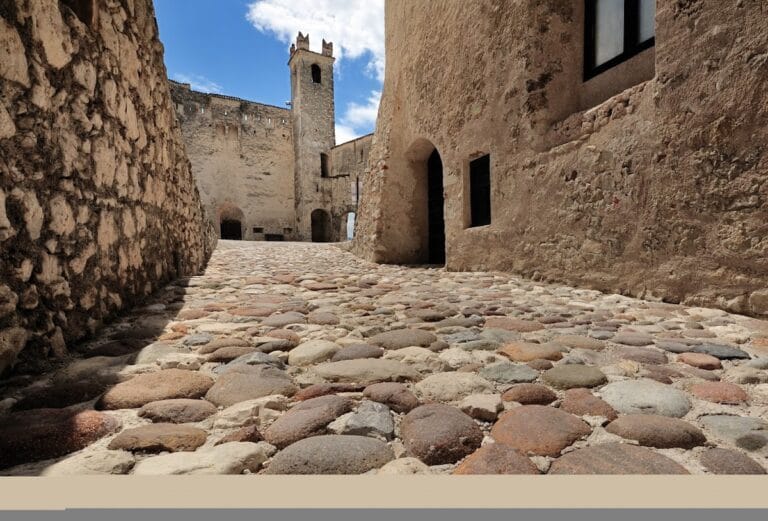
The Castle of Rovereto is set on an uneven, irregular pentagonal plan adapted to the natural landscape, covering an area of approximately 8,250 square meters. The interior rooms collectively total around 1,850 square meters. Its footprint stretches about 90 meters from west to east, and approximately 60 meters from north to south. The castle’s structure primarily consists of limestone and brick, with river stones and large boulders composing the flooring in the courtyard and entrance areas.
Surrounding the castle are massive defensive walls punctuated by three principal rondelles, which are circular towers designed to provide a wide field of cannon fire. The Malipiero tower occupies the northwest corner and is a covered tower with a 20-meter diameter base rising to four levels equipped with cannon openings called embrasures. On the southeast corner stands the Marino tower, roughly 25 meters tall with a 16-meter diameter base; it was built in 1492 to house four cannon embrasures. The Coltrino rondelle at the southwest corner is a semi-circular tower without a cover, completing the principal defensive circuit.
Between the Malipiero and Marino towers, a projecting bastion called the D’Alviano bastion juts into the moat, serving to cover blind spots between the adjacent towers with artillery fire. Attached to the southern wing of the main building is a smaller fortified rectangular tower known as Bastioncello Priuli.
A deep moat, nearly 15 meters in depth, surrounds the northern and eastern perimeters of the castle. To the south, the terrain slopes steeply down to the nearby Leno river. Portions of defensive walls on the western side survive only as partial ruins.
Access to the castle is gained through a passage beneath the Coltrino tower. This entryway features a walled corridor with broad steps that ascend to the vaulted southern wing and then open into the central courtyard. The courtyard itself predates the later Venetian renovations. Within it lies a notably deep well, measuring 57 meters, which was constructed during the Venetian period to provide a reliable water source.
Inside the castle, the layout is complex due to numerous alterations over time, making the original plan difficult to discern. One surviving interior feature is the former chapel dedicated to Saint Mark, commissioned in 1493 by Gerolamo Marino. This chapel was restored in the late 20th century and remains accessible as part of the war museum exhibitions.
The castle’s defensive system also includes an earthen embankment locally known as the “Füllwerk,” situated between the outer and inner walls. Its purpose was to absorb and lessen the impact of incoming cannonballs. Connecting the bastions and rondelles are tunnel-like covered passages, which allowed protected movement between defensive points and included some exits leading outside the fortress. These passages are not open to the public today.
The Malipiero tower’s roof was reconstructed in the early 21st century to restore its appearance from the late 15th century, following damage caused by a fire in the late 18th century. Within the Marino tower are two exhibition halls that display arms from the 16th through 18th centuries, while the Malipiero tower hosts archaeological displays on weaponry spanning from prehistoric times through the Middle Ages, forming an integral part of the Italian Historical War Museum housed in the castle.
Nearby sites