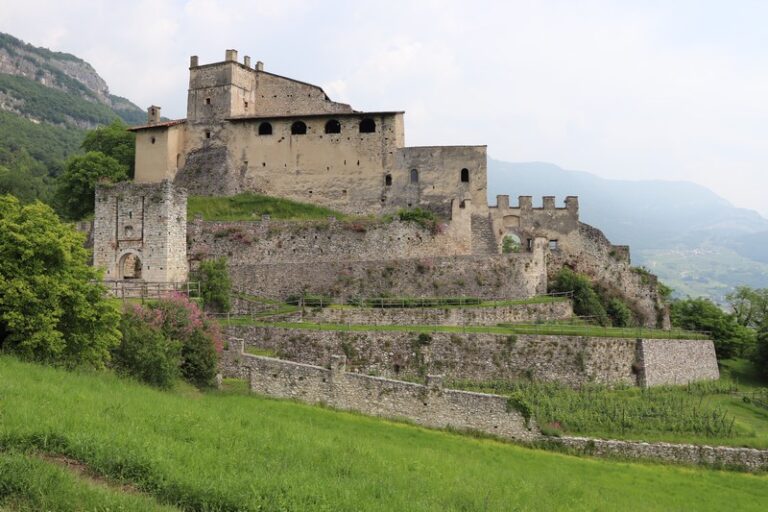
Castello di Drena: A Medieval Hilltop Castle in Italy


Site at a Glance
- Rating
- 4.4
- Popularity
- Low
- Country
- Italy
- Primary era
- Medieval
- External website
- Open
- Eras represented
- Medieval, Early Modern
- Civilizations
- Holy Roman Empire
- Site type
- Military
- Remains
- Castle
On this page8 sections
History
Castello di Drena is a medieval hilltop castle ruin in Drena, Italy, expanded in the twelfth century in the Romanesque style to control the route between Trento and Lake Garda. Its position also allowed visual contact with the neighboring castles of Arco and Madruzzo.
Early occupation and the medieval foundation
The hill had already been occupied during the Late Neolithic, between the fourth and third millennia BC. Bronze Age pottery fragments and flint arrowheads were found during the enlargement of the road toward Cavedine. Permanent settlement during the Roman period and Late Antiquity is not established by the available evidence, while occupation appears again in the Early Middle Ages.
In the ninth century, the hill contained a church-fortress dedicated to Saint Martin and an adjacent cemetery. More than 77 skeletons were discovered in the cemetery. The later castle developed from an earlier rudimentary fortification, and the first known record of Castello di Drena dates to 1175. At that time, the castle and the settlement below passed from the Seiano family to the Counts of Arco, a powerful noble family based in the region around Arco. The Counts of Arco expanded the fortification and held Drena for much of the following centuries.
Conflicts over Drena
During the mid-thirteenth century, Drena became involved in disputes among rival branches of the Arco family, local Guelf and Ghibelline factions, the Counts of Tyrol, and the Prince-Bishop of Trento. Guelfs and Ghibellines were political factions broadly associated with papal and imperial interests, although local family and territorial rivalries also shaped their conflicts.
In 1266, a dispute within the Arco family resulted in Drena being granted to the Seiano family, whose principal stronghold lay on the slopes of Monte Velo above Bolognano. The Arco family defeated the Seiano at the Battle of Bruttoagosto in 1267, after which the Seiano ceased to play a major role in the region.
Prince-Bishop Filippo Bonacolsi’s troops captured Drena in 1301 during a campaign to restore episcopal rights in the northern Lake Garda area. A prince-bishop combined ecclesiastical office with secular territorial authority. In 1315, Prince-Bishop Heinrich III of Metz temporarily settled the dispute with the Counts of Arco and secured rights to the castle for three years through a peace agreement.
In 1398, Gian Galeazzo Visconti and Leopold IV intervened to help Prince-Bishop Georg of Liechtenstein establish a more lasting peace among the opposing parties. In 1433, Drena and other possessions were finally granted to the Arco family as a fief.
Residence, destruction, and restoration
During the fifteenth century, the castle was adapted for use as a hunting and summer residence, although it continued to retain a defensive function. Its decline had already begun when French troops under General Vendôme plundered and burned it in 1703 during the War of the Spanish Succession, a European conflict fought from 1701 to 1714 over the succession to the Spanish monarchy. The castle was then abandoned to decay, and local inhabitants reused parts of its walls as building material.
A first restoration in 1910 prevented the complex from falling into complete ruin. The Municipality of Drena acquired the castle from the Arco family foundation in 1983. Extensive restoration and rehabilitation commissioned by the Autonomous Province of Trento began in 1984 and continued until 1988; former castle buildings were partly reconstructed during the work. Since 1988, the restored complex has been used as an archaeological museum. Castello di Drena has Italian national heritage status. In June 2018, about 20 metres of the western curtain wall collapsed, creating a hole of approximately 200 square metres. No one was injured.
Remains
Setting and defensive walls
Castello di Drena stands at approximately 465 metres above sea level on a hill on the orographic left side of the Sarca valley, at the western edge of Drena. The Rio Sallagoni gorge bounds the site to the south, while the Marocche di Dro lie to the east beside the provincial road leading from the Sarca valley toward the Cavedine valley.
A roughly triangular outer curtain wall, about one metre thick, encloses approximately 4,200 square metres. The wall is built from roughly dressed rubble stone and river pebbles and has swallowtail crenellations. A second inner wall once enclosed the central part of the castle, and portions of it survive. Together, these walls express the essentially Romanesque character of the complex.
Keep, gates, and outer ward
The principal tower is a square Romanesque keep, the castle’s main fortified tower, dating from the twelfth century. It stands at the centre of the enclosure and is described as approximately 25 to 27 metres high.
Access to the castle follows a roughly paved path to a sixteenth-century defensive tower containing the outer entrance gate. Immediately beyond it are the second inner gate and the arms yard. To the left stand the remains of a corner tower that served as the entrance gate until the fifteenth century. Beyond the entrance area are the ruins of the outer ward, including the former stables and service buildings. The former tournament ground lay between the inner and outer walls.
Church, palace, and water storage
The inner courtyard contains foundations exposed during restoration of the former castle church dedicated to Saint Martin. The church dates from the Carolingian period. Within the medieval castle, the Saint Martin chapel later ceased to serve a religious purpose.
A partly restored, multistory residential palace stands against the outer wall. This fifteenth-century residential complex is also identified as a comital palace. Finds recovered during restoration and archaeological excavations are exhibited inside the palace. The complex also includes visitable kitchens and an adjacent castle cistern, a water-storage installation designed to collect and retain supplies within a fortified settlement. The cistern borders the outer defensive wall and was formerly used to store water.