Castle of Fuentes de Valdepero: A 15th-Century Spanish Fortress


Visitor Information
Google Rating: 4.5
Popularity: Low
Google Maps: View on Google Maps
Official Website: castillodelossarmiento.com
Country: Spain
Civilization: Unclassified
Remains: Military

History
The Castle of Fuentes de Valdepero stands in the town of Fuentes de Valdepero in Spain and was constructed by the noble Sarmiento family during the 15th century. This lineage, known for their wealth and influence, had established estates since the 13th century in the regions now recognized as Palencia and Galicia.
The earliest phase of the castle was built between 1442 and 1465 under Diego Pérez Sarmiento, who held the titles Count of Santa Marta and adelantado mayor of Galicia, a high administrative and military office. His leadership coincided with the castle’s initial construction, confirmed by archaeological evidence and inscriptions bearing the family’s coat of arms on the southeast tower. After Diego’s death, ownership passed through a related branch when Andrés de Ribera married the count’s granddaughter, linking two influential family lines.
During the uprising known as the Revolt of the Comuneros in 1521, the castle became a focal point of conflict. Andrés de Ribera II, a descendant, faced a siege led by the rebellious forces under Bishop Acuña. Although a surrender was negotiated, Acuña betrayed the agreement, imprisoning the family and plundering the fortress. The castle remained under comunero control until their forces were defeated in April 1521 at the Battle of Villalar.
In the aftermath of the siege, Andrés de Ribera II undertook significant renovations, thickening walls and reducing window openings to better defend the castle against future attacks. A decade later, in 1531, it was sold to Diego de Acevedo. His daughter Juana was later awarded the title of Countess of Fuentes de Valdepero by royal decree in 1572 under King Philip II. Throughout subsequent centuries, the castle changed hands, entering the possession of the House of Alba by 1739, before being sold outside their control in 1874. In 1995, the historical structure was acquired by the Provincial Council of Palencia, marking the beginning of restoration and adaptive reuse efforts.
Remains
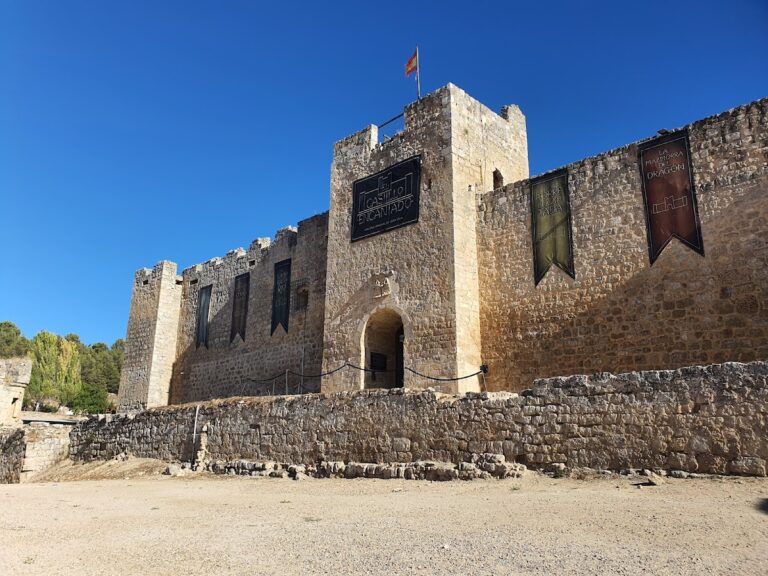
The Castle of Fuentes de Valdepero comprises a roughly square fortress constructed from large, carefully worked stone blocks known as sillares. Its enclosure covers over 2,000 square meters, with walls reaching an imposing thickness of up to 11 meters, among the thickest found in 15th-century Spanish fortresses. A towering keep stands on the northern side, originally taller than its current height of about 25 meters, featuring three vaulted floors and a battlemented terrace that overlooks the courtyard.
Access to the interior keep is through an entrance located at its northeast corner. From here, a stairway leads next to a vaulted dungeon characterized by a single elevated entrance, secured through a corridor with two successive doors. Several spiral staircases within provide passage to upper vaulted chambers, including a main hall flanked by four small storage rooms connected by short, L-shaped passages. This internal arrangement bears resemblance to the design of the nearby Castle of Peñafiel.
The courtyard itself is modest and square, with machicolated towers once standing at each corner. Of these, the southeast tower remains intact and has been recently stabilized, while the northeast tower suffered severe damage but has since been reconstructed. The two western towers no longer stand, their locations marked by modern indicators. Access to these towers was only possible from the battlements, reached via a terrace connecting them to the main keep. The main entrance is situated on the east wall, flanked by two small turrets equipped with machicolations—openings designed for defensive purposes.
A notable feature of the southeast tower is a Gothic-style pointed window, accompanied by two circular stone shields bearing the Sarmiento family’s coat of arms. These shields are supported by archaic male figures and inscribed with the titles held by Diego Pérez Sarmiento, confirming his role as Count of Santa Marta and adelantado mayor of Galicia. Evidence of a once-present canopy protecting these shields can be seen through the corbels that supported it.
The castle’s architectural style aligns with the Valladolid School, a tradition of masonry known for its intricate stonework and defensive innovations. It suggests the involvement of the same master mason responsible for the towers of other contemporary fortresses, including Fuensaldaña and Peñafiel. Historical photographs reveal that the upper courtyard once featured a Plateresque-style gallery, distinguished by polygonal columns and ornate balustrades; components of this gallery have been preserved within the nearby parish church alongside two additional family shields relocated there in the 19th century.
Overall, the Castle of Fuentes de Valdepero presents a well-documented example of late medieval military architecture, enhanced through various periods of modification reflecting both defense needs and residential use. Its surviving inscriptions and heraldic symbols provide valuable insight into the noble family that commissioned and inhabited this enduring fortress.
Nearby sites