Ampudia Castle: A Medieval Castle-Palace in Spain


Site at a Glance
- Rating
- 4.4
- Popularity
- Medium
- Country
- Spain
- Primary era
- Medieval
- External website
- Open
- Eras represented
- Medieval
- Civilizations
- Crown of Castile
- Site type
- Military
- Remains
- Castle
On this page10 sections
History
Ampudia Castle is a privately owned medieval fortress in Ampudia, Spain, built by Castilian nobility between 1461 and 1488 as an early example of a seigneurial castle-palace. Commissioned by García López de Ayala, Lord of Ayala and Salvatierra, it became involved in noble disputes, the Comunero Revolt, royal custody, and the occasional movements of the Spanish court.
Foundation and noble succession
García López de Ayala commissioned the castle as the son of Pedro García de Herrera, the first holder of the Ampudia entailment. After García’s succession, Pedro Ayala y Rojas, Count of Salvatierra, disputed possession with his mother, María Sarmiento. Pedro won the contest and retained control of the fortress.
The Comunero Revolt and royal custody
In 1521, Pedro Ayala y Rojas supported the Comunero Revolt, a Castilian uprising against the rule of Charles I, the Spanish king and Holy Roman Emperor. The conflict brought the Battle of Ampudia, where forces supporting Charles I fought troops commanded by Bishop Antonio de Acuña.
After the Comunero defeat in 1522, Charles I confiscated the castle. He returned it to the family shortly afterward in exchange for 20,000 ducats. Following the Battle of Pavia, the fortress held the sons of King Francis I of France as hostages in 1528.
The Duke of Lerma and later history
In 1597, Francisco Gómez de Sandoval y Rojas, Duke of Lerma, assumed the lordship. As Philip III’s principal favorite and chief political minister, he brought the king to Ampudia on several occasions, and the castle served at times as a seat of the Spanish court.
The castle later entered a prolonged period of abandonment. It was declared a National Historic-Artistic Monument in 1931 and remains protected as a Property of Cultural Interest in the monument category.
Restoration and museum use
In 1960, Eugenio Fontaneda Pérez, a confectionery entrepreneur from Aguilar de Campoo, acquired the castle from the Countess of La Granja. During the 1960s, he carefully restored the building and adapted it as a museum for his collection of art and antiquities, including archaeological material from the Duero River basin. Ampudia Castle remains privately owned by the descendants of its former owner and is regarded as one of the best-preserved castles in Palencia.
Remains
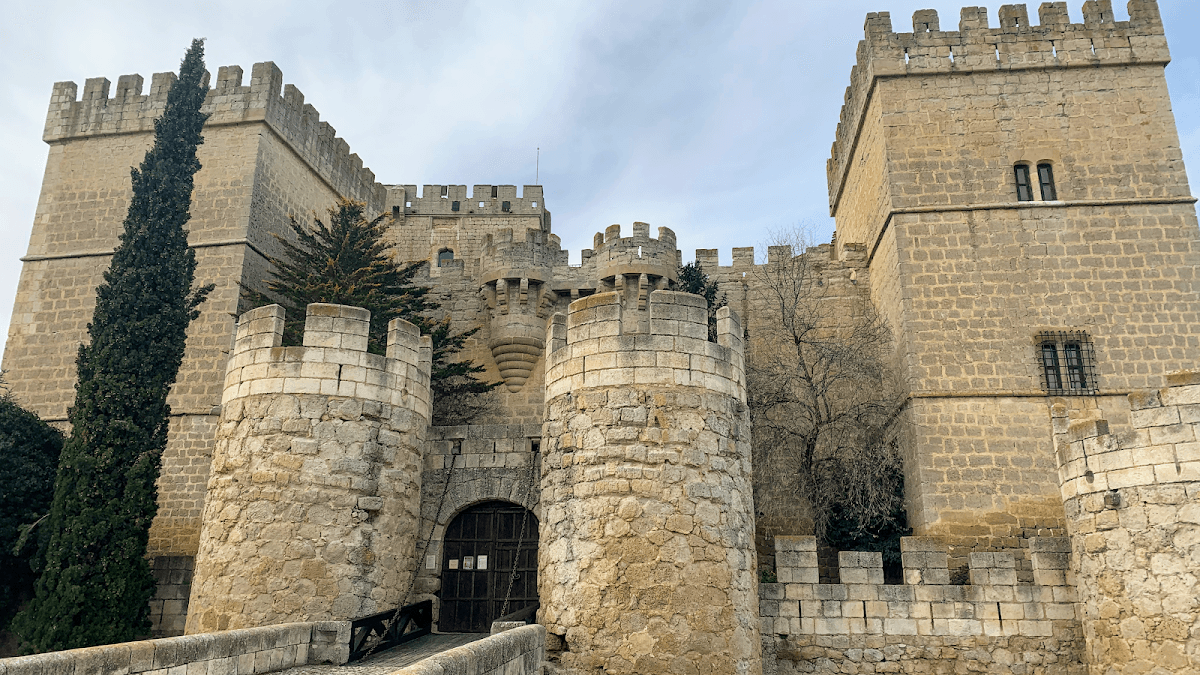
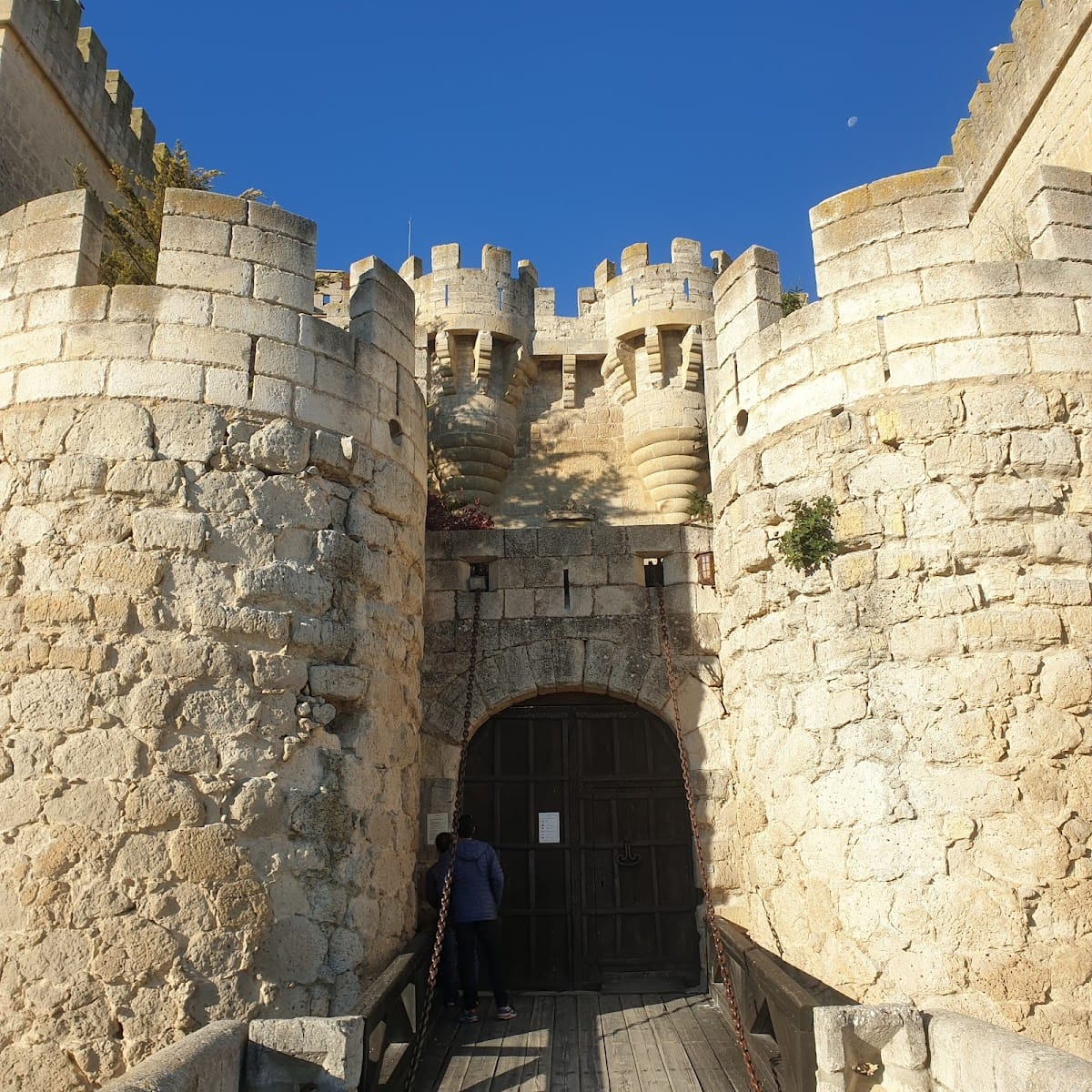
Ampudia Castle is an irregular quadrilateral, or trapezoidal, fortress with large corner towers. A moat surrounds the building, while a drawbridge provides the crossing. An outer defensive enclosure, known as a barbican, protects the main structure and includes cylindrical towers. The southwest corner tower is the keep, or Tower of Homage, the castle’s principal defensive and symbolic tower.
Defensive and courtyard architecture
Moat, barbican, and entrance
The moat, drawbridge, and outer barbican form the castle’s defensive approach. The facade has two ornamental projecting watch turrets, and the main gate carries the coat of arms of the Duke of Lerma, a heraldic emblem identifying his rank and lineage.
Arms Courtyard
The Arms Courtyard contains three arcaded galleries, each rising three storeys. Their arches are segmental, and the upper gallery is narrower and more modest in proportion than the two levels below. The arcaded sides display noble coats of arms, architectural elements, and baptismal fonts, vessels used in the Christian rite of baptism.
Eugenio Fontaneda Collection
The Eugenio Fontaneda Collection occupies six rooms within the restored castle. Its archaeological displays include Bronze Age weapons, Roman funerary stelae, which are upright stones associated with burial or commemoration, and Roman milestones that marked distances or routes. Sacred-art displays include sculptures from the thirteenth to fifteenth centuries, along with liturgical furnishings and paintings dating from the fifteenth to eighteenth centuries.
Other rooms contain toys, weapons, musical instruments, pharmacy material, and examples of ethnographic and popular art. Together with the objects displayed around the Arms Courtyard, these collections form part of the castle’s present museum use while remaining within its medieval architectural setting.