La Tour-de-Peilz Castle: A Medieval Fortress and Museum in Switzerland


Visitor Information
Google Rating: 4
Popularity: Very Low
Google Maps: View on Google Maps
Country: Switzerland
Civilization: Unclassified
Remains: Military

History
The site known as Castle, house and outbuildings, pavilion, towers, ramparts and ditches is located in La Tour-de-Peilz, Switzerland. It originated as a medieval stronghold built by local lords in the region that is now part of the Swiss canton of Vaud.
The earliest record of this castle dates back to 1160, naming Philippe de La Tour de Vevey as its lord, which confirms the presence of a fortress centered around a principal tower. During its initial phase, the structure functioned both as a residence for the local ruling family and as a place of refuge. By the early 1200s, the castle underwent significant enlargement with the addition of a large hall, referred to as the aula, which comprised roughly two-thirds of what is currently the main residential building.
Around the mid-13th century, ownership passed to the Counts of Savoy. In the 1280s, these new rulers reinforced the castle’s defenses by constructing two circular towers to flank the walls. Alongside these fortifications, they extended the aula to include private chambers for the lord (camera domini) and built a chapel attached to these rooms, reflecting the religious needs of the occupants. The Counts of Savoy also enhanced the outer defenses by adding a second, lower wall called a braies, which created an additional protective zone known as the lices. The moat was widened and flooded with water from the nearby lake, effectively transforming the castle into an island fortress. Access to the castle was initially granted by a bridge spanning the moat on its northern side.
The castle suffered damage during the Burgundian Wars in the late 15th century, with historical evidence suggesting it was set on fire. After the Bernese took control of the region in 1536, the fortress fell into disuse as a noble residence. Its role was reduced primarily to administrative and penal functions, with one of the circular towers serving as a prison and a nearby building used as a courtroom.
In the mid-18th century, specifically 1749, the castle entered a new phase when Jean Gressier, a French royal fortifications inspector of considerable means, acquired the property. He transformed the medieval fortress into a private residence by restoring the main dwelling with windows characteristic of classical architecture. The moat was partially filled, and the formerly defensive areas facing the lake were converted into terraces intended for leisure. Additionally, the large quadrangular tower was demolished to improve sunlight penetration into the compound.
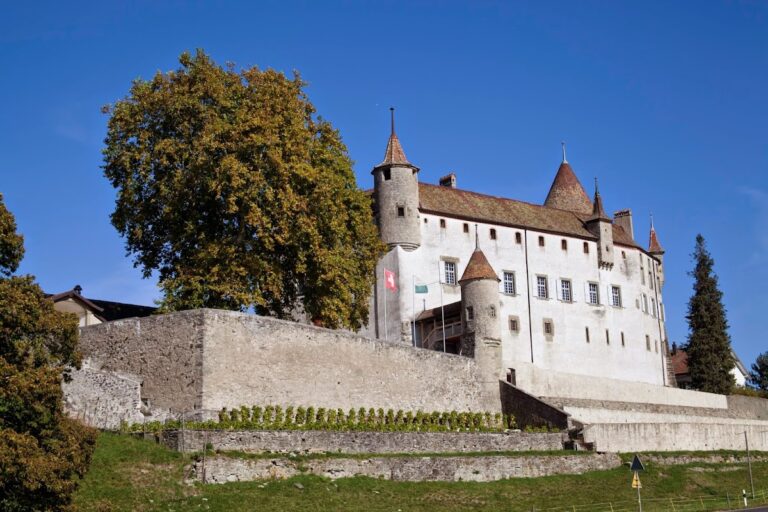
Throughout these transformations, the castle retained visible traces of its medieval origins, especially when viewed from the town side, where the old moat, tall walls, and the two circular towers from the late 13th century remain prominent. From the lakeside, the façade reflects the 18th-century classical modifications.
In recognition of its architectural and historical value, the castle’s key defensive elements—including the corner towers, surrounding walls, ramparts, and moats—were officially declared historical monuments in 1973. The local municipality acquired the castle in 1979, and since 1987 it has housed the Swiss Museum of Games. The site is also included in the Swiss Inventory of Cultural Property of Regional Significance, underlining its importance within the country’s heritage.
Remains
The layout of the castle combines medieval fortification elements with later residential adaptations, resulting in a complex that reflects centuries of continuous occupation and modification. At its core is the oldest surviving section: the lower part of the main tower. This tower measures about 16.5 by 11.5 meters at its base and rises to an estimated height between 16 and 22 meters. Originally, it served both defensive and residential purposes, functioning as a stronghold as well as the lord’s living quarters.
In the early 13th century, the construction of a large hall, or aula, expanded the residential area. This space covers roughly two-thirds of the current main building and was later extended northwest to house the lord’s private rooms and a chapel adjacent to them. These expansions illustrate the castle’s evolution from a purely defensive site to one that accommodated both living and religious needs.
The two circular towers added in the 1280s stand prominently along the curtain wall, or enceinte, taking advantage of their rounded form to enhance defensive coverage. While the large quadrangular tower remained in place during this period, it was altered to include a heated chamber positioned behind a high wall separating it from the courtyard, suggesting accommodation comfort alongside security. Surrounding the castle, a second, lower wall known as the braies created an outer defensive walkway called the lices, providing an additional layer of defense.
The moat encircling the castle was expanded and flooded with lake water to render the fortress effectively an island, a strategic enhancement typical of the late 13th century. The original main approach was from the north, where a bridge crossed the moat at its widest point, controlling access to the stronghold.
In the 18th century, modifications reflected a shift in use and aesthetic preference. The once strictly defensive moat was partially filled in, and the lakeside defensive terraces were converted to spaces suited for leisure, replacing their former military function. The main residential building’s courtyard façade was partly rebuilt, and new classical-style windows introduced a refined appearance. The demolition of the large quadrangular tower opened the castle to more natural light, marking a break from its former fortress-like silhouette.
Inside, remnants of original medieval features mostly survive on the ground floor. These include period wood panelling and ceramic stoves, which today serve as decorative and functional elements in reception areas. The upper floors and attic have been adapted for modern museum use, blending preservation with contemporary function.
Today, the site preserves significant components of its defensive heritage. The two circular towers, surrounding walls, ramparts, and flooded moats remain standing or visible and have been protected as historical monuments since the 1970s. These elements collectively illustrate the castle’s long history as a fortified residence and its gradual transformation over the centuries.
Nearby sites