Castle Goyen: A Medieval Fortress near Scena, Italy
Visitor Information
Google Rating: 4.4
Popularity: Very Low
Google Maps: View on Google Maps
Country: Italy
Civilization: Unclassified
Remains: Military

History
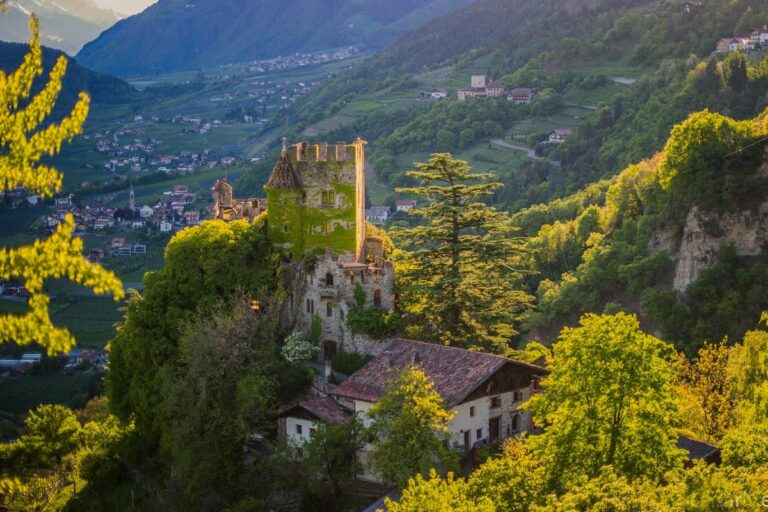
Castle Goyen, a medieval fortress constructed by local powers, stands near the municipality of Scena in Italy. Its origins trace back to the 12th century, placing its foundation within the period of feudal dominion across the Alpine regions.
The earliest known owners appeared in records from 1294, identifying the lords of Scena as its custodians. By 1371, control of the castle shifted to Oswald Milser von Klamm, a noble whose name endures in association with one of the castle’s towers. Later, in 1384, the property was sold for 400 Bernese marks to knights Hans von Starkenberg and Friedrich von Greifenstein, marking a formal transfer into new hands and indicating the castle’s ongoing military and residential significance.
During the early 15th century, Castle Goyen became involved in regional conflicts. In 1422, it faced a siege led by Ulrich von Matsch under Federico Tascavuota’s command. Although the fortress was taken, it did not suffer considerable destruction, signaling its robust defense. A fire in 1444 caused damage that precipitated another change of ownership, passing to Christoph Botsch. His family maintained stewardship through his sons Gaudenz and Georg, who gained formal recognition as castellans—the appointed guardians of the castle—from Emperor Maximilian I in 1498. This noble line retained possession until 1637.
Following this period, the castle came under the Counts of Stachelburg until the death of Johann Stachelburg, the last male heir, in 1809 amid the upheavals of the Tyrolean uprising against Napoleonic forces. Mid-19th century saw new ownership under Franz Count of Mohr, who developed the surrounding farmland. Subsequently, the property changed hands several times: Josef Innerhofer held it before Dr. Ahrens from Hamburg acquired it in 1890. The ownership shifted once more in 1927 to Ludwig van Heek, a Dutch businessman.
Significant restoration in 1928–29, overseen by architect Adalbert Erlebach, transformed the castle’s appearance into its present form. During the Second World War, between 1943 and 1944, the castle was used for recovery by Albert Speer, a high-ranking official of the Nazi regime. Since 1949, Castle Goyen has been protected as a cultural monument, remaining in private hands managed by van Heek’s descendants.
Remains
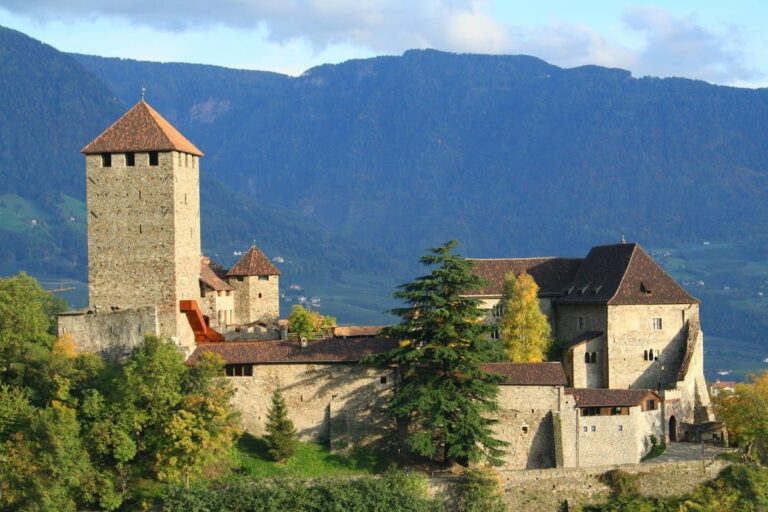
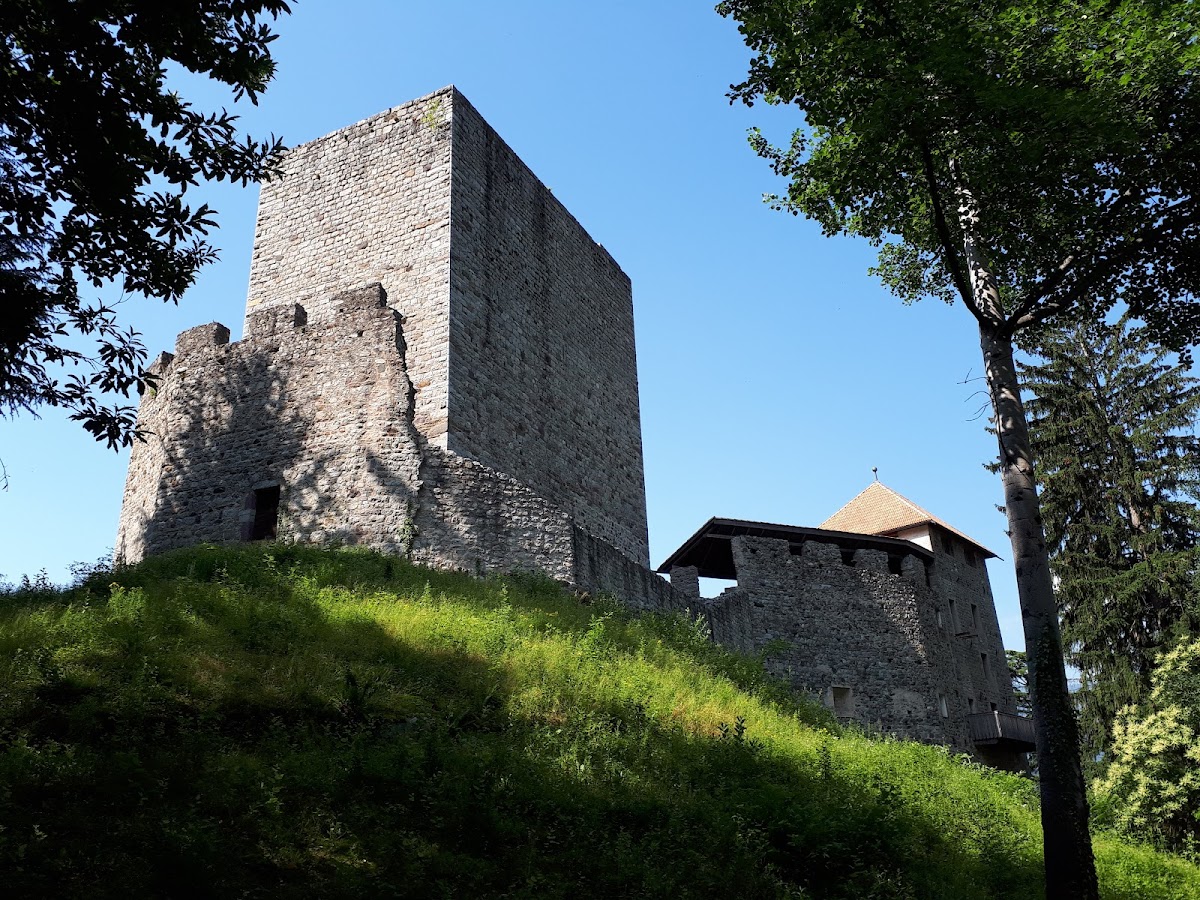
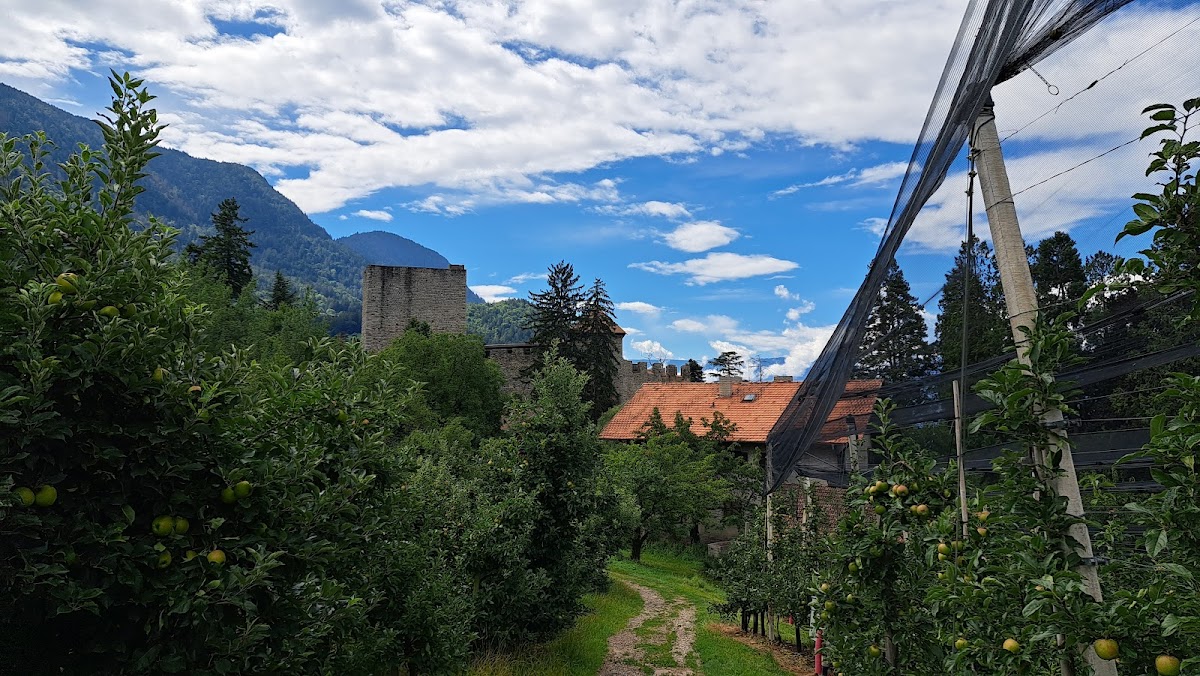
Castle Goyen occupies a strategically placed hill overlooking the Nova stream near the peak of Ivigna, providing extensive views over the landscape. The complex is anchored by a large rectangular main tower, or keep, dating to the 12th century. Standing about 20 meters tall, this stone structure features walls approximately two meters thick, constructed from finely shaped masonry blocks emblematic of the Romanesque style prevalent at the time. Notably, the tower does not have battlements, or merlons, which are protective parapets commonly found on defensive towers in the region. This absence suggests the possibility that the uppermost floor was originally made from wood rather than stone, a feature that would have influenced both the tower’s silhouette and its defensive capabilities.
Surrounding the keep is the first defensive enclosure, a high wall rising roughly nine meters and one meter thick, set a few meters away from the tower’s base to provide an added layer of protection. Part of this wall on the northern side collapsed in 1983, and this section has remained unrestored since.
Beyond this, a second ring of fortifications includes Renaissance residential buildings and a second stone tower known as the Mils Tower, which measures 19 meters in height. This area encompasses a late Gothic chapel, reflecting the religious functions integrated into the castle complex, and a palace, or Palas, remodeled around 1570. The palace contains a paneled room, known locally as the Stube, that speaks to the domestic refinements of its occupants during the Renaissance period.
The extensive restoration carried out in the late 1920s introduced numerous windows and balconies, altering the exterior appearance from its medieval origins. Today, while the main residential tower remains unoccupied, some surrounding buildings continue to be maintained and used. The castle’s irregular polygonal outer walls frame the entire complex, emphasizing its adaptation and expansion over several centuries to meet changing residential, defensive, and representational needs.
Nearby sites