Castillo de Puebla de Almenara: A Medieval Fortress in Spain


Visitor Information
Google Rating: 4.5
Popularity: Low
Official Website: www.castilloalmenara.com
Country: Spain
Civilization: Unclassified
Site type: Military
Remains: Castle

History
The Castillo de Puebla de Almenara is a medieval fortress situated in the municipality of Puebla de Almenara, Spain. Its origins trace back to an Andalusian fortification, built by Muslim settlers during the period of Islamic rule in the Iberian Peninsula.
The fortress’s name, “Almenara,” derives from the Arabic term “manārah,” meaning beacon or signal tower. This indicates that its original purpose was to serve as a point of communication through lights or fires, linking it with nearby fortresses. Its strategic location near the town of Uclés suggests it may have played a role in the notable Battle of Uclés in 1108, a significant conflict between Christian and Muslim forces during the Reconquista.
In 1177, the fortress was seized by the Order of Santiago, a military and religious group dedicated to defending Christian territories. This event occurred in the wake of Alfonso VIII’s conquest of Cuenca and marked a shift in control from Muslim to Christian hands. Following the stabilization of borders between Toledo and Cuenca after failed Muslim attempts to regain Huete in 1172, the castle’s critical frontline role diminished. This decline in frontier significance continued in the aftermath of battles such as Alarcos in 1195 and Las Navas de Tolosa in 1212, which expanded Christian control further into the peninsula.
During the 14th century, the castle became part of the estates of Infante Don Juan Manuel, a prominent nobleman who granted a charter for the repopulation of Puebla de Almenara in 1332. However, after rebelling against King Alfonso XI, Don Juan Manuel’s holdings including the castle were confiscated and assigned to Vasco Rodríguez de Cornado, the Master of the Order of Santiago, in 1336. That same year, Alfonso XI ordered repairs to the castle, which had suffered damage either from conflict or neglect. A reconciliation between the king and Don Juan Manuel in 1343 led to the restoration of the castle to its original owner.
In 1487, ownership of the fortress passed to the influential Mendoza family through Cardinal Pedro González de Mendoza. Under his direction, significant renovations took place between 1491 and 1492, led by master builder Alberto de Carvajal and others. One of the towers still displays the Mendoza family’s coat of arms, marking their lasting presence. By the 16th century, the castle was owned by Ana de Mendoza, Princess of Éboli, who inherited it from her father, Diego Hurtado de Mendoza. A detailed description from 1578 highlights architectural elements reminiscent of a castle in Íscar, Valladolid, potentially linked to the architect Juan de Zamora.
Despite its former importance, by the early 17th century the castle had fallen into disuse and ruin. In 1612, requests were made to dismantle parts of the structure to reuse materials for constructing a nearby hermitage. During a military survey in 1812, observers noted that the exterior walls were relatively intact, although a prominent 100-foot tower with a spiral staircase was close to collapsing and the cistern had been filled with debris. Ownership eventually transferred to the Vara family in the 19th century.
In recent years, restoration efforts have reinstated the castle as an important cultural landmark. Beginning in 2020, a new phase of conservation work included cleanup and structural stabilization, making the site accessible once more. The fortress is now officially recognized as a Bien de Interés Cultural, a designation that acknowledges its historical and cultural value in Spain.
Remains
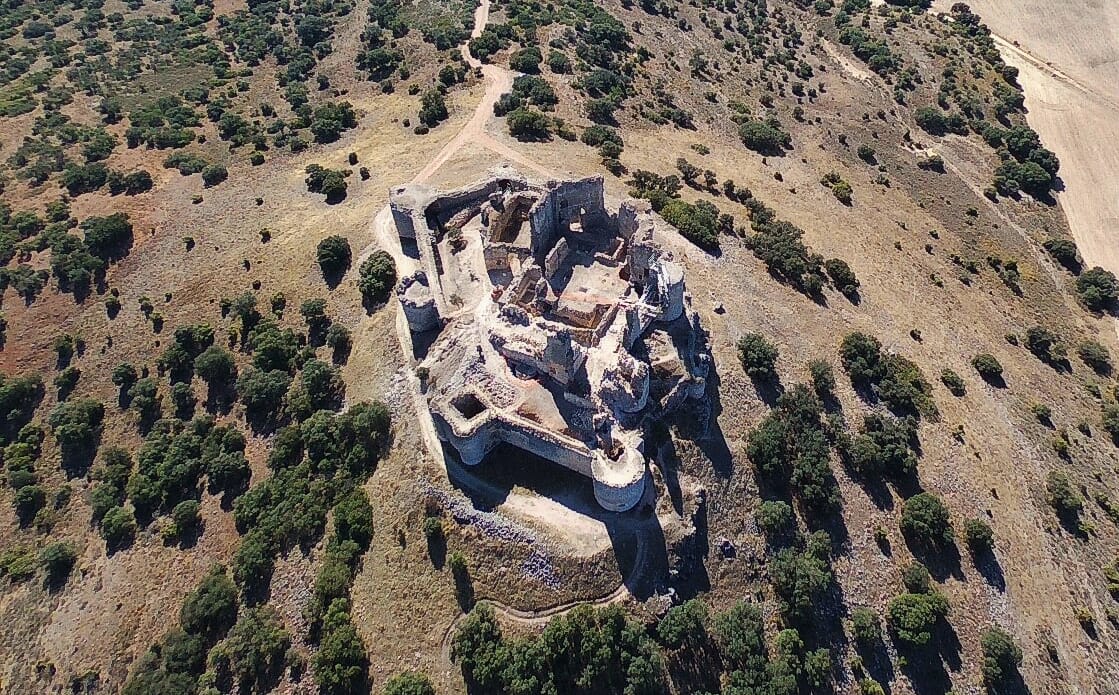
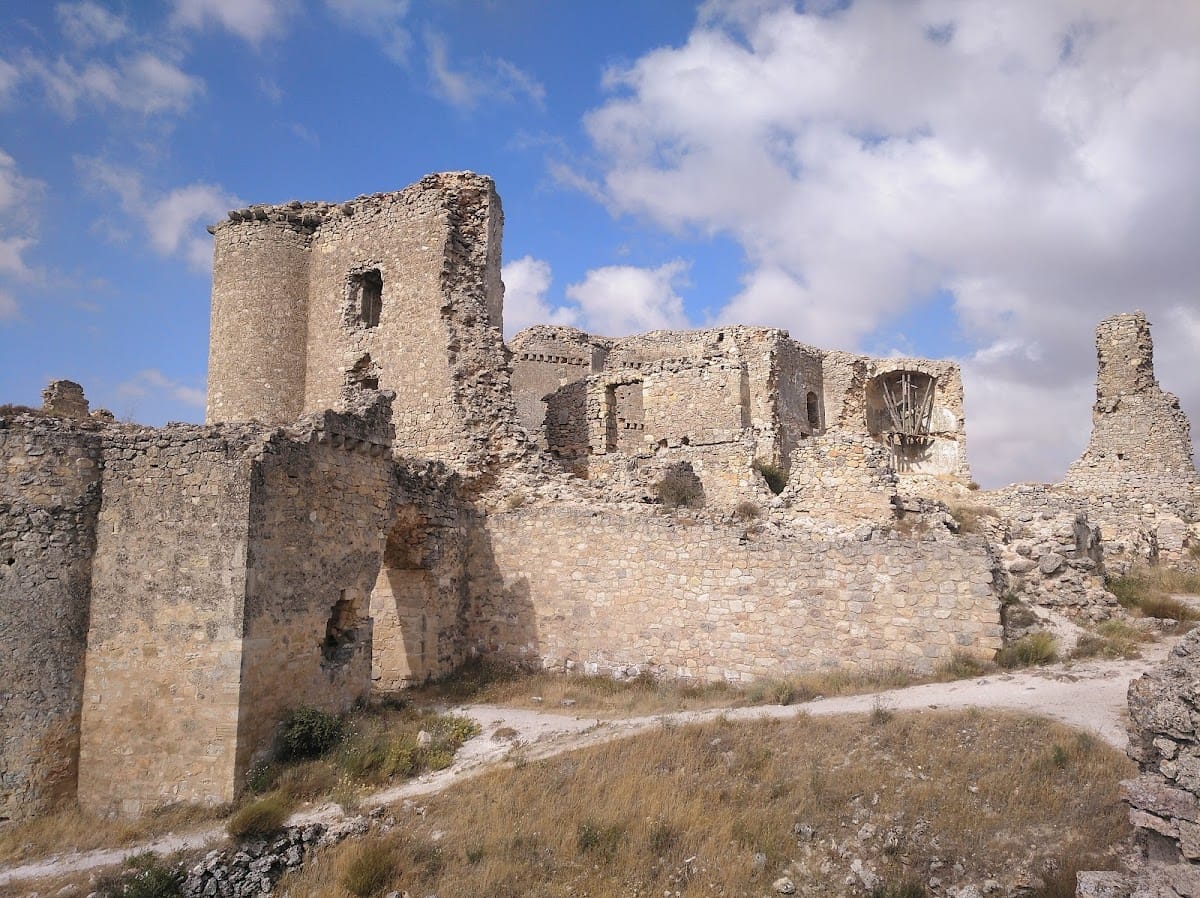
The Castillo de Puebla de Almenara is composed of a series of fortified enclosures typical of medieval military architecture. The layout consists of three successive enclosures, each serving distinct defensive and residential functions, constructed using traditional masonry techniques of the period.
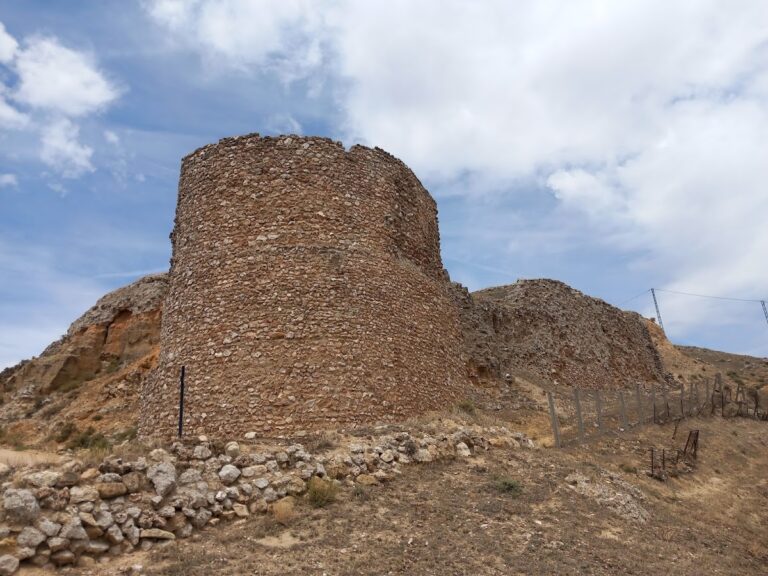
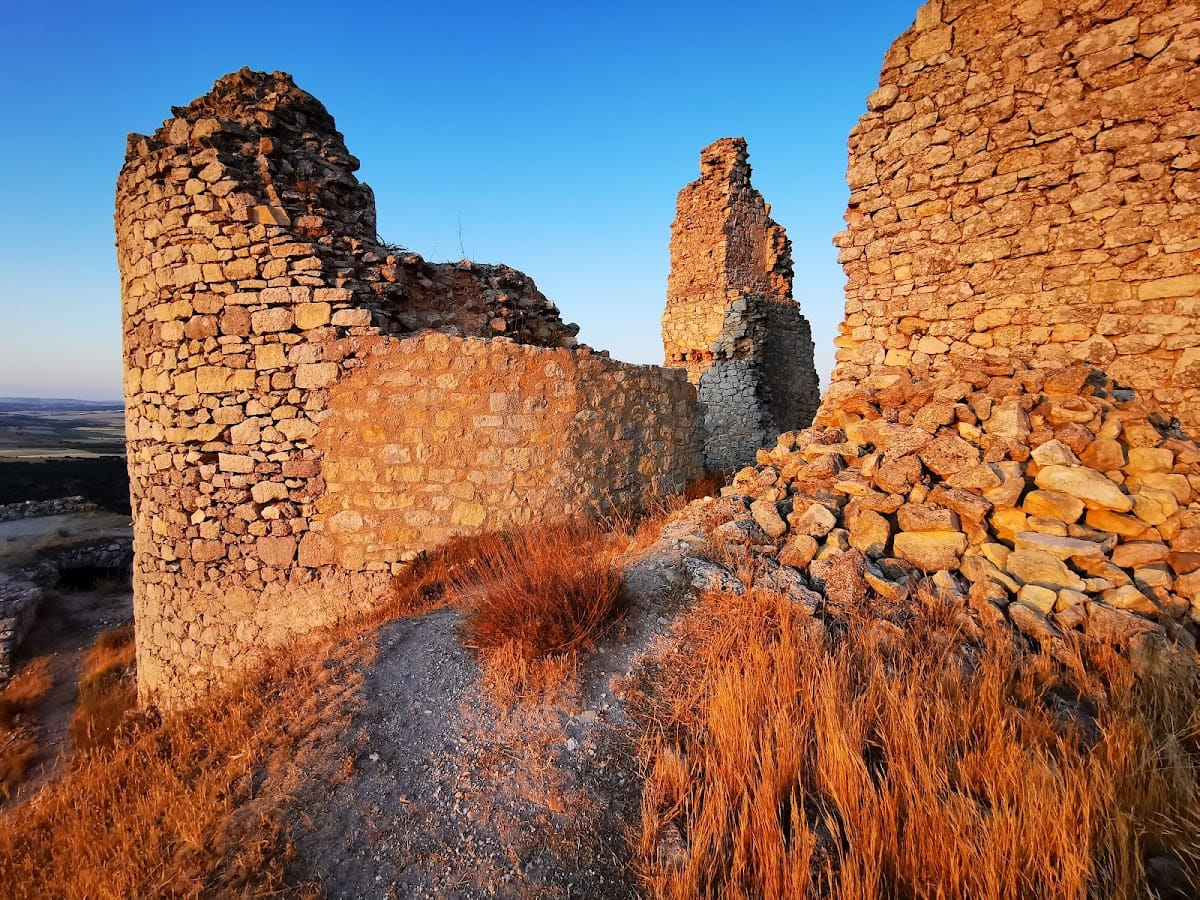
The outermost enclosure is the most recent and features a trapezoidal bastion alongside a square bastion that historically served as the original northern gateway. This first line of defense includes loopholes—narrow vertical openings designed to allow defenders to fire weapons while remaining protected. Notably, the trapezoidal bastion has double loopholes permitting the simultaneous discharge of two firearms. Near the current entrance stands a circular tower bearing a weathered coat of arms attributed to the Mendoza family, connecting it to the castle’s late 15th-century ownership and renovations.
Inside, the middle enclosure is the smallest and serves as a transitional space between the external defenses and the inner core. Excavations conducted in 2020 uncovered remnants of an Almohad masonry wall—indicative of the site’s original Muslim construction—and the buried remains of a tower within this enclosed area, reflecting the layering of architectural phases over the centuries.
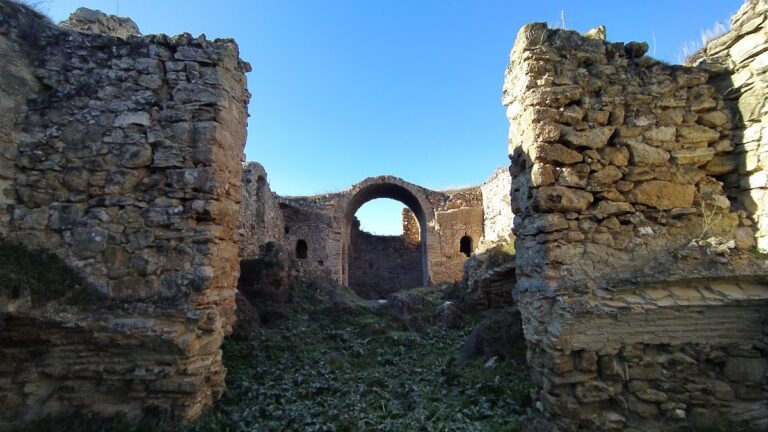
The innermost enclosure contains the main residential and service buildings but is heavily damaged, making full description challenging. Upon entering this area, visitors would come to a small triangular courtyard that leads to a distribution space with three ways to proceed: a descending ramp to the stables located below, a spiral staircase ascending to upper floors, or passage into the central courtyard.
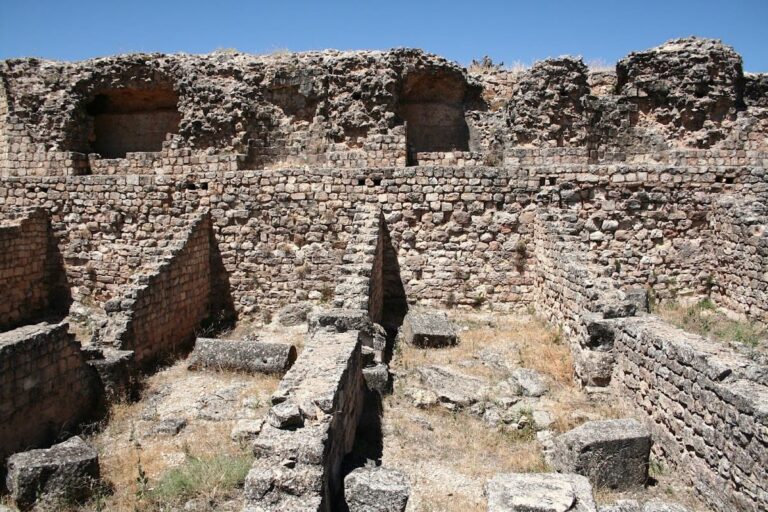
The stables consist of four vaulted chambers beneath the courtyard, surrounding a large cistern or water reservoir (“aljibe”). Sixteenth-century descriptions emphasize their capacity to house approximately a hundred animals. Opposite the cistern wall are the feeding troughs (mangers), and the stable areas were illuminated and ventilated by eight barred skylights opening onto the courtyard, two on each side, allowing light and air to circulate within the vaulted spaces.
At the heart of the castle lies the paved central courtyard, originally sheltered by a roof supported by columns creating a portico. At its center sits the cistern with a semicircular vaulted ceiling about five meters high. Its surface is coated in a reddish, waterproof and antifungal material of Arabic origin, demonstrating sophisticated medieval engineering. The cistern was supplied by a courtyard well and a ceramic channel that collected rainwater from the surrounding roofs.
Westward of the courtyard is the “sala de yeserías,” or plasterwork room, a large rectangular chamber aligned north to south and accessible from the courtyard. Named for its Renaissance-style plaster friezes, this room reflects the castle’s artistic embellishments added during later renovations.
The castle’s elevated position provides extensive views across the surrounding landscape, including nearby towns such as Tarancón, Belmonte, Uclés, and Segóbriga, as well as more distant landmarks like the Sierra de Guadarrama mountains and the Alcázar de San Juan fortress over 50 kilometers away.
Conservation interventions in recent years have included archaeological excavations, strengthening and cleaning of stone surfaces, installation of stairs within the courtyard, sealing of the cistern for preservation, and opening access to the battlements along the outer walls. These efforts have enhanced the comprehensibility of the fortress’s structure and secured the site for educational and cultural purposes.
Nearby sites