Castillo de La Calahorra: A Renaissance Castle in Spain



Visitor Information
Google Rating: 4.3
Popularity: Medium
Google Maps: View on Google Maps
Official Website: www.andalucia.org
Country: Spain
Civilization: Medieval European
Remains: Military

History
Castillo de La Calahorra stands on a hilltop in the municipality of La Calahorra, Spain, originally built during the early 16th century by a noble family. Its location offered commanding views over the surrounding valley known as the Marquesado del Cenete.
The castle’s current form was erected between 1509 and 1512 by Don Rodrigo Díaz de Vivar y Mendoza, the first Marquis of Cenete and Count of the Cid. Don Rodrigo was an illegitimate son of Cardinal Mendoza, founder of the Marquesado del Cenete majorat intended for his heir. His titles were closely connected to the fortress of the legendary Cid Campeador, linking the castle to a celebrated historical figure. The site itself had previously hosted an Andalusian fortress, evidence of an earlier Islamic presence before the Christian reconquest.
Don Rodrigo’s humanist education and a formative journey to Italy between 1506 and 1508 strongly influenced the castle’s design. Inspired by Renaissance ideals, he commissioned Italian architects and artists, importing marble and employing innovative techniques that brought one of the first examples of Renaissance civil architecture to Spain. Initially, the architect Lorenzo Vázquez from Segovia began the work, but after disagreements, the Genoese architect Michele Carlone took over, overseeing the installation of Carrara marble and local stone.
After completion, Don Rodrigo and his wife María de Fonseca lived in the castle for only eight years before it passed to their daughters. During the Morisco Rebellion from 1568 to 1571, the castle served a strategic role. It provided refuge for old Christians and acted as a garrison under the command of the Marquis of Mondéjar, reflecting its ongoing military importance in the 16th century.
Following its active use, the fortress saw centuries of abandonment. In the early 20th century, there was even a plan to dismantle and transport the entire structure to the United States, although this never materialized. Eventually, the property entered private ownership. Since April 2025, the Diputación de Granada holds ownership of the castle. In recent times, the castle’s impressive historic character made it suitable as a filming location for the television series “La casa del dragón,” a prequel to “Game of Thrones.”
Despite widespread royal decrees in the 16th century ordering the demolition of feudal fortresses to diminish noble power, Castillo de La Calahorra was spared. This exception highlights the significant influence wielded by the Mendoza family during that period.
Remains
The castle occupies a rectangular footprint measuring roughly 46.5 by 32 meters, with the main sides oriented north to south. Constructed primarily of masonry combined with carefully cut ashlar stone, the fortress embodies both defensive and residential qualities. Each corner is strengthened by large cylindrical towers capped with domes, two to the south measuring about 10 meters in diameter and two to the north approximately 13 meters.
Along the west facade, a rectangular wing extends measuring 26 by 15 meters. This section incorporates a circular artillery tower that houses the main staircase, a later architectural feature marking a shift from purely military use toward greater residential comfort and status. The staircase design, influenced by Genoese models, features three grand flights and required the enlargement of the fortress perimeter, which slightly reduced its defensive effectiveness.
The walls are topped by a parapet called an adarve, a walkway with partial covering that sheltered guards from the elements as they patrolled. The main entrance is placed at the northeast corner, where the original wooden doors still remain. These doors are fortified with overlapping iron strips, bolts, locks, and rings. Above the doorway, the Fonseca family coat of arms is prominently displayed, reflecting the lineage of Don Rodrigo’s wife.
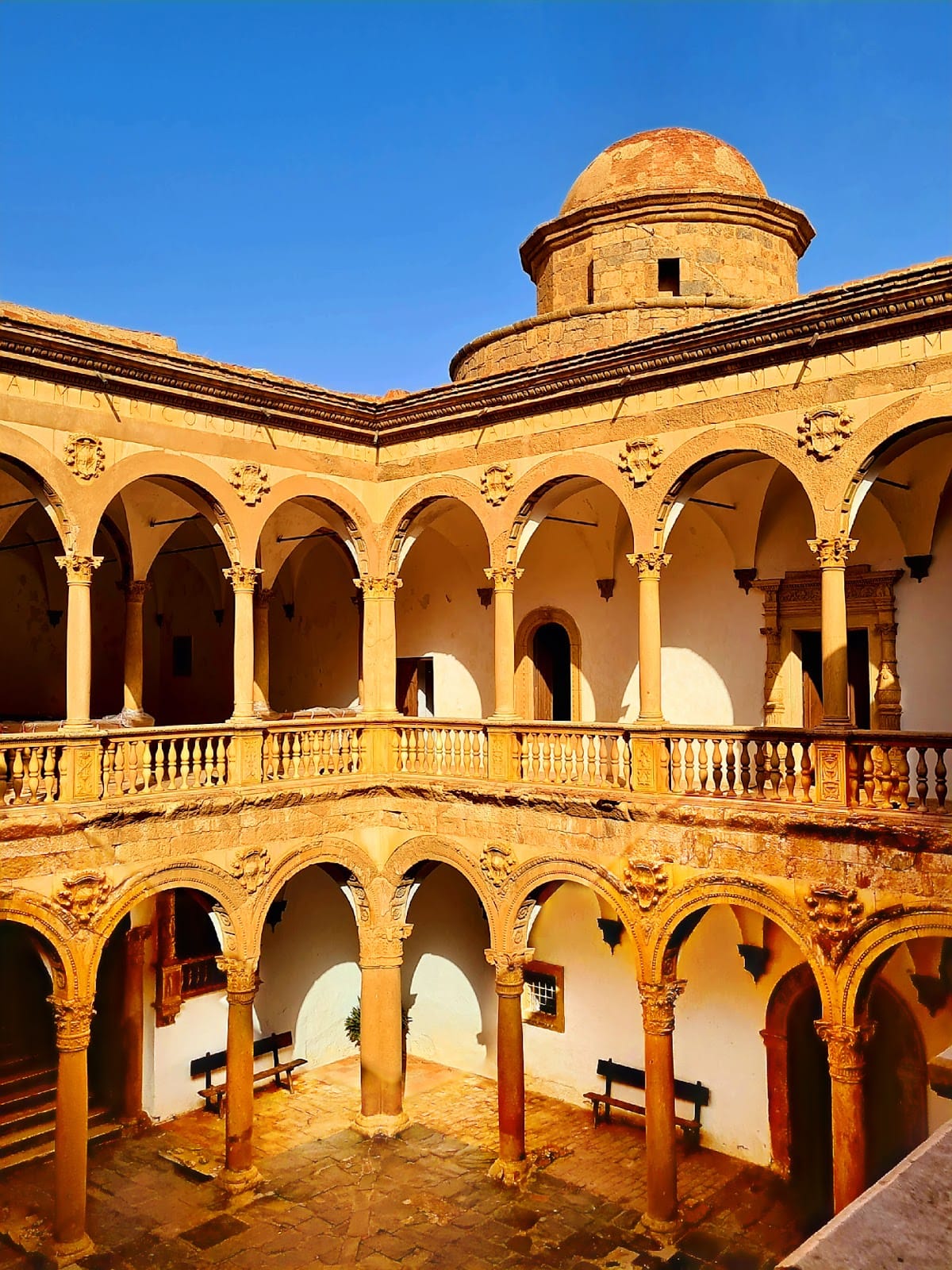
Inside, the castle centers around a spacious courtyard measuring 20 meters on each side, enclosing open galleries on two levels. Five arches grace each side of these galleries, supported by Corinthian columns associated with classical Greek and Roman architecture. The galleries’ ceilings are rib-vaulted, resting on black Italian stone corbels that support the stone ribs. To prevent lateral pressure from threatening the structure, iron tie rods made in Valencia are employed, a pioneering use of this technology in Spanish architecture.
The lower gallery presents semicircular arches and features tall Corinthian capitals resting on decorative collars, which alternate grotesque faces and geometric patterns. The arch ceilings boast intricate floral and garland carvings, and the spaces between arches display relief heraldry bearing the Mendoza and Fonseca shields. A Latin inscription once ran along this gallery commemorating Don Rodrigo’s building of the castle in 1510 and referencing his retreat to this stronghold amid royal attempts to suppress feudal power.
The upper gallery mirrors the lower level but with slightly flattened semicircular arches and stands on pedestals bridged by a balustrade made from Carrara marble imported from Italy. Here, the decoration emphasizes the noble family coats of arms and includes black stone ceiling coffers, adding to the classical atmosphere. Above, Latin texts featuring biblical psalms occupy the entablature, harmonizing with mythological themes from Greco-Roman culture found throughout the courtyard and interior spaces, expressing the humanist ideals of the castle’s patron.
Many of the castle’s interior doorways are elaborately ornamented according to each room’s function. For example, the doorway to the Sala de la Justicia (Hall of Justice) showcases columns adorned with garlands and cherub heads, and detailed jambs support a curved pediment decorated with floral and fruit motifs. Its lintel shows marine creatures alongside stylized fruit containers, finished with birds and grotesques along the architrave and jambs.
The Salón de Occidente (Western Hall) features intense decoration using chiaroscuro (contrasting light and dark) and horror vacui (a “fear of empty spaces”) design principles. Its walls display a rich variety of animals and mythical hybrids, including eagles, dolphins, satyrs, and mermaids resting on intricate grotesques.
The doorway to the Salón de los Marqueses (Hall of the Marquises) resembles a Roman triumphal arch and incorporates iconography inspired by classical mythology and 16th-century engraved drawings. Pilasters flanking the entrance contain niches holding reliefs of mythological figures such as the Farnese Hercules, Apollo, and the goddesses Fortuna and Abundance. Below, the pedestals depict Hercules’ famous labors, including his battle with the Hydra and the capture of the Cretan bull. The frieze above shows marine deities and tritons, while the jambs are carved with busts of Roman emperors, underscoring the Renaissance admiration for ancient Rome’s power and artistry.
An important artistic element is the oratory doorway, which has been relocated and is preserved today at the Museum of Fine Arts of Seville. Throughout the castle’s decoration, a variety of animals, fantastical beings, and motifs of fruits, flowers, and foliage appear, reflecting the Renaissance fascination with nature and mythology.
Together, these features illustrate a blend of fortified medieval architecture with the elegance and symbolism of early Renaissance design, revealing how the building evolved as a residence and status symbol while retaining defensive elements.
Nearby sites