Lipý Castle: A Gothic Water Castle in Česká Lípa, Czechia

Site at a Glance
- Rating
- 4.4
- Popularity
- Low
- Country
- Czechia
- Primary era
- Medieval
- External website
- Open
- Eras represented
- Medieval, Early Modern
- Civilizations
- Holy Roman Empire, Kingdom of Bohemia
- Site type
- Military
- Remains
- Castle
On this page15 sections
History
Lipý Castle is a Gothic water castle in Česká Lípa, Czechia, founded around 1268 by Chval of the Ronov family on an island between former channels of the Ploučnice River. It probably occupied the site of an earlier guard fort associated with the Milčané. Chval’s son Čeněk continued the work, although he may have been the castle’s actual founder. Lipý later became the centre around which the town of present-day Česká Lípa developed.
Foundation and the lords of Lipé
After Čeněk died in the Battle of the Marchfeld in 1278, his son Jindřich of Lipé became lord of the castle. In 1305, or sometime before 1319, Jindřich founded a town around Lipý. He began rebuilding the castle in stone before 1300, replacing its earlier timber defences and structures. In 1319 he sold Lipý to the Berkas of Dubá, relatives of the Ronov family, and moved to Moravia. The early documentary history is incomplete, with no surviving charters recording sales or transfers before 1320.
The Berkas held the castle for more than a century during this first period of their ownership. The first Berka lord was the wealthy Hynek Berka of Dubá and Lipé, who, like his father, served as Prague’s chief burgrave, a senior royal official responsible for the administration and defence of Prague Castle. After Hynek’s death in 1348, Lipý passed to his son Hynek, then in 1361 to his brother Jindřich and later to his nephew Hynek. Around 1400, another Hynek, known as Hlaváč, was recorded as its owner. During the fourteenth century, the castle was enlarged with a southern palace and a latrine tower.
Hussite destruction and renewed Berka ownership
On 19 May 1426, a Hussite orphan army led by Jan Roháč of Dubá captured and burned Lipý and its surroundings. The Hussite Wars were fifteenth-century religious and political conflicts in Bohemia connected with the reform movement inspired by Jan Hus. The Hussite orphans were a radical military faction active during the later stages of those wars. After taking Lipý, they used the castle as one of their bases.
In 1435, Zikmund of Děčín from the Vartenberk family became owner through his marriage to the widow of Hynek Hlaváč. A relative of Zikmund, Jan of Ralsko, conducted raids in Lusatia, prompting a retaliatory expedition by the Lusatian Six Cities, an alliance of six Upper Lusatian towns that acted together in regional military and political affairs. Their mercenary army captured Lipý in 1444. The castle was later returned to the Berkas, specifically to Jindřich Berka of Lipé and Milštejn.
The second period of Berka ownership lasted from 1444 to 1607. After Jindřich Berka died, the estate, the castle shares, and the town were divided among his four sons. Their grandsons divided the property again in 1502, and the separate shares were gradually sold. Vartenberks and other members of the Berka family became subsequent owners. During the sixteenth century, the Berkas transformed the medieval castle into a Renaissance chateau. A sale record from 1591 described part of Lipý, and Kunhuta Berka later acquired the entire chateau. Adam Berka was the last Berka owner and died in 1607.
Wallenstein, decline, and industrial transformation
After Adam Berka’s death, Jan Abraham of Salhausen acquired Lipý through his marriage to Adam’s widow, Anna Berka. When Jan died in 1616, his brother Volf inherited the property. Following the Battle of White Mountain, the castle was confiscated. Albrecht of Wallenstein, a Bohemian nobleman and imperial commander during the Thirty Years’ War, bought the estate and chateau from the Bohemian Chamber on 19 December 1622. Since he lived at Nový zámek, now Zahrádky Chateau, he installed officials at Lipý, and the complex began to deteriorate.
Wallenstein’s property was confiscated in 1636, and Lipý passed to Isabela of Harrach. Swedish troops captured and plundered the chateau in 1643, bringing its residential use to an end. The declining complex then belonged to the Kounic family for about two centuries. A major fire in May 1820 destroyed much of the chateau and large parts of the town. The buildings were still maintained in 1778, when Emperor Joseph II reportedly dined there with his generals. Joseph II ruled the Habsburg monarchy from 1780 to 1790 and was associated with major administrative and religious reforms.
In 1867, the Kounic family leased Lipý to Salomon Altschul and Josef Müller, selling it to them in 1871 for 27,000 gulden. The new owners established a sugar factory, whose refinery almost completely removed the surviving chateau structures during construction. The factory operated until the beginning of the First World War. Parts of the uninhabited ruins were later reused as a theatre, a Jewish school, a general school, and a bell-founder’s workshop.
Twentieth-century damage and archaeological recovery
In 1925, despite official opposition, Altschul and Müller built a group of emergency dwellings on the site. After the owners emigrated because of their Jewish origin, the town of Česká Lípa took over administration of the buildings. Some of the temporary shelters were demolished in 1939. During the Second World War, the complex contained storage areas, shelters, accommodation for troops, and quarters for French prisoners of war and deported Russian workers.
In 1957, the municipal national committee ordered the removal of the southern palace. State funds had been allocated for partial demolition without explosives and for conserving the surviving remains, but local officials instead had the remnants blasted. Almost none of the former castle and chateau remained, and various shelters were built on the site.
A complete archaeological investigation took place from 1995 to 2003. The surviving parts of Lipý were then progressively renovated, with furnishings for restored spaces lent by the National Heritage Institute, the Czech state institution responsible for the professional care and preservation of historic monuments. The city of Česká Lípa uses the complex for cultural activities, including Passion plays and parts of the city celebrations. Management was entrusted first to the Kulturní dům Crystal contributory organization and, from 1 January 2011, to the municipal organization Lipý Česká Lípa. Lipý is protected as a cultural monument, and the city of Česká Lípa is its current owner.
Remains
Lipý’s surviving remains preserve fragments of a castle that developed from a timber stronghold into a stone Gothic water castle and later a Renaissance chateau. The original site occupied an island between former channels of the Ploučnice. Its earliest arrangement combined a wooden residential building on the west with a ditch and an outer earthwork, probably topped by a wooden palisade. Later construction replaced these defences with angular stone walls, while the eastern side became the principal entrance area.
Early castle and Gothic fortifications
Wooden residential building
A wooden residential building stood near the present entrance during the castle’s earliest phase. Its surviving evidence is limited to the foundations of an oven, which preserves a small part of the domestic arrangement within the first timber-built stronghold.
Stone bergfried
Soon after the foundation, builders erected a substantial circular stone bergfried in the northern part of the castle. A bergfried was a strong medieval tower used chiefly as a defensive refuge rather than as the lord’s ordinary residence. Lipý’s tower measured 12.6 metres in diameter and served both as a storehouse and as the defenders’ final place of refuge.
Stone walls and first palace
Before 1300, the wooden palisades and outer earthwork were removed and replaced by angular stone walls. The eastern side contained the entrance gate, while a two-storey stone palace occupied the southwestern part of the enclosure. The palace had a basement, and its foundations remain visible.
Later medieval and Renaissance buildings
Southern palace and latrine tower
During the fourteenth century, a new palace was added along the southern side of the complex. A latrine tower projected into the northern moat, extending the castle’s facilities beyond the main wall line. The later southern palace had cellars whose vaults were reinforced by ribs. Substantial reinforced cellars and the foundations of the palace survive.
Eastern gate
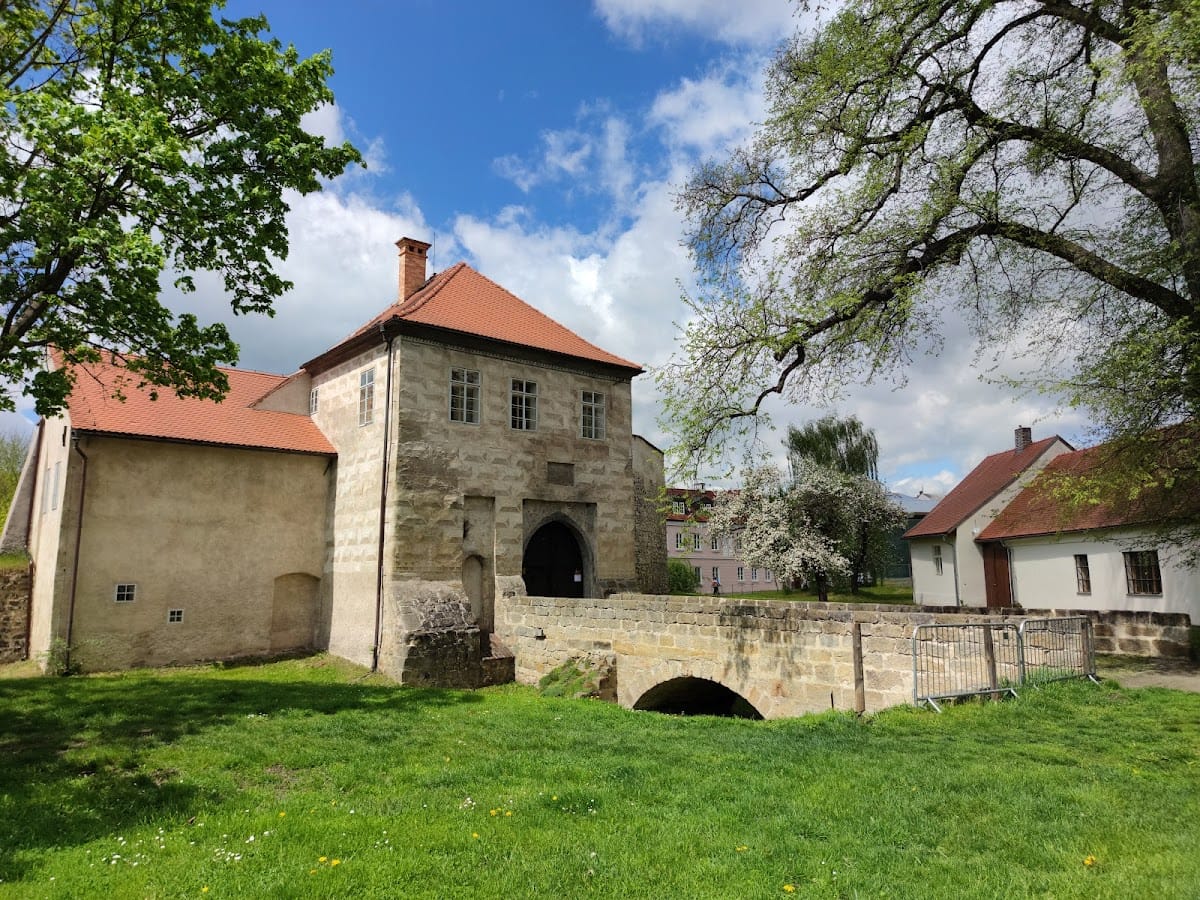
The Berkas built the eastern gate that still survives. It formed part of the castle’s later medieval entrance arrangement and remained within the complex as the surrounding buildings were altered.
Renaissance chateau
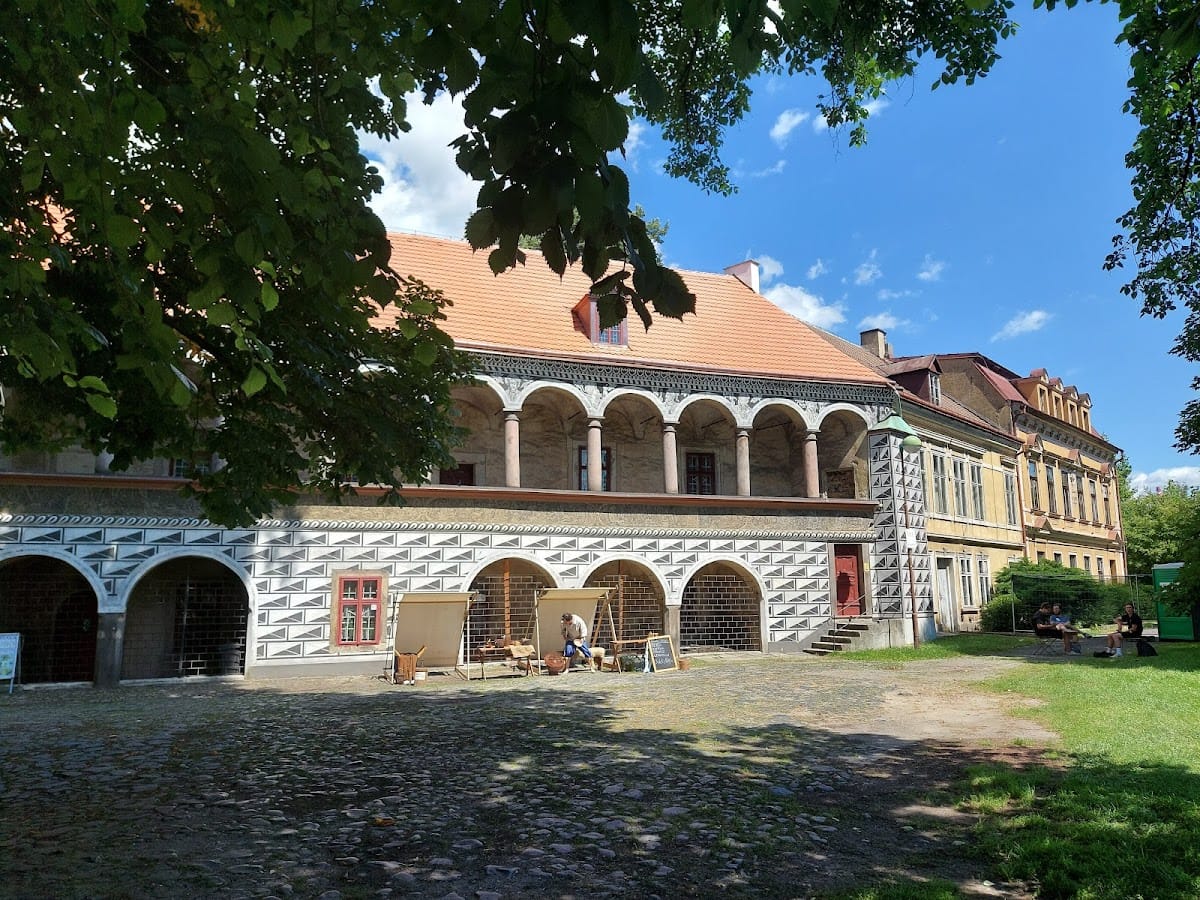
The sixteenth-century conversion added a new northern palace and a Renaissance house. A description from 1591 records a stone bridge with rooms at the chateau, two drawbridges, another bridge leading from the mill, moats, and cellars. These details show the extent of the water-managed approach and the chateau’s rebuilt circulation system during its Renaissance phase.
Surviving layout and present interpretation
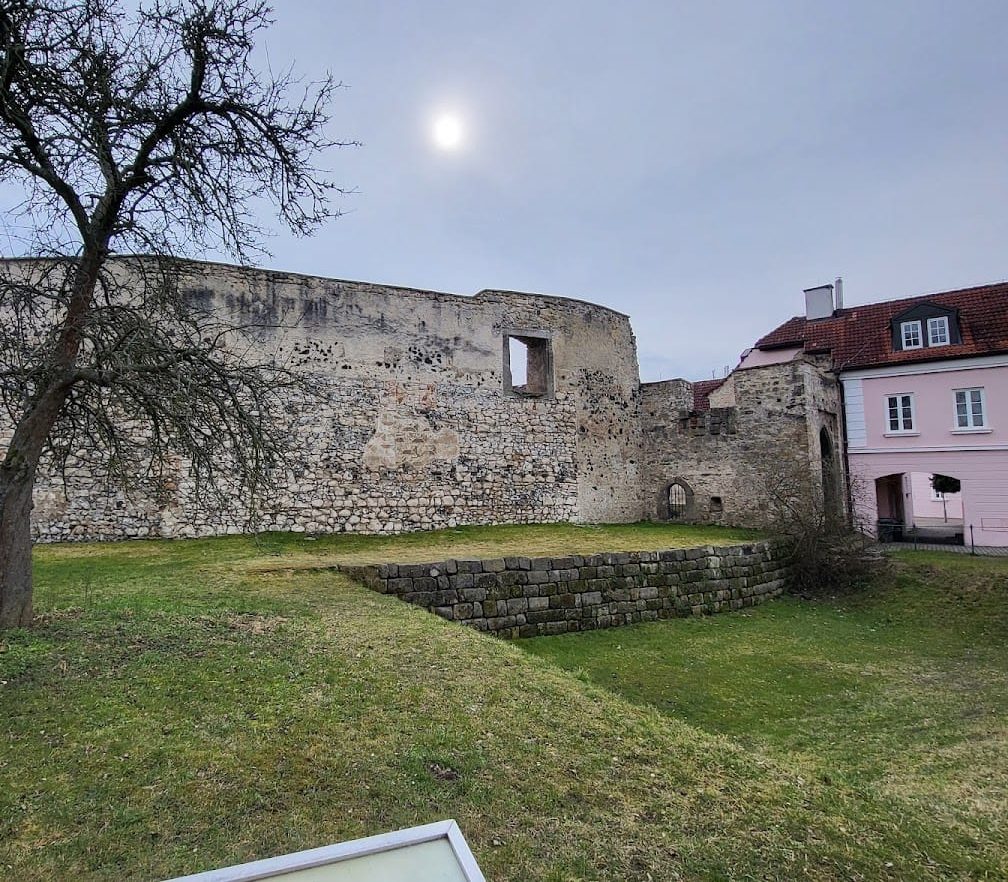
Fire, industrial construction, and the demolition of 1957 left Lipý fragmentary. Archaeological work and later renovation have recovered and conserved parts of the earlier layout, including foundations, cellars, the eastern gate, and remains associated with the castle’s successive building phases. The eastern part of the former castle contains a permanent exhibition on Česká Lípa’s former Jewish minority and the history of the sugar factory. The courtyard is used for cultural events and as an improvised summer cinema.