Castello di San Gaudenzio: A Medieval Fortress in Cervesina, Italy




Visitor Information
Google Rating: 4.6
Popularity: Medium
Official Website: www.hcsg.it
Country: Italy
Civilization: Unclassified
Site type: Military
Remains: Castle

History
The Castello di San Gaudenzio is situated in the municipality of Cervesina, Italy. Its origins trace back to the 14th century when the Visconti family, the ruling dynasty of Milan, likely established the fortress as part of their defensive network in the Po Valley region.
In medieval times, the village of San Gaudenzio held greater importance than Cervesina, serving as the center of a rural church district known as a pieve, as well as the site of the castle. Control of this area was vested in the Beccaria family, a noble Ghibelline lineage from nearby Pavia. A branch of this family, referred to as “Beccaria di San Gaudenzio,” exercised autonomous feudal authority over the locality. The fiefdom reached its height in the 16th century under Matteo Beccaria, who was elevated to Marquis of Mortara. Upon Matteo’s death in 1536 without male heirs, the castle and its domain passed to the Taverna family from Milan, counts of Landriano. This family maintained ownership until the abolition of feudal rights in 1797.
Throughout the centuries, the castle saw transformations from a fortified stronghold into a more comfortable residence. Significant renovations took place during the 17th century, reflecting changing needs and tastes, and the building underwent another phase of restoration in the 20th century, including a notable refurbishment in 1977 that preserved the structure’s integrity and historical character.
Remains
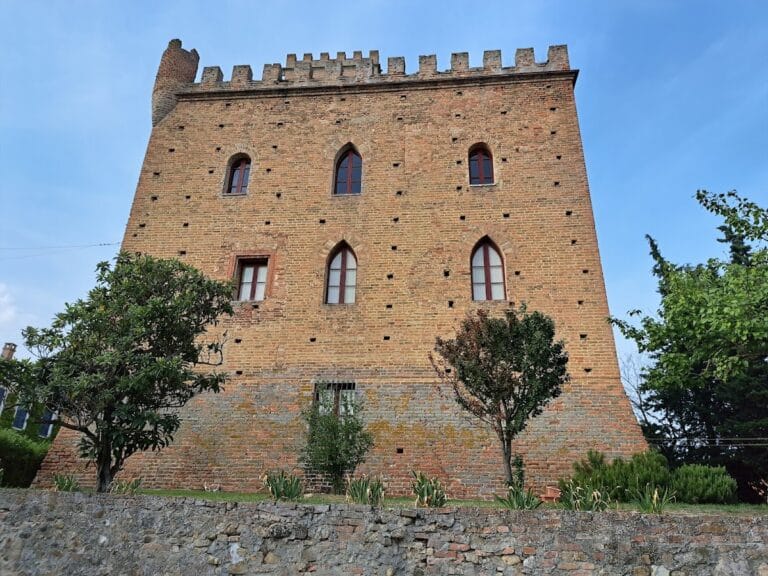
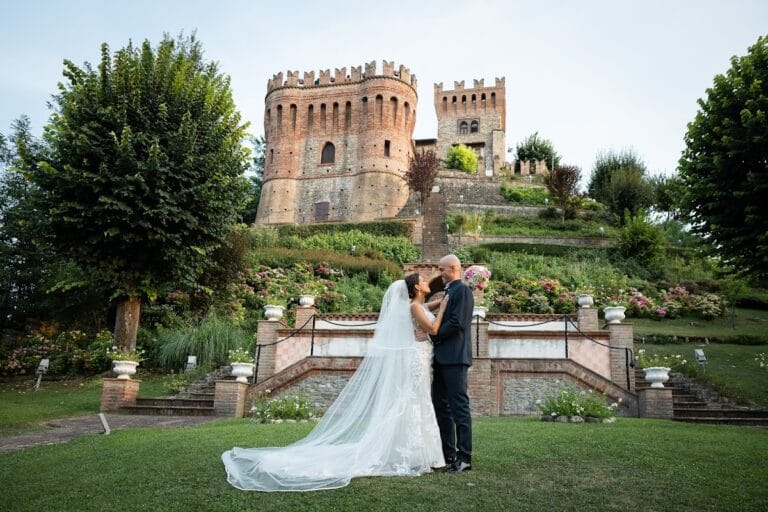
The Castello di San Gaudenzio features a square layout with four corner towers, each rooted on a square base, which together surround a compact courtyard at the center. Within this internal space lies a well, an essential element for sustaining the castle during times of siege or isolation. This design reflects typical characteristics of Visconti architecture, visible in the pointed arch windows and the crenellated tops of the corner towers, which combine both defensive and stylistic purposes.
Constructed primarily from local masonry, the castle’s walls and towers stand as a testament to medieval building techniques adapted for the flat terrain near the Staffora stream. The presence of crenellations—battlement openings along the parapets—further emphasizes its original military function. Around the main fortress are several annex buildings and an extensive park area, which over time have complemented the castle’s role as a noble residence.
After the restoration completed in 1977, the overall condition of the complex was stabilized and preserved, allowing the castle to remain intact and clearly showcase its historical architectural traits. The combination of defensive features and residential modifications visible today provide insight into the castle’s evolution from a feudal fortress to a countryside manor.
Nearby sites