Castello di Roccabianca: A Historic Fortress in Italy



Visitor Information
Google Rating: 4.3
Popularity: Low
Google Maps: View on Google Maps
Official Website: www.castellodiroccabianca.com
Country: Italy
Civilization: Medieval European
Remains: Military

History
Castello di Roccabianca is located in the municipality of Roccabianca, Italy. Its origins trace back to a fortification established in the 12th century within the territory that now bears its name. This original stronghold stood near the current hamlet known as Fossa, then called Rezinoldo or Arzenoldo. The castle was initially under the control of Oberto Pallavicino, who received it by investiture from Emperor Frederick Barbarossa in 1189.
During the early 15th century, the site became the center of a conflict involving the Rossi family, who ruled San Secondo. In 1413, Emperor Sigismund granted them control of the Rezinoldo castle, but just three years later, in 1416, Antonio Pallavicino launched a military campaign to reclaim the fortress, ultimately destroying it. This defeat ended the Pallavicino hold on the castle temporarily.
In an effort to settle this ongoing dispute, Duke Francesco I Sforza of Milan made a decisive intervention in 1449 by officially investing the fief to the Rossi family. Shortly thereafter, Pier Maria II de’ Rossi began the construction of a new castle on the site in 1450. This structure was finished around 1465 and was named Roccabianca, possibly in honor of Bianca Pellegrini, his lover, who was gifted the castle in 1467.
The political landscape shifted once again around 1480 with Ludovico Sforza seizing power. Aligning with the Pallavicini family, he reinforced the castle’s defenses. However, during the “War of the Rossis” in 1482, the fortress fell without significant damage and was granted to Marquis Gianfrancesco I Pallavicino, marking a change in ownership. Later, attempts to recapture the castle by Troilo I de’ Rossi and his descendants were unsuccessful.
In 1524, the Rangoni counts acquired Roccabianca. They maintained possession for over two centuries until 1762. Subsequently, the castle returned to the Pallavicini family in 1785, and in 1832 came under the claim of Duchess Marie-Louise of Parma. The property entered private hands in the 20th century when the Facchi family purchased it in 1901. Later, in 1968, Mario Scaltriti acquired the castle, repurposing it for the aging of spirits. During this period, original frescoes hidden beneath layers of paint were uncovered. Their restoration led to the castle reopening to the public in 2003.
Today, Castello di Roccabianca is part of a collective of regional castles, hosting cultural activities and preserving its heritage through associated museums.
Remains
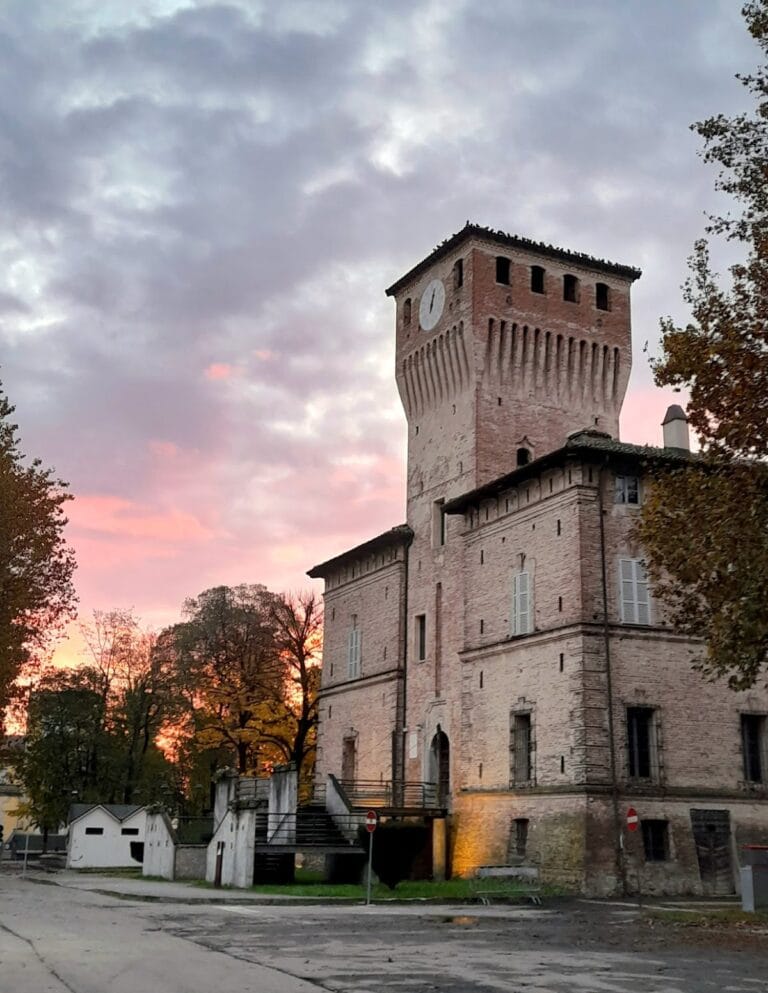
Castello di Roccabianca is built on a rectangular layout organized around a spacious central courtyard. The most prominent feature within this courtyard is a massive two-story bergfried, or keep, situated opposite the main entrance slightly off center. This tower offers wide views over the surrounding plain, emphasizing the castle’s defensive purpose.
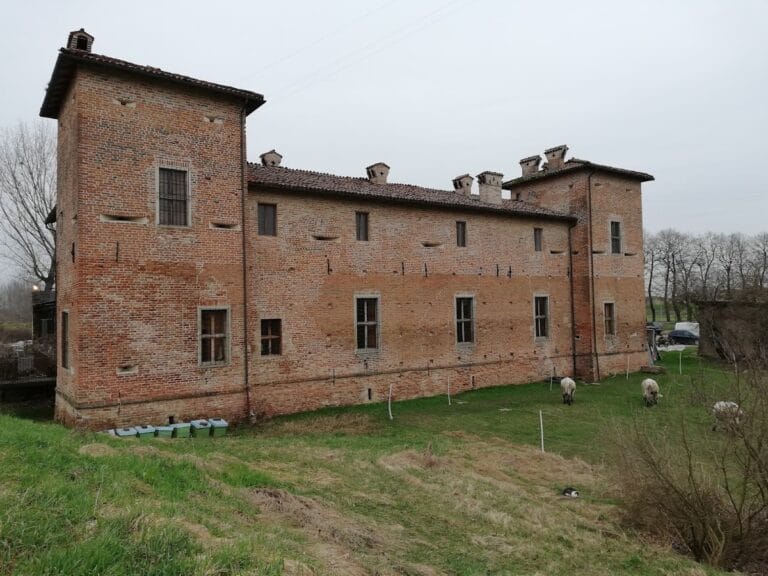
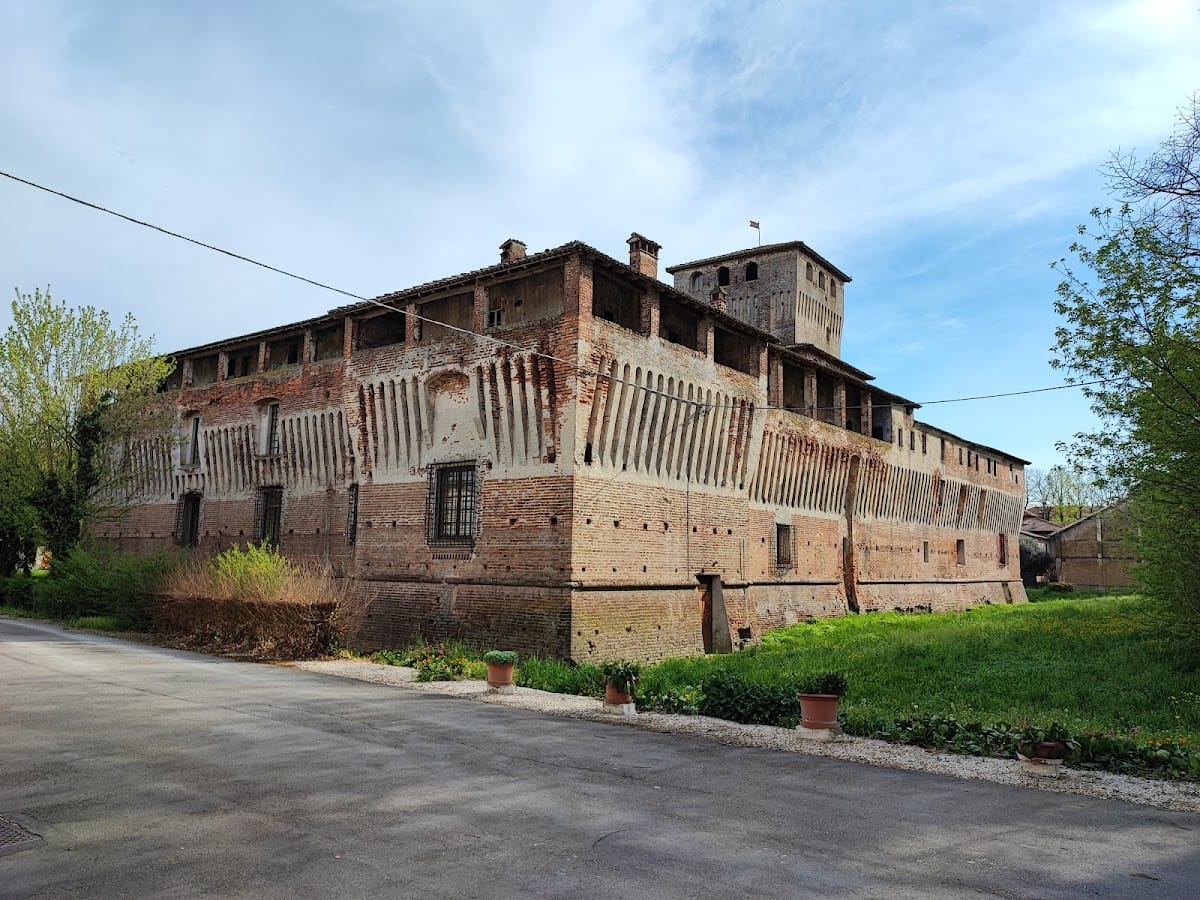
Surrounded entirely by a moat, the castle boasts two large corner towers located at the north and south edges. Portions of an outer brick wall remain visible on the southeast and south sides. These surviving sections, characterized by a sloped base known as a talus, have been incorporated into nearby private residences over time. The external walls display a continuous decorative pattern in brick, with battlements that survive in part. Protecting the main entrance is an ancient ravelin, a detached defensive work. The original drawbridge has been replaced by a small brick bridge, yet evidence of the former structure is still seen through bolt slots embedded in the walls.
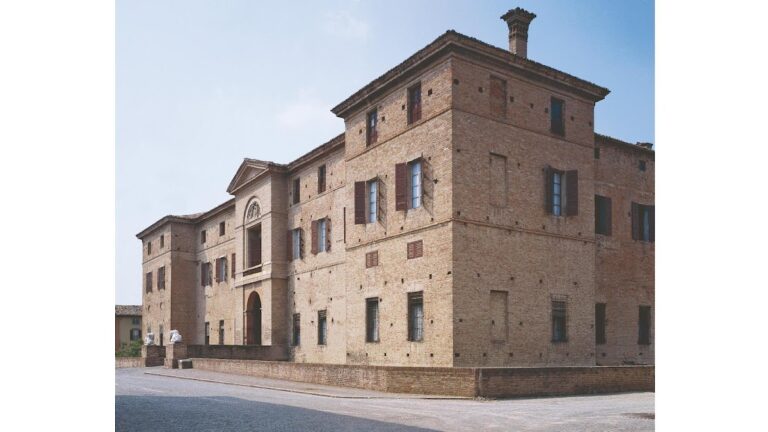
The facades, constructed primarily of brick and partially coated with whitewash, emphasize the castle’s military character through features such as the talus base and numerous corbels supporting machicolations — openings through which defenders could pour materials on attackers. The upper parts of the front and side walls are pierced by open loggias, or covered galleries.
Above the castle’s pointed-arch main portal, a white marble medallion bears the combined coat of arms of the Rangoni and Pallavicini families, signifying the castle’s ties to these noble houses.
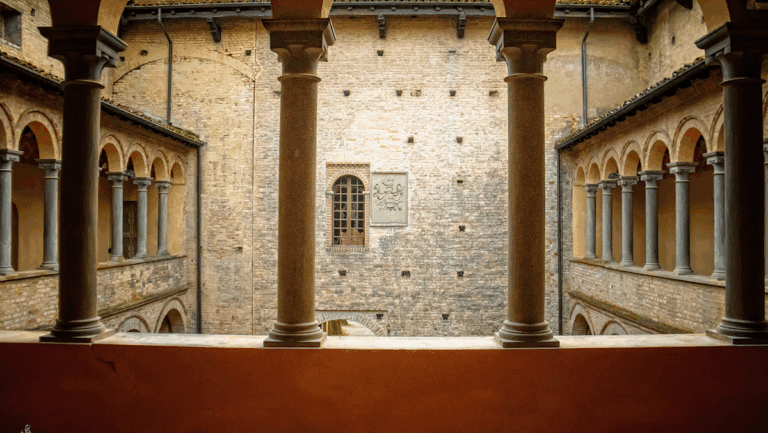
Inside the courtyard, the walls are richly covered with dense green vines. Various windows, added in different periods, irregularly interrupt these surfaces. Massive projecting cornices crown the tops of the courtyard walls, accentuating the enclosure.
On the courtyard’s eastern side lies the Honor Portico, a broad brick colonnade supported by square-shaped capitals resting on columns. This portico features three large rounded arches beneath which walls and groin vaults are adorned with 15th-century frescoes. These paintings showcase the intertwined coats of arms of Pier Maria II de’ Rossi and Bianca Pellegrini, surrounded by plant motifs and depictions of medlar fruits symbolizing fidelity in love. The frescoes also include the motto, “Although unripe, now sweeter than ripe,” reinforcing this theme.
The castle’s southeast tower houses the Sala di Griselda, named after a cycle of frescoes illustrating the story of Griselda from Boccaccio’s Decameron. These frescoes, crafted in the late 20th century, are precise copies of the originals removed in 1897 and now preserved in Milan’s Castello Sforzesco. Above, the vaulted ceiling features an astrological cycle fresco whose interpretation varies between serving as Pier Maria II de’ Rossi’s horoscope or representing a Mesopotamian star map.
On the ground floor, several rooms contain exceptional painted wooden beam ceilings. These beams, decorated with 17th-century frescoed friezes commissioned by the Rangoni family, portray fortified towns, playful cherubs known as putti, sculpted female figures called caryatids, ecclesiastical banners, and noble coats of arms. Additional chambers illustrate landscapes both real and imaginary alongside angels and the coats of arms of the Rangoni Farnese lineage. The walls throughout these rooms are embellished with valuable portraits of dukes, kings, and noblewomen connected to the Farnese and allied families.
In the castle’s northwest corner, the Sala Rangoni features stucco decorations shaped like shells as well as landscape frescoes originating from the 16th and 17th centuries. A significant lunette above a large window depicts the Madonna and Child accompanied by a small donor figure, likely dating to the early 1500s.
The upper floor contains four chambers furnished with antique pieces and wooden coffered ceilings, enhancing the historical ambiance. The Salone del Camino, once a court theater, centers around a large terracotta fireplace and holds three large paintings from the early 18th century, probably by Stefano Maria Legnani, illustrating scenes from the story of Judith and Holofernes.
One additional room presents a wooden beam ceiling painted in the style of the 16th or 17th century, while another stores a collection of antique copper kitchen utensils.
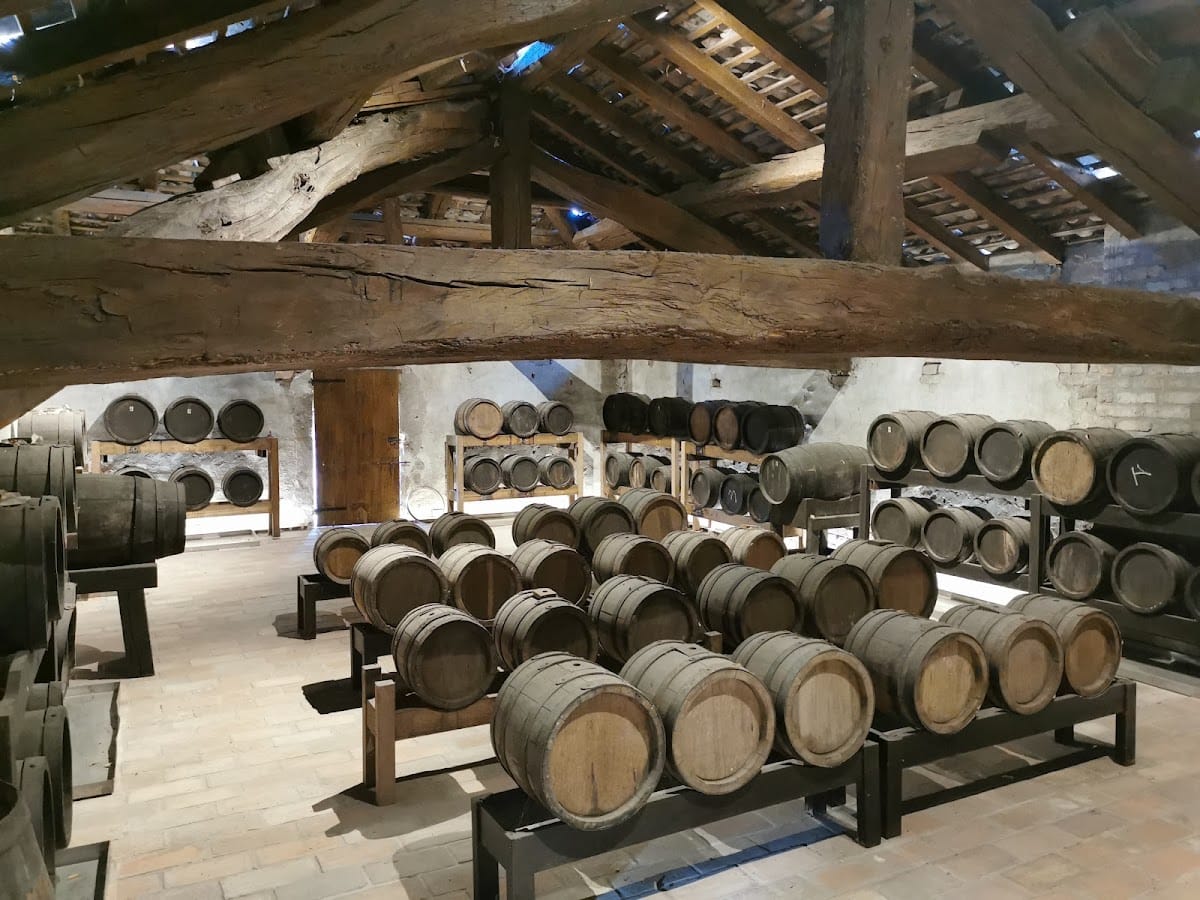
Beneath the castle stretch extensive vaulted cellars, originally built as stables. Today, these underground spaces serve practical purposes such as aging culatello, a prized cured meat, within the bergfried’s cellars. Large barrels used for this process occupy the vat room, alongside other cellars employed for the maturation of balsamic vinegar and spirits stored in oak barrels.
While the castle reflects numerous alterations and expansions across centuries, it retains a robust defensive character fused with refined decorative elements, showcasing the layered history and cultural significance of this enduring fortress.
Nearby sites