Castello di Monasterolo: A Historic Medieval Castle in Italy


Visitor Information
Google Rating: 4.5
Popularity: Low
Google Maps: View on Google Maps
Official Website: www.acquaroli.it
Country: Italy
Civilization: Unclassified
Remains: Military

History
The Castello di Monasterolo is situated in the town of Monasterolo within Italy. Its origins trace back to early medieval times, likely constructed on the site where a Benedictine monastery once stood. This monastery, active during the Early Middle Ages, was destroyed at the close of the eighth century either by forces of the Frankish army, according to prevailing views, or possibly by the military campaigns led by Frederick Barbarossa, though this latter possibility remains debated.
Archaeological evidence of foundations consistent with Benedictine architectural styles supports the presence of such a monastery. Although early documents from 989 and 1022 mention “castra monasteriolo,” these probably refer to a different location, leaving the precise date when the current castle was established uncertain. The first reliable record naming the castle itself dates from 1130, describing a structure serving both defensive and residential roles. At that time, the castle functioned as a secure shelter for storing livestock and food supplies during incursions by enemy troops and provided refuge for the local population.
Ownership of the castle initially rested with the Mozzo family, influential figures of the region, followed by the Suardi family, who rose to greater prominence locally. Later, the Terzi family took possession. During the first half of the fifteenth century, under the jurisdiction of the Republic of Venice, orders were issued to dismantle fortifications to quell ongoing conflicts between Guelf and Ghibelline factions. To preserve the building, the Suardi family transformed the castle into a noble residence, thus sparing it from demolition.
Over the following centuries, as its defensive function waned, the castle gradually slipped into neglect and deterioration. In the 1930s, the Terzi family sold the property to Countess Winifred Terni De Gregory, a British noblewoman who undertook significant restoration work between 1937 and 1945. These efforts revitalized both the interior spaces and the surrounding gardens. In recent times, the castle garnered attention as a filming location for the movie “Tutti gli uomini del deficiente,” produced by the Gialappa’s Band, where it featured as the headquarters of Totem Arts.
Remains
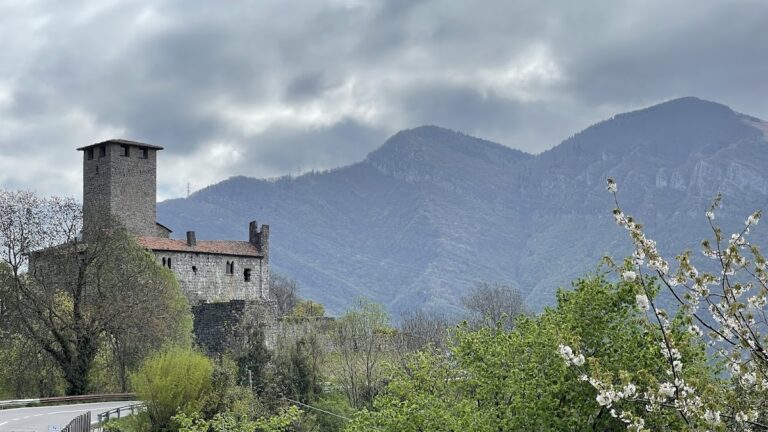
The Castello di Monasterolo occupies a small hill formed by ancient glacial deposits, nestled between the southern tip of Lake Endine and the left bank of the Cherio River. Its position takes advantage of natural defenses, with three sides enclosed by defensive walls and the northern face overlooking both the lake and historic marshlands, enhancing its strategic outlook.
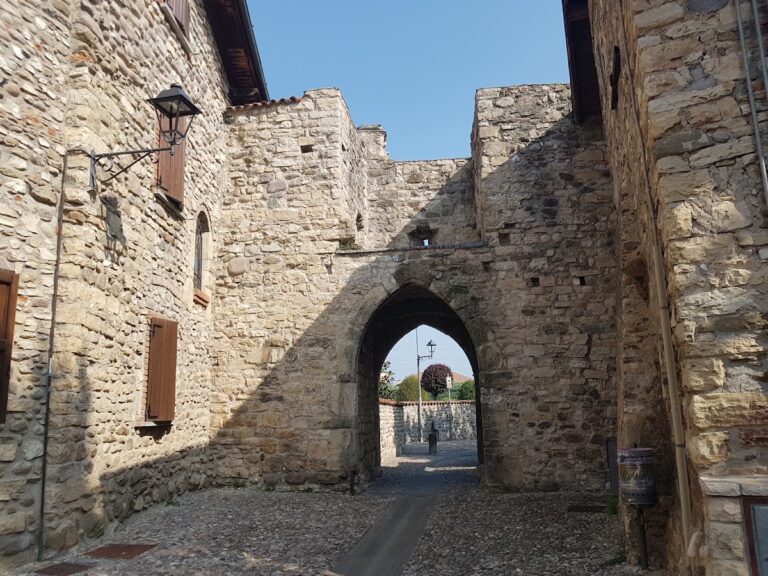
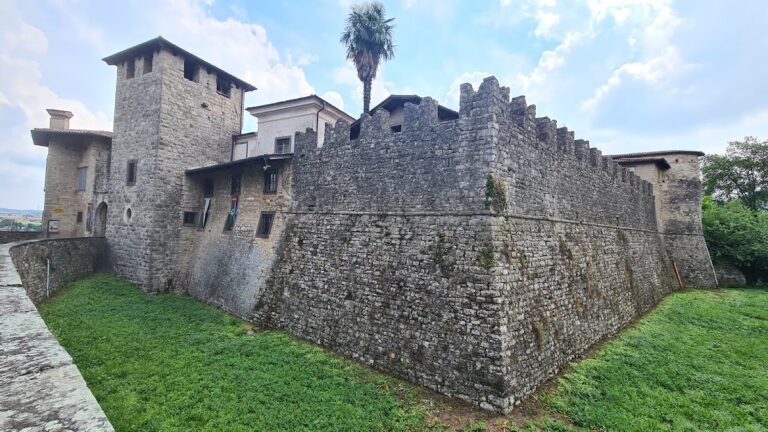
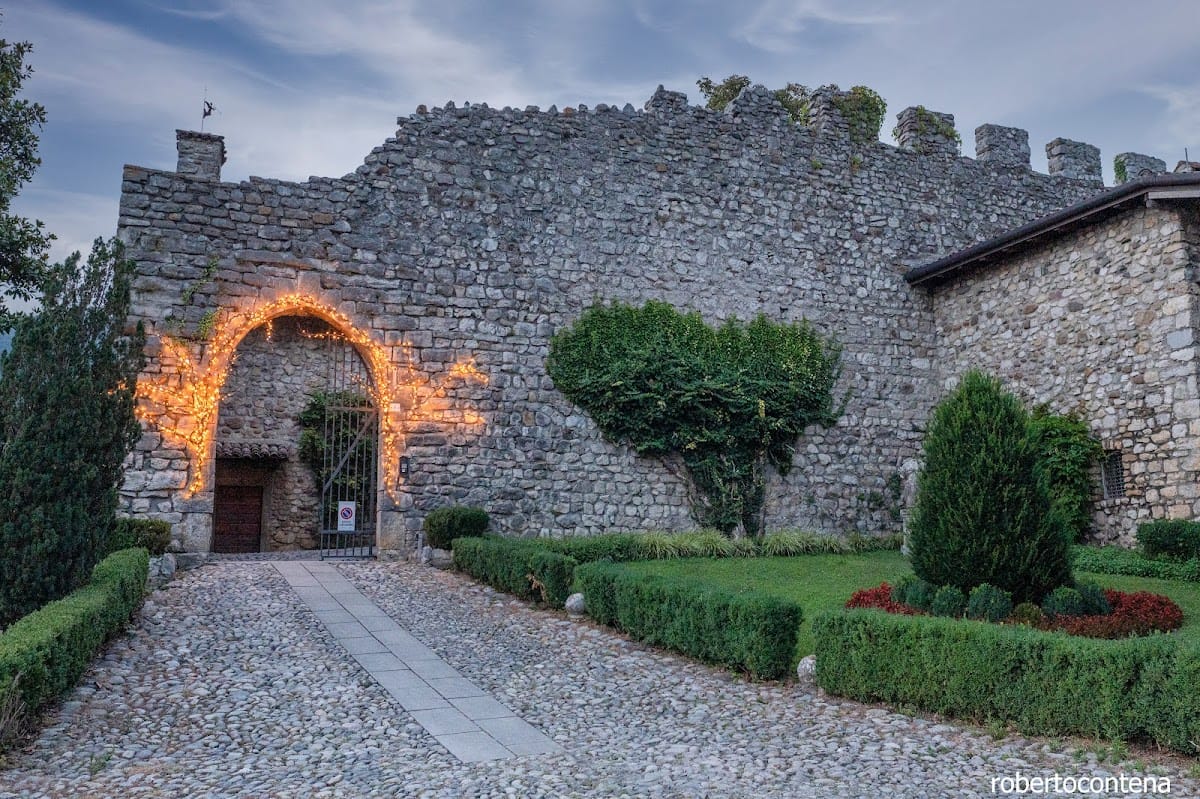
The enclosing walls are constructed from roughly cut stones and blocks of various sizes, arranged according to their placement in the structure’s height. The main entrance, found on the southern side, features a pointed Gothic portal—characterized by an ogival arch—that opens into the “Corte bassa,” a lower square courtyard. This courtyard is surrounded by walls topped with a walkway and battlements; these battlements, while giving the castle a traditional fortified appearance, were added later mainly for decorative effect rather than defensive use.
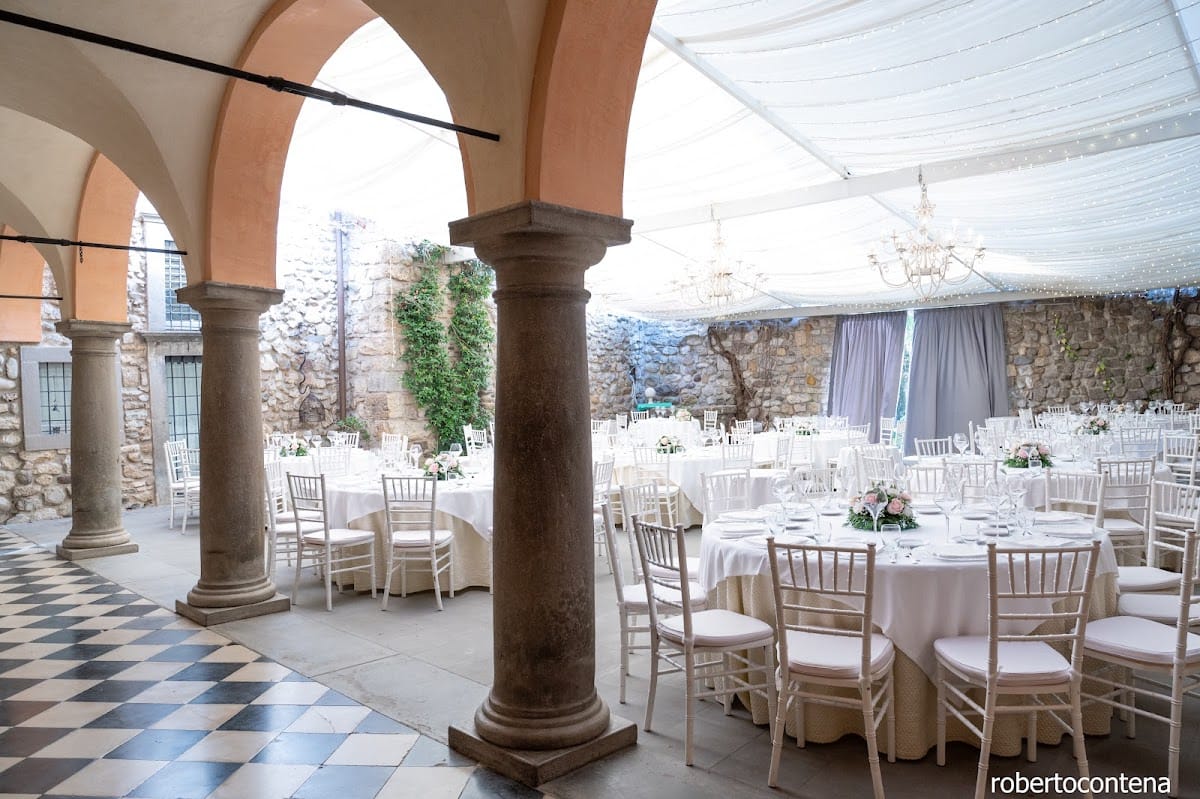
Adjacent to the entrance, to the left, stands a small oratory dating from the seventeenth century, dedicated to Saint Anne. Beyond the “Corte bassa,” the castle’s layout continues with the “Corte alta,” an upper trapezoidal courtyard. This space contains an L-shaped building of two stories featuring a portico supported by a series of arches resting on columns. Around this building are multiple rooms clustered around a smaller, irregular-shaped courtyard. This architectural arrangement reflects the castle’s evolution from a purely military structure to a residence adapted to noble living.
Overall, the castle’s walls and interior courtyards demonstrate a blend of military and domestic architectural elements that changed over time in response to shifting needs and ownership. Restoration efforts in the twentieth century have preserved much of these features, allowing the structure to remain a visible trace of its complex history.
Nearby sites